
Showing posts with label Review. Show all posts
Showing posts with label Review. Show all posts
Saturday, 12 August 2017
Don't Starve: Cheap Tricks and Fake Difficulty
Set in a fantasy world in which you must survive as long as possible, Don't Starve by Klei Entertainment is something of a rarity. It's a game with some interesting concepts that's actually really enjoyable in chunks. But then as you continue playing and more and more content is added, somehow the whole experience put together is as much fun as nailing your ball sack to a wooden plank and hanging off of it like a sleeping bat.
"Oh come on, it's not that bad."
Well, okay. I'll concede that I enjoy the core survival mechanics. The early game in particular starts you in Spring or Autumn, both relatively mild seasons, and tasks you with simple objectives such as collecting grass, twigs and berries to last you for the first few nights.
We're introduced to the first crazy supernatural element at night: if you don't have a fire going, you basically die instantly. Death is permanent, and you must start again ("Roguelike", an expression about as tired and overused as "Gate" being added to the end of any remotely scandalous occurrence).
It's harsh but reasonable, and provides an early incentive to huddle round the fire at night rather than brazenly treating it like any other time of day.
Your character possesses health and hunger levels, which spell death if they hit 0 (obviously). In addition to that there is the more opaque Sanity meter, which at 0 doesn't immediately kill you but does spawn monsters that will almost certainly guarantee that you'll die soon.
"This sounds pretty cool."
Thank you, mysterious voice. It is. These mechanics are all pretty logical, and the idea of gathering grass and sticks makes just as much sense as it would in real life.
You assemble a little camp of tents, drying racks and stoves and you start feeling like you're doing pretty well. But actually in all likelihood you're not, you just don't realise that you've already lost at this point.
The problem comes when the game starts trying to increase the difficulty, and does so in the lamest ways possible.
The first major spike is experienced at the onset of Winter. Your character must contend with the cold sapping your energy if you stray too far from the fire without good clothing. Again, while a little irritating that it slows the gameplay down, this makes sense and is reasonable.
Then we have the arrival of Deerclops, and the horse apple fake difficulty alarm begins to sound. You see, Deerclops is a gigantic monster who randomly turns up during Winter. He will walk straight towards your camp, knowing where it is no matter where he spawns. He then proceeds to prioritise smashing your buildings up over smashing you, meaning unless you already knew he was coming and magically prepared with copious weapons and armour, your entire camp will be annihilated.
Even if you did prepare for him, having already learned about him through death trial-and-error or just through sheer luck, it's very likely you'll only be able to kill him after he's trashed most of your camp. If you take him down, you get a measly couple of lumps of meat.
At this point you might be around 10 hours into the game, and you've just watched everything you built get deleted for...pretty much no reason. Fun, right?
Then we have the Hounds. On random nights, a bunch of dog-monsters will spawn and attack you. On their own this feels like annoying harassment of the player (and later in the game is sometimes deadly on its own). But have the bad luck to time their arrival with a Deerclops attack and you're basically screwed. Combine it with the instant death night-time when you're limited to just standing next to your camp fire and you're just hog-tied, bent over and...well, you get the idea. You did nothing wrong but that's game over for you, chump.
Later in the game the hounds can set fire to everything around them when you kill them, burning your whole base to the ground in seconds. Why? Because f*** you, that's why.
Not only do the enemies get obnoxious in their design and intent, but the seasons do too. Sensible design ("Gather grass to make rope") gives way to bizarre bonkers nonsense mechanics that it's very hard to plan for or even understand ("Craft an Ice-Fling-O-Matic using loot from rare chess pieces to stop fires.").
Summer arrives. That should be a time where food is plentiful and life is easier? Well no, because the game's increasing departure from logic and reason means that Summer is basically Hot Winter. Heat is so dramatic that you burn to death if you stray too long from sources of cold.
How do you keep cold? What a silly question! You build an endothermic fire that cools everything down, of course! You mean you didn't build an endothermic fire when you were surviving in the Australian outback in real life?! You dummy!
Remember how annoying the Fire Hounds were, burning your whole camp down? Well, in Summer things just catch fire at random. Because that's such a fun game mechanic. Why add it in? Because f*** you, that's why.
In fact, "Because f*** you, that's why." was probably the mission statement in Klei's design brief.
Instead of adding fun new challenges that make life interesting for the player or expand on the core gameplay, every new addition seems to have been a case of them studying the player base, realising some strategies are viable and then basically adding a new creature or mechanic designed to just mess that up completely.
The game encourages you to centralise and build a big camp to save hours collecting twigs all over the map. Then it unleashes Deerclops on you and totally ruins your life.
So next time you spread out, because the game has encouraged you to do that. You survive Deerclops this time, but instead you get murdered by the Hounds because you're too far from the area of the map that gives you some protection against them.
So next time you combine both strategies, but the new boss creature they've just added arrives in Autumn and kills you instantly because you forgot to craft a cucumber you could only grow in Summer with two bits of gold to make a Cucumber Amulet to ward it off.
I made that last one up but that's the kind of stupid nonsense the game throws at you. And I've not even mentioned all the meaningless little events that can end your game. Like getting shot from off-screen by a blow dart you're not expecting, or killed by a passive creature that somehow got aggro'd without you knowing, or killed by frogs raining from the sky.
So I don't know what I'm trying to get at in summary with this rant. I guess I'm just fed upwith how such poor design has let down such a good concept. Other developers take note: Don't Starve is not how you do difficulty.

Sunday, 4 January 2015
TV Series Overview: Mad Dogs
*Contains spoilers*
So today, after a TV journey that's lasted a couple of years, I finally finished watching the British TV series Mad Dogs.
My feelings have flickered between real interest and irritated boredom over the course of the series, and the ending itself was so disjointed and bizarre as to really highlight exactly where the script was weak along the way.
For the uninitiated, the show follows four English middle-aged friends: Baxter (John Simm), Quinn (Philip Glenister), Woody (Max Beesley) and Rick (Marc Warren). Having reached the mid-point of their lives they have very little to show for it.

All of them exist in a state of disillusionment at the start of the series, whether it be with erstwhile partners, dull jobs or kids they've missed growing up...and so they agree to take a holiday trip out to Majorca to meet their old friend Alvo (Ben Chaplin). Alvo is rich beyond the wildest dreams of the other four, and they quickly end up embroiled in dangerous business after he is murdered in Season 1.
Season 2 and 3 then focuses on the after-effects of this disaster, and how the four hope to extricate themselves. Season 4 deals with the inevitable consequences of all that came before.
Now, all four actors are pretty much heavyweights of British drama, so you'd expect the script to pull the big punches too. The actors certainly play the characters very convincingly: but disappointingly, Cris Cole's writing seems to go nowhere over the course of the four seasons.
"Going nowhere": it's a prominent theme of the series. In every season, oddly melancholy and sinister billboards can be spotted in the background in some scenes showing a sad woman in makeup, or a creepy demonic face, prefaced with the slogans "road to nowhere" or "going nowhere" in foreign languages.

It's a clever bit of foreshadowing that hints at the ultimate fates of the characters, but at the same time as the series drags on for four seasons without any real character development it becomes hard to see if the characters' lack of self-awareness is intentional or an oversight of bad writing.
Both in the first and last series the characters bicker with each other over stupid things. They get into a major fight in practically every series. And despite being offered the chance to leave behind all the bad things that happened to them, they repeatedly go back for more.
This isn't so much of a dealbreaker when you consider that it's likely that Cole intended for the narrative to feel like it's stuck on a loop: the show attempts to go for that Shakespearian tragedy feel of characters that are painfully unsure of themselves or even how to interact with their life-long friends. Characters who can't be grateful for what they have, and who always want the easy way out rather than facing up to fixing their lives.
However, other choices in the finale and from the halfway point of the third Season on feel very lazy and generic, almost as though the series was cut short.
There are several big plot strands in the last few episodes that are introduced and then dropped with no explanation, which I found highly irritating:
- Rick at one point finds a glass eye in a toilet seemingly at random: the object later prompts him to change his mind and risk his life when he could otherwise remain safe. No explanation is given for what the object might represent, or why he came to find it in the first place.
- The *third* CIA agent in the story seems amazingly incompetent, even given that Season 3's Lazaro was an absolute nutjob. Cole seems to have written her as an obligatory "zany" character, but she just comes across as really unprofessional and irritating. She then gets killed in a really stupid way, too, and we're expected to believe that a thirty-year veteran of the CIA would just turn up at random to a house siege and not even be prepared for a violent confrontation: ridiculous.
- Quinn's friend at the bar, the "connected" bald guy he shares many discussions with in Season 3, doesn't do anything. He does literally nothing over the course of the series except provide an ear for Quinn to talk into. I kept thinking he would turn up later and help the group out, but no.
- Mercedes, the female soldier who saves the four in Season 3, vanishes forever at the conclusion of S3 and isn't seen again. This is despite the group looking for the CIA's files on her, and finding that she mysteriously had none. It's repeatedly hinted that she is somehow a lot more important than she seems, but this never materialises.
- The fate of Woody's girlfriend and adopted kid is never answered.
Even more unforgivably, the choices the friends make at the end of the show are absolutely insane and show no forethought at all:
- Pursued by professional killers, they make no attempt to hide, contact the police or other authorities, or even just lay low at a hotel or something. Instead they drive out to a deserted beach (!)
- Quinn owns a bar and supposedly has lots of social connections, but mentions that "You can't just call people there, they don't give out numbers." If he owns the bar, why not just call the bartender and get his friends put on the line? That he doesn't even try to do this seems ludicrous.
- Woody ineffectually fires the group's only weapon (a shotgun) at a guy about 500 metres away, until he runs completely out of ammo. WTF?

Season 1: The group goes to Alvo's villa. Alvo is murdered by a group run by Dominic (a corrupt cop, English ex-pat), Maria (a CIA agent running narco-finance operations) and an old English dude named Mackenzie who is running the drug operations. The series ends with Maria dead and the very tense scene of Dominic walking up to the villa, about to kill an unsuspecting Quinn.
Season 2: The group promptly run Dominic over in a car and escape. There's a lot of well-plotted stuff with Mackenzie, who wants his cash back. The group is eventually cornered in Morocco by a militia force funded by the UK.
Season 3: The group is held in a blacksite prison, the CIA connection is explained, eventually they are sent to South Africa with new identities and they wriggle their way out of a CIA hitlist (though it's perplexing the CIA care about them so much, since they're essentially four civvies in the wrong place at the wrong time).
Season 4: This, for me, was where it started getting stupid. The group sells Alvo's villa, gets rich, decides to move back to Cape Town for no reason and promptly the whole lot of them get executed by Dominic's gang. The ending has them plunging off a metaphorical road to Hell.
I mean, just look at those summaries: we go from a plausible crime thriller in Season 1, to the Season 4 ending in which everyone dies and goes to straight to Hell, do not pass go, do not collect $200.
While the doom of the group was hinted at the whole way through, I was pretty disappointed at how it happened. It seemed completely avoidable had the group actually had half a brain, but the plot demanded they died in such a fashion and so they did.
Verdict
So, should you watch Mad Dogs? I'd say yes - just be prepared to be irritated by it towards the end.
The acting's good and Seasons 1-2 have some really good moments. Season 3 has some poignant scenes and purposeful plotlines, but for me Season 4 was when the show really seemed to lose sight of where it was going.
For the record, I don't mind ambiguous endings: and the ending of Mad Dogs is very surreal and very ambiguous. It's more the fact that you can assemble such a talented cast with such an interesting concept...and then do so very little with it and leave so much unexplained.
[*][*][*][ ][ ]
3/5
A show that's equal parts interesting and frustrating, and sadly descends into poorly written nonsense close to the end as it searches to be more profound than the sum of it's parts.
So today, after a TV journey that's lasted a couple of years, I finally finished watching the British TV series Mad Dogs.
My feelings have flickered between real interest and irritated boredom over the course of the series, and the ending itself was so disjointed and bizarre as to really highlight exactly where the script was weak along the way.
For the uninitiated, the show follows four English middle-aged friends: Baxter (John Simm), Quinn (Philip Glenister), Woody (Max Beesley) and Rick (Marc Warren). Having reached the mid-point of their lives they have very little to show for it.
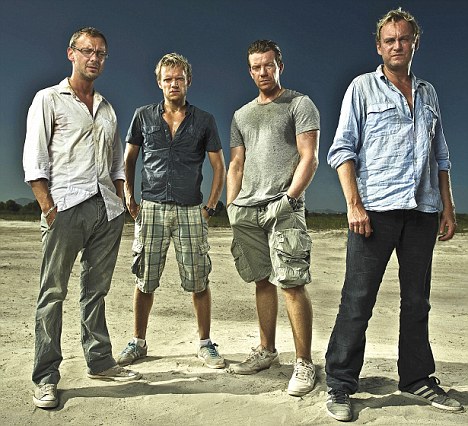
All of them exist in a state of disillusionment at the start of the series, whether it be with erstwhile partners, dull jobs or kids they've missed growing up...and so they agree to take a holiday trip out to Majorca to meet their old friend Alvo (Ben Chaplin). Alvo is rich beyond the wildest dreams of the other four, and they quickly end up embroiled in dangerous business after he is murdered in Season 1.
Season 2 and 3 then focuses on the after-effects of this disaster, and how the four hope to extricate themselves. Season 4 deals with the inevitable consequences of all that came before.
Now, all four actors are pretty much heavyweights of British drama, so you'd expect the script to pull the big punches too. The actors certainly play the characters very convincingly: but disappointingly, Cris Cole's writing seems to go nowhere over the course of the four seasons.
"Going nowhere": it's a prominent theme of the series. In every season, oddly melancholy and sinister billboards can be spotted in the background in some scenes showing a sad woman in makeup, or a creepy demonic face, prefaced with the slogans "road to nowhere" or "going nowhere" in foreign languages.
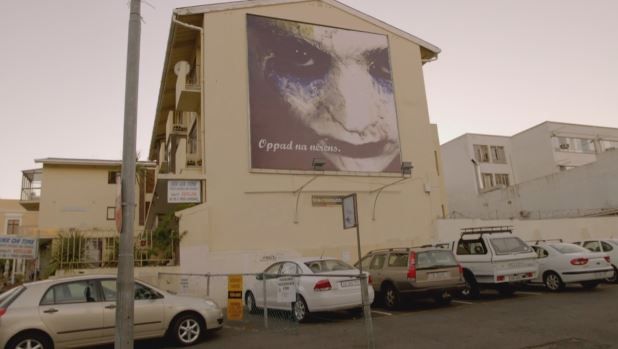
An example of one of the sinister billboards
It's a clever bit of foreshadowing that hints at the ultimate fates of the characters, but at the same time as the series drags on for four seasons without any real character development it becomes hard to see if the characters' lack of self-awareness is intentional or an oversight of bad writing.
Both in the first and last series the characters bicker with each other over stupid things. They get into a major fight in practically every series. And despite being offered the chance to leave behind all the bad things that happened to them, they repeatedly go back for more.
This isn't so much of a dealbreaker when you consider that it's likely that Cole intended for the narrative to feel like it's stuck on a loop: the show attempts to go for that Shakespearian tragedy feel of characters that are painfully unsure of themselves or even how to interact with their life-long friends. Characters who can't be grateful for what they have, and who always want the easy way out rather than facing up to fixing their lives.
However, other choices in the finale and from the halfway point of the third Season on feel very lazy and generic, almost as though the series was cut short.
There are several big plot strands in the last few episodes that are introduced and then dropped with no explanation, which I found highly irritating:
- Rick at one point finds a glass eye in a toilet seemingly at random: the object later prompts him to change his mind and risk his life when he could otherwise remain safe. No explanation is given for what the object might represent, or why he came to find it in the first place.
- The *third* CIA agent in the story seems amazingly incompetent, even given that Season 3's Lazaro was an absolute nutjob. Cole seems to have written her as an obligatory "zany" character, but she just comes across as really unprofessional and irritating. She then gets killed in a really stupid way, too, and we're expected to believe that a thirty-year veteran of the CIA would just turn up at random to a house siege and not even be prepared for a violent confrontation: ridiculous.
- Quinn's friend at the bar, the "connected" bald guy he shares many discussions with in Season 3, doesn't do anything. He does literally nothing over the course of the series except provide an ear for Quinn to talk into. I kept thinking he would turn up later and help the group out, but no.
- Mercedes, the female soldier who saves the four in Season 3, vanishes forever at the conclusion of S3 and isn't seen again. This is despite the group looking for the CIA's files on her, and finding that she mysteriously had none. It's repeatedly hinted that she is somehow a lot more important than she seems, but this never materialises.
- The fate of Woody's girlfriend and adopted kid is never answered.
Even more unforgivably, the choices the friends make at the end of the show are absolutely insane and show no forethought at all:
- Pursued by professional killers, they make no attempt to hide, contact the police or other authorities, or even just lay low at a hotel or something. Instead they drive out to a deserted beach (!)
- Quinn owns a bar and supposedly has lots of social connections, but mentions that "You can't just call people there, they don't give out numbers." If he owns the bar, why not just call the bartender and get his friends put on the line? That he doesn't even try to do this seems ludicrous.
- Woody ineffectually fires the group's only weapon (a shotgun) at a guy about 500 metres away, until he runs completely out of ammo. WTF?

Plot Summary:
Season 1: The group goes to Alvo's villa. Alvo is murdered by a group run by Dominic (a corrupt cop, English ex-pat), Maria (a CIA agent running narco-finance operations) and an old English dude named Mackenzie who is running the drug operations. The series ends with Maria dead and the very tense scene of Dominic walking up to the villa, about to kill an unsuspecting Quinn.
Season 2: The group promptly run Dominic over in a car and escape. There's a lot of well-plotted stuff with Mackenzie, who wants his cash back. The group is eventually cornered in Morocco by a militia force funded by the UK.
Season 3: The group is held in a blacksite prison, the CIA connection is explained, eventually they are sent to South Africa with new identities and they wriggle their way out of a CIA hitlist (though it's perplexing the CIA care about them so much, since they're essentially four civvies in the wrong place at the wrong time).
Season 4: This, for me, was where it started getting stupid. The group sells Alvo's villa, gets rich, decides to move back to Cape Town for no reason and promptly the whole lot of them get executed by Dominic's gang. The ending has them plunging off a metaphorical road to Hell.
I mean, just look at those summaries: we go from a plausible crime thriller in Season 1, to the Season 4 ending in which everyone dies and goes to straight to Hell, do not pass go, do not collect $200.
While the doom of the group was hinted at the whole way through, I was pretty disappointed at how it happened. It seemed completely avoidable had the group actually had half a brain, but the plot demanded they died in such a fashion and so they did.
Verdict
So, should you watch Mad Dogs? I'd say yes - just be prepared to be irritated by it towards the end.
The acting's good and Seasons 1-2 have some really good moments. Season 3 has some poignant scenes and purposeful plotlines, but for me Season 4 was when the show really seemed to lose sight of where it was going.
For the record, I don't mind ambiguous endings: and the ending of Mad Dogs is very surreal and very ambiguous. It's more the fact that you can assemble such a talented cast with such an interesting concept...and then do so very little with it and leave so much unexplained.
[*][*][*][ ][ ]
3/5
A show that's equal parts interesting and frustrating, and sadly descends into poorly written nonsense close to the end as it searches to be more profound than the sum of it's parts.
Saturday, 3 March 2012
Movie Review: Wolf Creek
*Contains spoilers*
I'm not a big fan of slasher flicks, but the family wanted to watch this one and so I went along with it for the company.
Wolf Creek was, to me, both a surprising turnaround of the stale old genre norms, yet also a depressing trudge right through all the things that I don't enjoy about "slasher" movies.
Filmed by an Indie group on a low budget, it was nice for once to see that the "Shakycam" effect is foregone for more conventional filming.
The plot concerns the ill-fated adventure of three young people (2 girls and a guy) travelling through the Australian outback.
The acting from everyone involved in the film is quite impressive, though the film gets off to a slow start and I found myself getting restless during the intro 30 minutes or so, where the obligatory scenes of young people having "crazy" parties were thrown in. Since that sort of thing seems to be in every slasher flick ever, I was straight to thinking "Ah, this movie is going to be a pile of turd, no surprises there."
However, things took a turn for the better upon the group's first arrival at an isolated petrol station. The male of the group, Ben, is intimidated by some burly rough-looking men in a conversation that's genuinely tense. Eventually he is bailed out by the "weird over-friendly local", who actually turns out to be the most normal person there - he tells the leader of the men to stop "acting like a dickhead".
Impressed by the atmosphere in the scene, I equally enjoyed it when the villain of the film turned up. Oozing a strange charm and easy sense of humour at first, John Jarratt is great as the terrifying Mick Taylor.
After offering to help out the group with their broken down car, he takes them back to his place of residence (an old mining outpost) and sits around a campfire with the trio.
Mick is a drifting hunter in the outback, moving from place to place. Despite being tough and rough, he seems warm and welcoming to the party. After some lengthy scenes in which we get a glimpse of his superfically friendly personality, he slowly shows his true colours.
Taking offence at one of Ben's "Crocodile Dundee" jokes, he stares at him for an excessive length of time, mouth open slightly, and we start to realise that he's clearly not as friendly as he seems.
It's not long before he drugs them and has them tied up, at his mercy.
And this is where the film took a huge nosedive for me, sadly. The rest of the film is pretty much torture-porn of the nastiest kind.
It's one thing to create a tense and disturbing atmosphere, but the film goes further. It creates that atmosphere, but it seems to stop being entertainment in the process. The effect is more akin to watching a horrific car crash in slow motion.
Take, for example, the scene where Mick apparently rapes a member of the trio. He then takes great delight in taunting the girl, telling her in the most unpleasant ways how he will horribly kill her and so on.
This is not an uncommon sort of thing in horror films...and I expect the most twisted killers out there probably do act like that in reality. But even so, Wolf Creek focuses on this particular scene for what feels like about 15 minutes.
And I did not enjoy that time a bit - it was less like an atmosphere was being manipulated by the director, and more like a prolonged and unpleasantly "indulgent" trip into something that I have no desire to experience. "Exploitation film" is a phrase which comes to mind.
This continues throughout the film, with the two women of the group being subjected to absolutely horrendous things that I won't bother with here. And the film also sacrifices itself to an irritating horror cliche: when given the completely obvious chance of easily killing the main antagonist, the heroines don't take it.
By far the most excessive scene has to be the "head on a stick" scene. Mick essentially ends the life of a main character by severing their spine with a knife, rendering them paralysed from the neck down and completely open to any further torture he'd like to inflict.
When I saw that scene, I just thought "What the fuck? What's the point of this movie, other than "enjoying" watching some poor souls get horribly sliced up in ways I don't even want to imagine?"
The male lead does disappointingly little once the horror begins - instead it feels like watching 1.5 hours of women in the most unpleasant distress imaginable.
John Jarratt's character felt truly promising at the outset, when he is at his most disarmingly "nice", and I had high hopes for the film. He's undoubtedly a very talented actor to make such a blunt and horrible role something you can study with interest.
However, he was let down completely with the material. I don't mind gore in horror films, I don't even mind psychological horror (in fact I enjoy it).
What I don't enjoy watching is an entire feature length which essentially features people put in an inescapable, hopeless situation, then delights in showing their brutal violation with the worst kind of sadistic, directorial glee that revels in every pitiful moment of suffering on screen.
I'll give it two stars purely for Jarratt's acting and the scenes before the "horror" begins, because those elements were enjoyable.
[*][*] [ ] [ ] [ ]
Sunday, 4 September 2011
Film Review: Saving Private Ryan
*CONTAINS SPOILERS*
I caught Saving Private Ryan in a DVD sale recently and decided to watch it again for the first time in ages.
First thing that struck me is how powerful the film remains all these years later. There are scenes all the way through that will shock, sadden and occasionally also intrigue and uplift.
Most of all, though, it is great in the same way that Touching the Void is - it shows us the incredible hardships human beings will endure for a cause, whether that be survival or something else entirely.
The opening scene shows an aged man approaching a white cross (from the familiar harrowing seas of white crosses used as war graves). He becomes emotional as he looks down at it, and the camera zooms to his eyes to take us back in time.
Next, the Omaha Beach scene occupies the first 30 minutes of the film. It gives us a mere hellish taste of how horrific such a scenario would have been. Men are cut down again and again, mortars severing limbs of those trying to hide from the bullets. There is a non-stop chorus of screaming and shooting.
Tom Hanks plays the captain of a squad of Rangers landing there, and he is "lucky" enough to survive the initial landing. We see the rest of the destruction from his viewpoint more or less, but the filming style is chaotic and disjointed.
Several scenes really stick with you, as I still remember them from the first time I saw the film years ago. In one, a soldier missing an arm staggers around the beach in shock, paying no attention to the bullets all around him. Eventually, he picks up his severed limb and wanders slowly off-screen with it, apparently unsure what he was going to do with it.
Hanks himself said that even though he knew that everything he saw on the set was comprised of special effects, even he found himself shocked when actors nearby were suddenly collapsing all around.
The film is commendable for it's portrayal of both sides. While seen from an Allied perspective, both sides are seen to be capable of equal cruelty and mercy. Allied soldiers execute surrendering German soldiers at several points throughout the film (and in fact, one of the film's largest moral dilemnas hinges on this). Germans kill the wounded without hesitation. It's a huge moral grey-area, frequently crossing into ugly and very murky territory.
I think a very interesting statement is made by Wade, Hanks' squad medic, played by Giovanni Ribisi. He announces he has "stopped the bleeding" on a casualty, only for the wounded man to be killed by more bullets seconds afterwards. "Just give us a fucking chance!" he screams. It's peculiar but understandable that "fairness" be expected in warfare, but it's interesting to wonder at just where the line should be drawn, or if there is a line at all.
After the beach is taken, we see the squad progress on a new mission to bring home the titular "Private Ryan", whose 3 brothers have all died in service, in order to save his mother an absolutely horrendous blow and the US Government a public embarrassment.
Barry Pepper, one of my favourite actors for this role in particular, plays Jackson, a very religious sniper in Hanks' squad. Jackson is quite poetic in voicing his opinions and has a tendency to kiss his cross and begin religious prayers whenever looking through the scope of his gun.
That a character takes comfort from God when seemingly violating the Commandments is the obvious point of interest for the role. However, it's also compared in the film to the "God is on our side" propaganda of the time, and how appropriate or inappropriate that was to the war situation.
Medic Wade was perhaps my favourite character of the film however. The film makes time for even the more "minor" characters, which contributes to the idea that all these men are equally valuable both to the plot and to us as an audience.
He has a quiet reflection upon his past in one of the film's quieter moments, describing how his mother would always work late, and he would try to stay up as a child to talk to her, but often fall asleep. Then he mentions that sometimes she would get home early, stand in the doorway, but he would pretend to be asleep.
There is a long pause, and then he says "I don't know why I did that."
I think there's something we can all identify with in that line - something we did or even still do to deny ourselves what we actually want in order to prove some kind of "point" perhaps. When it comes to what's important, we suddenly realise how foolish and petty that was. Wade realises that he was denying himself something very important at that moment, just with that simple line of dialogue, and indeed that he might never see his mother again.
Later in the film, Wade is fatally wounded off-screen. His death is perhaps the most high-impact of any in the film. As a medic, he tries to assess his own injuries while the others attempt to stop him bleeding, eventually crying out with horrendous despair "Oh God, it's my liver!"
He asks for more morphine to "fix himself", and the squad realise that he simply wants to dull his pain and die. As he fades away, he cries out for his mother, tragically highlighting his past musings.
This desire for the presence of a mother figure apparently occurred a lot when men really died during the war (in fact, a man is seen shouting the same thing on Omaha beach earlier in the film). The film reflects that in much of the character's speech.
As an example, I think another one of the most touching bits of dialogue comes from the rebellious Private Reiben (Edward Burns), who describes a mischievious and rude encounter with an older lady. He mentions how he was helping her try on a dress he knew was too small for her, and laughs when recalling her breasts.
His story builds up to be more and more crude, with his colleagues laughing at the situation, until he retells what she said to him upon noticing his wandering eyes:
""Now when you're over there, if you see anything that upsets you, if you're ever scared, I want you to close your eyes and think of these. You understand?" So I said, "Yes, ma'am.""
Instantly the mood changes - the laughter and grins drop immediately and the soldiers suddenly become self-conscious and silent. Spielberg masterfully turns something apparently shallow and without meaning into something that really hits at human vulnerability in an oddly poignant manner.
The film presents many other fascinating characters, and I have merely scratched the surface with my observations here, but it's a thoroughly rewarding and expansive film that will make you think that maybe you now understand just a tiny, tiny bit better the terrible struggle soldiers went (and still do go) through.
5/5
[*][*][*][*][*]
Monday, 20 June 2011
Series Review/Discussion: The Shadow Line
*Contains some spoilers*
So I somehow missed the excellent BBC Drama series The Shadow Line when it was on over the past few weeks. I heard about it through a friend yesterday and promptly set about watching it on iPlayer.
I must say I was pleasantly (and unpleasantly, given the nature of the programme) surprised.
The series has some moments in which it loses "Oomph" a little, but overall I would say it was a very tight and well acted Drama.
The basic plot concerns the murder of a drug lord, the instatement into power of his reluctant right hand man and the investigation of the murder by the police, the gang and an unknown third party.
Amazingly, the script (and some spot-on acting by Christopher Eccleston) actually manage to make the Heroin-dealing mastermind Joseph Bede a highly sympathetic character whose fate eventually adds a huge emotional swell to a highly charged ending. Surprising and also very pleasing to see such reversal of traditional roles in media.
Rafe Spall is great as the slimy psychopath Jay Wratten and Stephen Rae turns his character Gatehouse into a ruthless, efficient and incredibly evil man that you will utterly loathe as the series goes on.
Chiwetal Eijofor also plays DI Jonah Gabriel very believably, and he is able to present both a confused and shattered man and a decent human being simultaneously.
I found the middle episodes the weakest of the lot, but they were still enjoyable. The beginning episodes set things up very well, the later episodes all have very sharp knife-edge twists and the ending episode in particular is an hour of near non-stop revelation and shock.
In The Shadow Line, there are no happy endings. Good does not always prevail, and there is indeed the question of what "good" actually is.
In fact, when we look at the nastiest characters, they tend to be the ones that consistently profit most from the events of the series. Interestingly, however, the question is raised of whether they are the true winners over the more "noble" characters, who generally aspire to have more than money or drugs.
The only thing I found confusing (and perhaps I will not on subsequent re-watchings) was the police corruption plot overarching with the main story. Not only does this plot result in one of the most surprising and gut-wrenching twists, but it also gets very complicated to the point of confusion. In the end, I could witness the acts the characters commit, but not always their motivations.
I got the impression I was meant to know why, but it was hard to remember every small detail.
The series is also the absolute darkest I can remember ever really seeing on TV. The ending just didn't let up and felt very much like a Shakespearian tragedy - many of the characters really do not get what they deserve.
In a way though, this relentless bleakness is strangely appropriate. It almost feels like after the long tunnel that came before, things just could not have possibly ended happily in any plausible fashion. After so many murders and drug deals, so many personal heartaches for the main characters, a happy ending would have looked flippant and inconsistent.
I highly recommend you catch the series on BBC iPlayer if you haven't already, it's up for 3 more days. I know that I'm certainly going to be getting the DVD so that I can live through that final nail biting episode again at some point.
5/5.
Thursday, 31 March 2011
Movie Review: 300
Given that I usually enjoy the "titanic ancient battle" genre in general, I should technically love this film.
Why do I not, then?
The best I can describe it is that someone offers you a delicious steak sandwich. You bite into it and the bread is soft and fluffy, but the meat feels and tastes alarmingly like wet cardboard liberated from a tramp's living quarters.
300 is the wet cardboard of ancient battle movies. It's just bland, dull, predictable, brainless and above all fake. To sum this up, let me break it down into sections.
Presentation
The presentation is my least favourite part of the film - I don't think a single shot in the film was captured without the aid of CGI, if not completely constructed by CGI. It just sucks.
Even the scenes in which Leonidas (Gerard Butler) strides around Sparta all look like they were created completely by a computer. The simplest sets look like they've been airbrushed and edited and CGI'd to within an inch of their lives as opposed to being built of something real.
We see valleys, seas, hills, trees, all with lense effects and filters and virtual graphics. Even the Spartans themselves are created apparently out of a plastic mould, all walking around with the same chiselled granite torsos.
I wonder how much CGI was performed on the main cast too. One unintentionally hilarious moment, I paused because something didn't seem quite right about the lighting on the few characters stood in the foreground.
When I looked closer, their heads seemed to be shaded in differently to their perfect physiques. It was like a competently performed photoshop, but one that looks stupid nonetheless.
This is to ignore the dreadful battle scenes and the Persian hordes. If the Spartans come out of plastic moulds, the Persians must come off of a freaking mass production line.
There are about 3 types of Persian soldier in this film: Masked Man With Turban, Masked Man Without Turban and Immortals (Masked Men In Dark Clothing).
These faceless antagonists run at the Spartans like sausages leaping into a meat grinder. They exist merely to be eviscerated in slow-mo, fast-mo, in-between-mo and collapse in ridiculous sprays of unconvincing blood.
Now I'm aware that the film is hardly meant to go for realism (seeing as it depicts oracles as monsters and delights in other similar silliness), but the fight scenes are really a highlight of the CGI bullcrap.
Remember how I said Gladiator looked real, because the effects are real? Here is the opposite.
Typical combat scene: Identikit Persian #45409 charges in, gets hit by sword, does a 360 degrees backflip with CGI blood going everywhere (the "blood" is all perfectly spherical and never hits the ground, even when about 40 guys are beings stabbed) and then makes a landing that would be shunned at the Olympics.
Making every combat scene in a whole movie boring is actually quite an impressive feat, so I salute the effects team there. Perhaps if the film wasn't structured entirely around fighting it would be forgivable, but since that's the selling point AND the narrative of the film, having crap action sequences is quite embarrassing.
If you love films where not a single shot actually looks plausible in any way, you'll love this picture.
Story
So this movie is based on Frank Miller's graphic novel "300". If you've watched Sin City, you might be lured into thinking that 300 would have similar levels of weirdness and complexity. Sadly not.
No, this film is all about MANLY BELLOWING and MANLY SHOUTING and MANLINESS and MANLINESS THAT'S A BIT HOMOSEXUAL and not a lot else.
"Spartan" is used as a replacement for the word "badass", and is overused so much ("He kept his Spartan reserve", "We are Spartans!") that it's quite comical.
The Persian army is not elaborated on in any detail besides how evil they are. Which increases with every scene. Apparently the Persians don't just execute men, they execute them with obese disfigured guys with huge blades for arms. And they have pseudo-zombies as troops. Riiiiiight.
Sometimes the film tries to pretend that it's a little clever and knows about tactics. Leonidas repeatedly mentions the importance of a good Phalanx formation. This is then followed by the battle scene showing Spartans just wading in with no order at all, somehow striking down 4000 Persians each with a flick of the wrist because the script demands it.
Unlike in Gladiator, where the death of major characters feels sad and poignant, I found myself not giving a hoot about Leonidas' fate, or the fate of his men, because they're all such airheaded macho stereotypes that you could just replace them all with Arnold Schwarznegger. About the most deep exploration of emotions in this film is a closeup of someone's eyes...that's it.
The rest of the movie boils down to a silly, predictable tale of senate conspiracy, like a low-rent rip off of Roman politics. Oh, and boobs. We get to see boobs several times, but somehow even these have suspicious hints of CGI about them and fail to be interesting.
Overall rating: 2/5
When your film is about fighting and passion but fails at both, you know that you've done something wrong somewhere along the line.
[*][*][ ][ ][ ]
Sunday, 6 March 2011
Movie Review: Taken
*This review contains "spoilers" for a rather predictable plot!*
So I caught this movie for the second time on TV last night and the second watching really saw the film pulling itself to pieces for me.
Now, I hate to rant on a film starring Liam Neeson, who portrayed the lovable "Dad" in Fallout 3, but I think the problem with this movie is really the script.
He gives a pretty decent performance with what he's given, but the whole film is like power trip father-revenge pornography. The film is pretty much just "I AM A DAD, DAMMIT, AND SO I AM JUSTIFIED TO SHOOT PEOPLE!11oneone!"
The plot concerns a CIA agent named Bryan (Neeson) whose daughter is kidnapped by an Albanian Mafia group. The group specialises in prostitution and Neeson's character is promptly told in dramatic fashion that he'll probably never see her again within a few days.
Anyway, this setup is all pretty irrelevant, the entire story of the film basically boils down to "Dad murders lots of bad men, happy ending." There's essentially no character development aside from "I'm pissed off, where is my daughter?" and the typical whiny ex-wife character that gets 2 minutes of screen time.
The bad guys are all completely 1 dimensional amoral arseholes and exist only to spout dickish lines before they get executed in a suitably violent fashion by the enraged Neeson.
While it has trappings of a Thriller, it has the despoiled brains of an Action film.
Take the ending, which is absolutely ludicrous and kind of reminded me of Mirror's Edge. Neeson spends 90% of the film killing people, whether by snapping necks, beating them senseless, stabbing them or just substantially altering their blood-lead molar ratio.
He has no government backing for these vigilante murder sprees and makes next to no effort to cover his tracks, he just storms in and starts piling up the corpses. We even see the police after him at one point.
So when he kills the final bad guy, does he go down for life? Or maybe he gets a death sentence for the amount of carnage he wrought?
Err, no. Actually he just takes a leisurely stroll to the airport with his daughter and goes back home to live happily ever after. Let's ignore the 50 or so people he killed, they were bad after all and so there are no repurcussions...
There is also a kind of half-arsed attempt to make Neeson's character anti-heroish. Neeson plays the part with skill, and so this actually kind of works (such as in a rather unpleasant torture scene, easily the agent's most morally dubious act).
The problem is, there is no heart to it. The film poses no moral questions, without which the whole idea of an anti-hero is kind of pointless. One minute we are encouraged to think "Wow, Bryan is actually quite a merciless dickhead", but the rest of the time the film is back to "Bad people have to die 'cos they're bad."
The action itself is quite engaging, some of the scenes, such as a shootout and the conversation beforehand in a run-down block of apartments are pretty well done. In general the film is well choreographed.
That's the only thing really that lets me save the rating a bit to 2.5/5 (rounded to 3).
If you watch it as a brainless action flick it's kind of entertaining, just don't be lured in by the false pretense that it's anything deeper, because you'll be disappointed.
It's also quite amusing how xenophobic Taken is. Literally all but one foreign character is portrayed as some kind of corrupt tosspot. Uncle Sam's people are almost all intelligent and helpful, but every French, Albanian or Arabic person is of course a complete dick, if not an outright bad guy (which they normally morph into as the film progresses).
Still, Hollywood has long been like that, so it's no real surprise.
2.5/5 --> 3/5.
[*][*][*][ ][ ]
Saturday, 19 February 2011
Movie Review: Fargo
So, yet another review ( I will really have to get back to Blood Bowl soon!) and yet another "Coen brothers" movie.
Fargo is quite similar in terms of themes to No Country For Old Men, yet also reminds me of a Shakespearian play in terms of the tragedies that seem to befall practically every character in the story.
Just like NCFOM it focuses on a merciless, senseless evil in a traditionally laid-back, moral rural setting and the impact such an invasion of darkness has on the casual observer.
Similarly, Fargo also has elements of dark comedy. I'd say it goes further than NCFOM in that regard (which is more thrillery all around) and goes into the territory of all out black comedy in places.
One point, in which a character screams incredulously "I got f**kin' SHOT! I got f**kin' shot IN THE FACE!" made me burst out laughing. It's peculiar that I can't pin down exactly why that scene is so funny, but the delivery and the context of the line (as well as the response of the other party) just showcases the edge on things perfectly. The events that unfold are so outrageously grim at points and so extreme that the instinct they grab hold of is the instinct to laugh.
The cast of this film are universally fantastic in their roles. Peter Stormare and Steve Buscemi deserve a special mention as characters Gaear Grimsrud and Carl respectively. The two are a great double act.
Carl is cowardly, anger-prone, nervous, loserish criminal and yet is more human than his partner. He can't seem to stop talking. We sense there is a shred of
humanity in him despite his unpleasant nature, particularly after the first death on screen.
Gaear Grimsrud has no such human spark. He hardly ever speaks throughout the film (much to Carl's annoyance) unless it's to make a threat or deliver a statement matter-of-factly.
He's a heavily built, intimidating man, yet also gives the impression that he is somewhat mentally slow - a brute in every sense of the word. Below this exterior there lies mystery.
His name doesn't sound American. Unlike Carl, he hardly ever begins yelling or getting angry - he simply kills people who anger him instead. He's like Anton Chigurh if he was obsessed with pancakes, less intelligent and a lot less professional.
He doesn't approach that almost metaphysical level of evil, but he has an animalistic, brutal simplicity that makes him a great villain.
Buscemi's character morphs throughout the picture. He starts off slimy, unpleasant and yet more eloquent than his partner, then slowly shifts towards losing that spark himself. In a way he seems to mingle with Gaear's personality - he loses any morals he may have had, while Gaear ends the film the more coldly rational of the two.
The plot itself is interesting. It's impossible to go into detail without spoiling it, but it concerns a car salesman named Jerry (William H. Macy) trying to prop up his financial situation by having his own wife kidnapped. Needless to say his hiring of Carl and Gaear to carry the task out is very ill-advised, and the whole plan quickly goes awry. It's hard to say who is more pathetic - Jerry or the criminals.
There are many parallels in the story between seemingly unrelated characters that show up in many different sub-plots, another nice trait of the film.
Following a trail of corpses and carnage is Marge Gunderson (Frances McDormand), a pregnant cop in Brainerd, Minnesota (the setting for much of the story) who tries to fathom the situation unfolding before her. She, as Tommy Lee Jones in NCFOM, has a great line near the end of the film that provides some redemption for all that we see before.
So Fargo is a strange beast. It's a crime film, a comedy film and a strangely poignant tale all rolled into one. There is a brilliant irony to the story too that you will only get once you see it.
I'll leave you with one of Marge's quotes: "[It was all] for what? For a little bit of money. There's more to life than a little money, you know. Don'tcha know that? And here ya are, and it's a beautiful day. Well...I just don't understand it."
5/5.
[*][*][*][*][*]
http://www.youtube.com/watch?v=dJUvPZI3Cr4
Monday, 7 February 2011
Movie Review: No Country For Old Men
No Country For Old Men is pretty close to being a "perfect" Thriller.
The movie, set in 1980, focuses on the convergence of the lives of 3 men in Texas. The story focuses on the escalating violence and immorality associated with propagation of the heroin trade at the time and contrasts it with "the old times".
One man is Llewyn Moss (Josh Brolin), an everyman character from humble origins who one day happens upon a drugs deal gone wrong in the middle of the desert. He encounters a dying dealer who begs for water - Moss doesn't have any, and instead checks to see if anyone else survived the incident.
Eventually he finds the last dealer dead under a distant tree. Next to him is a case containing $2 million.
Moss takes the money home, where he has an attack of conscience and goes back to the scene to give water to the dying man. This act of kindness ultimately gets him embroiled in a terrifying chase.
The second man is experienced Sheriff Ed Tom Bell (Tommy Lee Jones), a man who has been Sheriff since he was 25. Early in the film, he narrates his confusion on how the world seems to be changing, quoting an example of a very callous murderer he recently brought to justice.
He mentions with fondness how the "old timers" never had to carry guns on their belts - something that has changed enormously in recent years in his mind.
He has several excellent monologues in this vein which really sum up parts of the film nicely.
The third man is the enigmatic Anton Chigurh (Javier Bardem). Chirgurh is the character that really steals the show.
He is the hitman contracted by one of the drug factions to find the money taken from the deal (inside the case, unknown to Moss at first, a tracking device is hidden). Chigurh has an implaceable accent and is clearly not from Texas.
He is a completely merciless psychotic who is very, very good at his job. While he is undoubtedly unhinged, the most disturbing thing about the character is how efficiently and intelligently he carries out his murders.
After accepting the contract, he promptly decides to simply take the money for himself instead of returning it to his clients - and then he executes them calmly with a handgun before leaving the scene.
Chigurh also has his own twisted philosophy on life. He is obsessed with fate, and throughout the film we see several scenes in which he apparently decides whether or not to take the life of a character with a coin toss.
Take this pitch-perfect scene in which Chigurh is apparently antagonised by the small talk of a petrol station clerk:
Throughout the film, he becomes an almost supernatural force, silently killing anyone who he feels like.
His unusual choice of weaponry reflects his demented personality - at one point he fires at Moss indiscriminately (killing an innocent in the process) with a silenced machine gun. Many of his other killings are carried out with a silenced shotgun, a gun which mirrors his quiet-spoken but brutal personality perfectly.
Most creepy of all, however, is the "oxygen tank" an ill-fated policeman notes that he carries with him. It is a captive bolt gun which fires a pressurised cylinder used to kill cattle. Chigurh uses it to break the door locks of his victims with a sudden, soft hiss...and is not against using it against people either.
I've deliberately avoided plot details as discussing them too much ruins the film. Hopefully I have illuminated the characters (Chigurh especially) who are really fantastic.
The film is quite violent and I'm surprised it achieved a 15 certificate rating. Swearing is actually pretty low throughout the film.
Final Word:
If you want a Thriller with a real punch that raises a lot of questions by the end, No Country For Old Men is for you.
The plot will unfold in ways that you honestly can't predict.
5/5.
[*][*][*][*][*]
Monday, 13 December 2010
Movie Review: Gladiator
I fancied watching an old favourite film of mine recently: Gladiator.
Having first watched it 10 years ago, I remember thinking how wonderful the battle sequences looked, and how perfect the ending to the film was.
10 years on, I have to say my feelings haven't changed. In fact, I think they've grown stronger.
The Action and Aesthetics
You know how every second film in recent years seems to have CGI for the hell of it? One of the most refreshing elements of Gladiator is that Director Ridley Scott knows when to use CGI (the awe-inspiring huge battle sequences) and when to scale back on the technology and use live action filmed with real stunt men (the up-close action sequences).
The difference is immediately noticable. Watch "300", a far inferior film in my opinion, and look at all of the battle sequences closely as they happen.
You'll notice immediately that when King Leonidas is slicing and dicing enemy troops, all the blood present is in bizarre diamond shapes, obviously computer generated, and never settles on the ground. This is combined with all the enemies on screen being CGI too (the whole enemy army was made of "man in mask" clones who don't cast shadows?!) and some really ridiculous CGI stunts (hurling a full grown man over your head with a shield bash?...Riiight-o!).
Then watch Gladiator. The actors are gritty and realistic, the fights look believable and have a concussive impact to them. The effects, particularly the blood and dust effects, were obviously performed using squibs and real machinery - and they look fantastic.
In this new(er) age of obsession with computer generated pixel men falling over with crappy over-the-top animations, it's a breath of fresh air to see real horses and men performing stunts.
The difference in budget between these two films? $30 million. Gladiator had a $100 million budget, 300 had a $70 million budget. Yet Scott extracts immense value from that pretty small gap in budget and makes a far more believable picture.
The Story
The story is at heart a revenge story. However, it touches on many themes: greed, lust for power, deception and the moral ambiguity of war. The film is also a really interesting look at Roman society.
Despite some minor factual errors that history buffs will spot immediately (such as the rather dubious fighting tactics of the Roman Legions shown), the film doesn't often compromise accuracy needlessly - aside from the clearly fictional elements of the story, that is.
One of my favourite qualities in the film is how it's themes are universal and unpolitical: good and evil, the triumph of the human spirit against all odds.
Like Touching the Void and The Shawshank Redemption, the film gives us a really splendid glance into not only the darkest pits of despair, but also the brilliant highs of being a human being. Despite a bittersweet ending that almost always gets the throat choking up, Gladiator finishes on an up note.
Acting across the board is top notch. Russell Crowe is excellent as the grizzled, valiant Maximus, Djimon Hounsou provides a calm balance in the form of his friend Juba and Oliver Reed, Joaquin Phoenix and Connie Nielson are all top notch.
Ralf Moller deserves a special mention for his performance as Hagen, a huge Germanic barbarian who looks more like a shaved bear than a man.
Final Word
Unlike Braveheart, a "similar" film (which I loathe!), Gladiator isn't interested in distorting events of history or making sweeping moral generalisations and passing it off as "real". Instead it uses a loose framework of history to weave a compelling fictional story.
And it does it successfully with every crashing sword, roaring chariot, hushed whisper and epic orchestral score.
Speaking of music, this film's soundtrack is also sublime - just listening to it is enough to provoke shivers:
http://www.youtube.com/watch?v=d8v2TUQomZU&feature=related
http://www.youtube.com/watch?v=FgCevpO18t4&feature=related
http://www.youtube.com/watch?v=ZAOTSO9ioZk
Overall, Gladiator is like a hybrid of what made old "epic" films great, combined with modern ideas and techniques, all mixed together with the heart of a good old morality play.
5/5.
[*][*][*][*][*]
Sunday, 28 November 2010
Movie Review: Touching the Void
Put simply, Touching the Void tells one of the most incredible stories you're ever likely to hear - doubly so because it's true.
It's a movie-slash-documentary recreation of a real-life disasterous mountain climb in Peru, undertaken by two British adventurers in the mid twenties.
The two guys, Joe and Simon, along with their support man Richard (who remained back at camp) return to intersperse the on-screen action with interviews about their thoughts and feelings throughout the events in the film.
I may as well reveal the events - the film delivers the story in such a simple but spectacular fashion that knowing "what happens" doesn't do anything to change what you'll feel when you see it. You will still be amazed by the survivors' retelling of events.
We know both Joe and Simon survived, because obviously they give us the interviews. What we can't get until they explain is the ordeal they went through, and the enormous impact that has on the human body and spirit.
After successfully reaching the summit, the two begin their descent. Joe, moving first but blinded by a snow storm, slips down the side of a vertical drop and breaks his leg.
That sounds painful enough, but Joe recalls that his shin bone had splintered, and actually grated right over the top of his knee. Simon refused to leave his friend to die despite their lack of supplies, and the two slowly and painfully began threading down the mountain.
Such a drastic event is only the beginning of their troubles. In the next scene, Joe slides too far over a cliff edge. Unable to hear or see him, Simon didn't know how far the drop was and couldn't do anything to help. Stuck for hours in a wind chill factor of "around -80", Simon felt the snow under him giving way, and eventually cut the rope to save both of them from falling.
Quite what you must feel after slicing away your friend's lifeline I don't know. That's not the end. Joe survives the 150 foot fall into a dark, hellish crevasse. He then goes on to escape his icy prison by lowering himself deeper into it.
Without food or water and completely alone he nonetheless crawled and hopped across around 5 miles of cliff-ridden snow and rocklands to safety over the next 4 days. His leg was so agonisingly painful he was nearly blacking out with every movement. Unsurprisingly, he was completely delirious by the end of his journey.
The cinematography is superb, great landscape shots. The recreation is well filmed, and the story itself I must admit had me close to tears by the end. That a man can endure so much is almost more surreal than most fiction.
Final word:
Highly recommended, a truly excellent film.
5/5.
[*][*][*][*][*]
Wednesday, 10 November 2010
Movie Review: Harry Brown
*May contain spoilers*
Harry Brown is a weird film. That's about the best way to describe it.
It starts out like a hard-hitting realistic drama, and then morphs about halfway through into a vengeance-fuelled killing spree that seems lifted from the pages of a comic book.
Similarly, the film flits between chillingly accurate portrayals of British 'hoods', and an apparent alternate universe Britain where total anarchy reigns.
Whether the film is in one mood or not, at any given point it is very, very dark indeed. It has an almost unique quality to be bleak from beginning to end.
Harry Brown is a reaction to increasing street crime and yob culture in Britain, but it does not offer any solutions. Perhaps that is what the film intends - there are no easy solutions. Even the main protaganist seems to become slowly consumed by the hellish things that happen in his home area throughout the film.
First of all, the film gets off to an intimidating start. Opening scenes of the film are very powerful, and had me hooked to the screen immediately. Filmed on a mobile phone, they depict a gang of hooded youths initiating a new member to their gang. They shove drugs in his mouth and force him to smoke them for an extended time, and then with the spine-chilling words "This is how we roll", someone hands him a loaded pistol.
The next scene shows the same group roaring around on mopeds from a passenger perspective. They harass pedestrians and eventually begin firing their weapons, ending with the 'accidental' murder of a woman walking her young son in the park.
As they flee the scene, they crash violently into a truck at a junction. Fade to black.
Wow. The filmography during these first scenes is gritty, frenzied and pretty disturbing in itself, which is quite an accomplishment as usually I moan about such camerawork making me nauseous.
From there on we meet Harry Brown (who is in bed listening to news of the killing on the radio. Pretty neat linking trick there). Played by Michael Caine (an actor who varies very much in his work, but he's definitely solid here), Brown is an ageing ex-Marine previously posted in Northern Ireland during the height of the Troubles.
Caine conveys the loneliness of Brown's life wonderfully. Brown goes through a morning routine of sitting at his kitchen table, silently drinking tea, eating his breakfast, and then visiting his comatose elderly wife at the hospital.
In the evenings, he plays chess with a friend named Leonard (David Bradley, who you will immediately recognise as Filch from the Harry Potter films), the only person who seems to be there for him.
In between these activites, the estate he lives on is constantly plagued by violent, replusive young criminals who care nothing about the police or the law. Leonard in particular is constantly victimised.
It doesn't take long for things to quickly spiral downwards, and at around halfway into the film a broken Brown tools himself up and warms up the old military training.
Sean Harris puts in a notable performance as a drug-addled pimp-slash-gun dealer. His husky, hoarse voice and absolute lack of morals make him one of the most menacing and watchable characters to appear (however briefly) in the film.
The "twist" at the end of the film was not to my liking (it felt a little like it was added on for the sake of it) and the film steadily gets more ludicrous as it progresses.
My biggest issue, strangely enough, is with Harry's very first killing. The police don't realise he's the vigilante until right at the end, but I saw a glaring error immediately. Harry gets ambushed by a knife-wielding mugger, and when the guy goes to stab him, he instinctively turns the knife back on him without thinking, stabbing him in the heart.
The guy dies and Harry shuffles off home, destroying his clothes and wiping up the blood in a shock.
However, surely his prints would be all over the knife? Game over. Except not in movies :\
Final Word:
The villains (aside from Harris anyway) are sadly one dimensional. They spout the foulest language imaginable and do some very repulsive things.
The scenes in which the villains work best is in those in which Harry simply observes them from a distance harrassing and terrorising others- behaviour which is carried off with horrifying authenticity.
Intense verbal abuse of a female police officer was perhaps the most disturbing thing in the film, coupled with sexual abuse of a gang member by a drug dealer. Both were pretty shocking, though the second scene felt more exploitative, as if it had been included purely to shock.
The movie is also pretty violent, and there are several rather nasty uses of gore throughout. Overall I'd say the swearing is definitely the worst thing though. Expect to hear the "mother of all swears" multiple times.
My 'favourite' scene was probably when Harry confides in a dying criminal one of his most upsetting memories of the Troubles, that he never told to anyone else before, not even Leonard or his wife. A member of his unit was shot in a similar way to the criminal, and Harry recalls that they couldn't call in a medic to help him, and instead watched him die.
After Harry has finished speaking, there's a very short but poignant moment before Harry finishes him off where the weakened scumbag seems almost to finally realise what a wretched human being he's been...but far, far too late.
Similarly, that little window gives a perfect insight into just how much Harry has become like those he crusades against with his use of extreme violence - and there definitely lies the most interesting part of the film.
3/5
[*][*][*][ ][ ]
Saturday, 30 October 2010
Movie Review and Analysis: Full Metal Jacket
Yes, not the Bourne Identity still. I know. I'll watch it soon!
*This review contains spoilers*
Full Metal Jacket is a film that, despite famous lines of dialogue and the impressive performance of R. Lee Ermey, I only recently got around to seeing.
Let me say this now - I thought The Shining, also directed by Kubrick, was a good horror film. It is.
Even so Full Metal Jacket is an even more effective horror film despite being a different genre altogether. It has to be one of the most openly anti-war films I have seen.
The first half or so of the film centres on some green US Marine Corp recruits being trained up for deployment in the ongoing Vietnam War.
R. Lee Ermey plays Sergeant Hartman, a tough, intimidating and yet generally fair Drill Sergeant. Kubrick apparently allowed Ermey to improvise his lines, something which he almost never allowed his actors to do. It was a wise move - the ad-lib nature of the lines (many of which are profanity filled and repulsive) allows Ermey's performance to shine given his real background as a drill instructor. The actors actually look scared and uncertain the minute he opens his mouth.

There are many moments of dark humour in the first half of the film, most often through Ermey's creative put-downs of his recruits. These are interspersed with some profoundly disturbing scenes, most of which centre around Leonard Lawrence (Vincent D'Onofrio), or as Hartman calls him, "Gomer Pyle".
Lawrence is an unfit and mentally slow recruit who has an almost childlike innocent demeanour. Hartman's relentless abuse of him during numerous failed training drills, and the other recruits' bitter (and even violent) resentment towards his ineptitude is shocking but captivating.
Other main characters include Joker (Matthew Modine) and Cowboy (Arliss Howard), who form a friendship while at the barracks.

Joker attempts to help Lawrence with aspects of the training that he struggles with (even helping him dress smartly), but slowly becomes exasperated. After one particularly bad foul-up in which Lawrence gets the entire group punished, he is gagged and then beaten with bars of soap in the middle of the night by his fellow recruits.
Joker eventually caves into the frustration along with the others, and joins in the beating of the helpless Lawrence. One of the most haunting shots of the film shows Cowboy, the only recruit not to join in, lying in his bunk and covering his ears to drown out Lawrence's cries.
Ironically this harsh kind of treatment transforms Lawrence into a model soldier, and he becomes one of the best in the unit at the various discipline drills. Then Joker notices that he is holding conversations with his rifle in private.
From there things get worse and worse, eventaully building to a tense crescendo. In the dead of night, the unhinged Lawrence loads his rifle with live ammunition. Joker walks into a shower room to find him screaming drill commands and shouldering the gun. Horrified, Joker is powerless to calm him down.
Hartman wakes up and attempts to defuse the situation, but his ultimate lack of emotional understanding proves fatal. Lawrence shoots him dead when he begins to shout orders at him. Grinning uncontrollably, he considers killing Joker too, but eventually sits down on a toilet seat.
Before the stunned Joker can do anything Lawrence lifts the rifle and promptly commits suicide - an act which brings the first half of the film to a chilling conclusion.

How close is a "model marine" to a psychopath in a system which encourages loss of emotion and dehumanisation? The film makes a powerful and uncomfortable argument that the line is very blurred indeed.
Is the system of mentally breaking recruits to form new soldiers as inhumane and cruel as war itself? Or even worse?
The second half of the film covers the actual war, in which Joker is assigned a journalistic role. He frequently writes semi-propaganda stories for army media to appease his superiors.
A lot of reviews I've read rate FMJ highly, but state that the film loses cohesion after the first half. Here I agree, but I don't think it's to the detriment of the film.
The rest of the movie has a kind of organised chaos about it. We move rapidly from location to location with Joker, again culminating at the end of the film in a prolonged tension-laden scene. We see fleeting pieces of the war with Joker's eyes and start to build up our opinions as he does.
This half of the film is of course home the infamous comic relief scene with "Da Nang Hooker", which popularised the whole "me so horny" thing that you still hear occasionally today.
The film throws us another interesting scene here. On the way to his next assignment (which coincidentally causes him to run into Cowboy's squad) he flies in a helicopter.
The door gunner, firing the machinegun at enemy troops, repeats almost constantly under his breath:
"Get some. Get some. Get some, get some. Get some. Get some."
Apparently unaware he is even muttering it, the camera pans round to reveal that he is actually gunning down civilians below indiscrimately. Joker notices this, and asks the soldier incredulously how he can shoot women and children.
The gunner boasts of his kill count (157 people and around 50 water buffalo, apparently equivalent in his view) and explains that shooting women and children is easy. "You just don't lead 'em so much."
This scene is never laid to rest, which is partly what makes it so uncomfortable. Joker doesn't respond, we never see any kind of conclusion to such a dark moment, the film simply moves on.
It's hard to sum all of the characters up, but easily one of the most prominent from here on is "Animal Mother" (Adam Baldwin), a heavy-machinegun toting soldier in Cowboy's squad. He is renowned for being brave and aggressive while under fire, and we see numerous times that he is.
However, he is simultaneously cold and emotionally hollow, his feelings apparently burnt away by the fighting. When Joker questions his motives for what he does, he explains that all that matters is "winning". Being right doesn't matter, and it was never about that. His whole motivation comes from surviving the next battle, and the prostitutes they all frequent afterwards.

From then on Joker finds himself in the thick of combat (and is widely criticised by his peers for having never killed anyone before). This all changes in the final act of the film.
Cowboy is forced to lead the squad after the previous leader is killed by a booby trap. Eventually the squad advances through an urban area, where a deadly sniper picks off several more squad members. Animal Mother suppresses the sniper and leads the squad forward.
Cowboy himself is sniped and wounded while answering the radio. His last words echo weakly from training: "I can hack it." The others can do nothing to help him but whisper words of encouragement, and he bleeds to death.
Finally they settle on killing the sniper as payback. They sneak into the building and Joker is the first to encounter him - or more precisely her. The sniper is a young girl dressed in a dusty uniform. Joker's gun jams as he goes to fire on her, and he cowers behind a pillar as she shoots at him.
Eventually she is gunned down by Joker's friend, who tastelessly whoops with joy as she lays dying on the ground. The Marines gather around her and she starts whispering something.
Eventually Joker's friend stops cheering, everything becomes silent and someone asks what she's saying.
"She's praying." Joker says. Animal Mother reasons to leave her "for the rats", but Joker insists that they must put her out of her misery.
She begins quietly begging them to kill her, and AM tells Joker that he'll let her die quickly - but only if Joker himself does the deed, and so gets his first kill.
Joker hesistates for a long time, grimacing and staring at the floor, but eventually he pulls the trigger. No-one speaks for a while, and then everyone but Joker begins whooping and cheering again, who just stares down at the corpse pale-faced and vacant eyed.
The closing scene of the film shows the soldiers marching across the landscape and singing, and Joker narrates that he "is in a world of shit, yes. But I am alive. And I am not afraid."
This very ambiguous statement is all we get in way of closure, and it works perfectly. Has Joker found some kind of meaning in the horrors he has witnessed? Is that what his last quote refers to? Or has he finally lost his grip on humanity, like so many other characters in the film?
The "world of shit" quote is particularly interesting. Early in the film, Hartman informs the Marines that "No Marine dies without permission", because doing so lands them in "a world of shit".
One of the last things that the mentally broken Lawrence says to Joker in his final scene, is that he is "in a world....of shit."
Does Joker's use of the term imply that he has also lost that "spark" that makes us people? Or has he become stronger, having overcome that initial shock, and understood what Lawrence meant in his final moments?
Final Word:
So this has been a long review/analysis, and I could rattle on more (I won't fortunately ;) ) but FMJ is a film that really gets you thinking. Every few moments something comes along that really feels masterfully planned and executed, and the whole film drips with themes.
The ending, and scenes such as the soap beating generate a kind of emotional reaction that movies so regularly fail to nail. That alone makes FMJ more disturbing than any horror film and many times more poignant than lots of other films in the same genre.
If you want to see an occasionally amusing, frequently chilling film which has a hefty layer of meaning on top, I highly recommend this film. Just make sure you're suitably hardened for the harsher bits before you turn it on.
5/5
[*][*][*][*][*]
*This review contains spoilers*
Full Metal Jacket is a film that, despite famous lines of dialogue and the impressive performance of R. Lee Ermey, I only recently got around to seeing.
Let me say this now - I thought The Shining, also directed by Kubrick, was a good horror film. It is.
Even so Full Metal Jacket is an even more effective horror film despite being a different genre altogether. It has to be one of the most openly anti-war films I have seen.
The first half or so of the film centres on some green US Marine Corp recruits being trained up for deployment in the ongoing Vietnam War.
R. Lee Ermey plays Sergeant Hartman, a tough, intimidating and yet generally fair Drill Sergeant. Kubrick apparently allowed Ermey to improvise his lines, something which he almost never allowed his actors to do. It was a wise move - the ad-lib nature of the lines (many of which are profanity filled and repulsive) allows Ermey's performance to shine given his real background as a drill instructor. The actors actually look scared and uncertain the minute he opens his mouth.
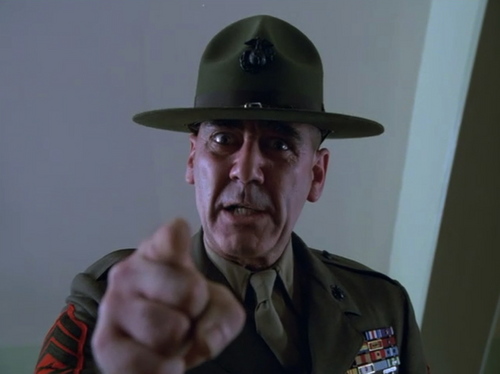
That's SERGEANT R. Lee Ermey, you scum-sucking waste of space!
There are many moments of dark humour in the first half of the film, most often through Ermey's creative put-downs of his recruits. These are interspersed with some profoundly disturbing scenes, most of which centre around Leonard Lawrence (Vincent D'Onofrio), or as Hartman calls him, "Gomer Pyle".
Lawrence is an unfit and mentally slow recruit who has an almost childlike innocent demeanour. Hartman's relentless abuse of him during numerous failed training drills, and the other recruits' bitter (and even violent) resentment towards his ineptitude is shocking but captivating.
Other main characters include Joker (Matthew Modine) and Cowboy (Arliss Howard), who form a friendship while at the barracks.

Joker
Joker attempts to help Lawrence with aspects of the training that he struggles with (even helping him dress smartly), but slowly becomes exasperated. After one particularly bad foul-up in which Lawrence gets the entire group punished, he is gagged and then beaten with bars of soap in the middle of the night by his fellow recruits.
Joker eventually caves into the frustration along with the others, and joins in the beating of the helpless Lawrence. One of the most haunting shots of the film shows Cowboy, the only recruit not to join in, lying in his bunk and covering his ears to drown out Lawrence's cries.
Ironically this harsh kind of treatment transforms Lawrence into a model soldier, and he becomes one of the best in the unit at the various discipline drills. Then Joker notices that he is holding conversations with his rifle in private.
From there things get worse and worse, eventaully building to a tense crescendo. In the dead of night, the unhinged Lawrence loads his rifle with live ammunition. Joker walks into a shower room to find him screaming drill commands and shouldering the gun. Horrified, Joker is powerless to calm him down.
Hartman wakes up and attempts to defuse the situation, but his ultimate lack of emotional understanding proves fatal. Lawrence shoots him dead when he begins to shout orders at him. Grinning uncontrollably, he considers killing Joker too, but eventually sits down on a toilet seat.
Before the stunned Joker can do anything Lawrence lifts the rifle and promptly commits suicide - an act which brings the first half of the film to a chilling conclusion.

Lawrence, mid break-down
How close is a "model marine" to a psychopath in a system which encourages loss of emotion and dehumanisation? The film makes a powerful and uncomfortable argument that the line is very blurred indeed.
Is the system of mentally breaking recruits to form new soldiers as inhumane and cruel as war itself? Or even worse?
The second half of the film covers the actual war, in which Joker is assigned a journalistic role. He frequently writes semi-propaganda stories for army media to appease his superiors.
A lot of reviews I've read rate FMJ highly, but state that the film loses cohesion after the first half. Here I agree, but I don't think it's to the detriment of the film.
The rest of the movie has a kind of organised chaos about it. We move rapidly from location to location with Joker, again culminating at the end of the film in a prolonged tension-laden scene. We see fleeting pieces of the war with Joker's eyes and start to build up our opinions as he does.
This half of the film is of course home the infamous comic relief scene with "Da Nang Hooker", which popularised the whole "me so horny" thing that you still hear occasionally today.
The film throws us another interesting scene here. On the way to his next assignment (which coincidentally causes him to run into Cowboy's squad) he flies in a helicopter.
The door gunner, firing the machinegun at enemy troops, repeats almost constantly under his breath:
"Get some. Get some. Get some, get some. Get some. Get some."
Apparently unaware he is even muttering it, the camera pans round to reveal that he is actually gunning down civilians below indiscrimately. Joker notices this, and asks the soldier incredulously how he can shoot women and children.
The gunner boasts of his kill count (157 people and around 50 water buffalo, apparently equivalent in his view) and explains that shooting women and children is easy. "You just don't lead 'em so much."
This scene is never laid to rest, which is partly what makes it so uncomfortable. Joker doesn't respond, we never see any kind of conclusion to such a dark moment, the film simply moves on.
It's hard to sum all of the characters up, but easily one of the most prominent from here on is "Animal Mother" (Adam Baldwin), a heavy-machinegun toting soldier in Cowboy's squad. He is renowned for being brave and aggressive while under fire, and we see numerous times that he is.
However, he is simultaneously cold and emotionally hollow, his feelings apparently burnt away by the fighting. When Joker questions his motives for what he does, he explains that all that matters is "winning". Being right doesn't matter, and it was never about that. His whole motivation comes from surviving the next battle, and the prostitutes they all frequent afterwards.

Animal Mother in a tough situation
From then on Joker finds himself in the thick of combat (and is widely criticised by his peers for having never killed anyone before). This all changes in the final act of the film.
Cowboy is forced to lead the squad after the previous leader is killed by a booby trap. Eventually the squad advances through an urban area, where a deadly sniper picks off several more squad members. Animal Mother suppresses the sniper and leads the squad forward.
Cowboy himself is sniped and wounded while answering the radio. His last words echo weakly from training: "I can hack it." The others can do nothing to help him but whisper words of encouragement, and he bleeds to death.
Finally they settle on killing the sniper as payback. They sneak into the building and Joker is the first to encounter him - or more precisely her. The sniper is a young girl dressed in a dusty uniform. Joker's gun jams as he goes to fire on her, and he cowers behind a pillar as she shoots at him.
Eventually she is gunned down by Joker's friend, who tastelessly whoops with joy as she lays dying on the ground. The Marines gather around her and she starts whispering something.
Eventually Joker's friend stops cheering, everything becomes silent and someone asks what she's saying.
"She's praying." Joker says. Animal Mother reasons to leave her "for the rats", but Joker insists that they must put her out of her misery.
She begins quietly begging them to kill her, and AM tells Joker that he'll let her die quickly - but only if Joker himself does the deed, and so gets his first kill.
Joker hesistates for a long time, grimacing and staring at the floor, but eventually he pulls the trigger. No-one speaks for a while, and then everyone but Joker begins whooping and cheering again, who just stares down at the corpse pale-faced and vacant eyed.
The closing scene of the film shows the soldiers marching across the landscape and singing, and Joker narrates that he "is in a world of shit, yes. But I am alive. And I am not afraid."
This very ambiguous statement is all we get in way of closure, and it works perfectly. Has Joker found some kind of meaning in the horrors he has witnessed? Is that what his last quote refers to? Or has he finally lost his grip on humanity, like so many other characters in the film?
The "world of shit" quote is particularly interesting. Early in the film, Hartman informs the Marines that "No Marine dies without permission", because doing so lands them in "a world of shit".
One of the last things that the mentally broken Lawrence says to Joker in his final scene, is that he is "in a world....of shit."
Does Joker's use of the term imply that he has also lost that "spark" that makes us people? Or has he become stronger, having overcome that initial shock, and understood what Lawrence meant in his final moments?
Final Word:
So this has been a long review/analysis, and I could rattle on more (I won't fortunately ;) ) but FMJ is a film that really gets you thinking. Every few moments something comes along that really feels masterfully planned and executed, and the whole film drips with themes.
The ending, and scenes such as the soap beating generate a kind of emotional reaction that movies so regularly fail to nail. That alone makes FMJ more disturbing than any horror film and many times more poignant than lots of other films in the same genre.
If you want to see an occasionally amusing, frequently chilling film which has a hefty layer of meaning on top, I highly recommend this film. Just make sure you're suitably hardened for the harsher bits before you turn it on.
5/5
[*][*][*][*][*]
Saturday, 23 October 2010
Movie Review: Orphan
*This review contains spoilers*
"There's something wrong with Esther." is the tagline for this film, and it certainly isn't lying.
Unfortunately though, Orphan is one of the most frustrating films I've watched in recent times. It's a textbook example of how needless cheap scares and shoehorned cliches can derail a decent thriller.
Peter Sarsgaad and Vera Farmiga play a kind and well-off couple who have a nice house and lovable kids. Their life is shaken when they lose their third child before birth. They decide, after much deliberation, to adopt a child. That child is Esther (Isabelle Fuhrman).
Esther is something of a child prodigy. She's polite, mature, intelligent and is very good at art. She also has some rather bizarre personality traits, and her history is dogged by a series of tragic accidents.
I found the first half or so of Orphan very watchable. It was surprisingly smart for a "horror" film, and reminded me more of a thriller. The characters were likable and believable. As the story progresses, we learn things about them not easily guessed (Farmiga's character used to have an alcohol problem, for example).
Interesting characters who develop? A dubious antagonist? Unreliable viewpoints? Good film so far.
Sadly though, the film is filled with these little nuggets that seem forced in from the scripts of other, lesser films.
It's kind of like someone in Hollywood watched the film, then said "Nah, this won't appeal to the market enough. Throw some cheap-ass scares in and change the ending."
So, the character building and interesting build-up is then interspersed with some of the most ludicrous "make-u-jump" scenes I've seen in a film. Think of it, and it's in the film. Kids laughing suddenly (at deafening volume), things banging, sudden unusually aggressive hugs, that sort of crap.
It just feels so unneccesary and cheapens the whole movie. It's like eating lobster and having a guy run up and bellow in your ear at random intervals.
Even worse, I didn't actually jump at any of the "sudden" bits (and I haven't done in any film for some time now). That makes it feel even more redundant.
Then I mentioned it felt like the ending was changed. Well, yeah. The film does well to avoid cliches until about 50-75% of the way through, and then they start sprouting like ugly mushrooms.
Cops taking a millenia to arrive when needed? Check. Main character dying through very dubious judgement? Check. Antagonist refusing to be killed off? Check
It really is sad to see what felt like such a promising film take a nosedive, and all because it tries to up the "horror" side of things while ditching what made it interesting in the first place.
Final Word:
Orphan oozes a kind of sneaky, devious charm until around halfway through. Then it tries to escalate things higher and higher until it has nowhere to go but cheesy horror film territory. Disappointing.
3/5.
[*] [*] [*] [ ] [ ]
Monday, 11 October 2010
Movie Review: Casino Royale
Weren't expecting that, were you?!
Since unfortunately I didn't manage to see The Bourne Identity this weekend, I decided to have a look at the "old new" Bond film.
Now, while I found the original James Bond movies entertaining as a kid, as an adult I find them dated and tedious.
Yes, Roger Moore and Sean Connery game some reasonable performances, but the content was formulaic and sometimes rather insulting, especially in the oldest ones.
*Old Bond film rant starts here*
---------------------------------------------------------------------------------------------------------------
Bond is some kind of superhuman being in all of them who is ridiculously excellent at everything. Villains are always genius madmen who nonetheless are too stupid to just shoot Bond, and insist, every single film, in putting him into "escapable situation X".
The other bad guys are always great at murdering anyone but Bond, and then they suddenly become incompetent morons who can't shoot straight. Ebert's review of Casino Royale also nailed something I find annoying in most films: when was the last time in an action film, if ever, that the main character was killed by a machinegun?
It's strange movie logic that comes up again and again - machineguns aimed by baddies make sparks fly everywhere, but are otherwise utterly useless against a hero. On the other hand, a simple pistol in the hands of a hero becomes some kind of 100% accurate railgun that can kill 10 people in 5 seconds. Sigh.
Then there are the women, perhaps the most irritating part of old Bond films. They're always named after some kind of lame double entendre (which fortunately I never cottoned on to as a kid, aside from thinking the names were "weird".)
Holly Goodhead, Pussy Galore, Mary Goodnight, Honey Rider.
I mean, the second one in particular isn't even a vaguely realistic name, and it's pretty graphic. Quite why the films are seen as harmless for kids when the characters are practically named "Ivanta Shagyu" I don't know >_>
Then there's how they behave. I forget which film it is, possibly The Man With The Golden Gun, but the girl helps James fight the baddies. She's insultingly stupid and inept, hopping around and squealing "Oh James, I don't know what to do! Which button do I press?!" when the only button is a giant red one.
Plus there are also several Bond films with cringeworthy lines towards racial minorities. I'm don't like how Britain is so PC-obsessed now days, but even so some of the Bond films definitely class as being in the "exploitation" genre.
So, old Bond films: The villains are idiots, Bond is some kind of superman, henchmen are useless, black and asian people are stereotyped completely and all girls are sex objects with IQs of about 10. Nice.
---------------------------------------------------------------------------------------------------------------
*Rant end*
The following review may contain some spoilers.
Fortunately, Casino Royale is a departure from 99% of the crap in the old films.
The main antagonist isn't a bald maniac with a base on the moon, but a slimy, desperate banker who provides large scale investments for terrorists.
The "Bond girl" (Eva Green) displays refreshing intelligence and saves Bond's life on several occasions.
Q, the gadget guy, and Moneypenny are both missing. Instead there is just M (Judi Dench), Bond's boss. Dench puts in a characteristically decent performance. This cuts down quite considerably on the cheesy humour typically associated with the "Bond formula".
Bond (Daniel Craig) is very competent at his job, but is also ruthless and emotionally cold, something that intentionally makes him quite unlikable in several scenes. While still intelligent and sharp-witted, he is a more realistic character than in any of the old films. He is a human being with strengths and flaws rather than a man made of steel.
In one scene he seduces and manipulates a target's wife purely to gain information - she is murdered as a result. As the body is bagged up and removed from a beach, M and Bond stare at it.
When M speaks her voice is sad, almost disgusted. "I would ask you to remain emotionally detached, but that's not really your problem, is it, Bond?"
Bond doesn't seem to feel a twinge of guilt. "No."
This more mature character development is a shining example of how the film differs from its predecessors, in which I couldn't imagine a scene anywhere near as stark or chilling.
Even the action has had an overhaul. While the scenes are familar: fights in speeding vehicles, fights in stairwells, car chases, they also soak up the new visceral feel. Bond frequently ends struggles blood-smeared, beaten and exhausted, but his enemies end up even worse. No longer are fights your usual Bond case of Big Evil Man With Cheesy Advantage versus Man In Sharp Suit.
Sebastien Foucan, one of the big names of parkour, makes a cameo in a very impressive chase scene.
Mixed in with all this are casino scenes that manage to milk every last drop of tension from the turning over of two cards, and an end which results in the villain's demise in a far more satisfactory and creepy way than any over-the-top cartoony death ever could.
Final Word:
Casino Royale is in a different world to the Bond films before it, and I highly recommend watching it even if you typically dislike old Bond cliches.
[*] [*] [*] [*] [*]
5/5
Friday, 1 October 2010
Movie review: The Day After Tomorrow
After enjoying Collateral in my last review, it makes sense that it couldn't last and I've now seen a film I loathe!
I have seen The Day After Tomorrow perhaps 4-5 times. This is not out of choice, but because (for perplexing reasons I can't fathom) it is on TV about every 2 weeks. Nothing else is on when it's on either.
Let's get one thing straight from the start: I am not "trendy" when it comes to Global Warming, which is what this film claims to be about.
(Global Warming rant here. If you want to skip, move down second dashed line!)
----------------------------------------------------------------------------------------------------------
I accept there is a problem, yes, and I believe we should closely monitor it. I also believe mankind should attempt to be eco-friendly as much as is possible while maintaining efficiency.
However, I don't believe this scaremongering crap that has been so popular lately - that we are going to be the "tipping point" with our CO2 emissions.
Why? Well, when one huge-arse volcano can erupt at any time and totally dwarf the CO2 emissions of the entire Human race, I tend to think this talk of Human tipping points is ludicrous. Include underwater volcanos we don't even know about and the fact that geysers are always spewing crap out (plus the gases emitted when tectonic plates shift) and we start to look less and less significant.
Scientific evidence for this "human factor" theory is also weak, and this is what really annoys me. Take the leaked emails from East Anglia's Climate Research Unit, which announced that "[we] must suppress the level of change" - I.E. no significant evidence to point to human-caused climate change, but the Unit wanted to cover it up. That's great ethical science right there!
There is a cult-like mentality (ingrained in many self-righteous individuals I have met personally) that we are killing the planet with CO2, and the science is being bent to fulfill this political agenda. Science is there to present an empirical, quantitative truth, but sadly with GW that one goal seems to be obfuscated completely.
The way half of this stuff is presented is really more like religious zeal than factual evidence.
The Government loves these types of smug fanatics and this kind of perversion of science. Up taxes, and people actually agree with it! Perfect!
This is all compounded by the fearmongering adverts put out by the government and climate change groups. I remember seeing one recently aimed at children, which announced that "scientists" (got to love generalisation) have told everyone that we're all going to get screwed soon by it. Then we see images of animals and people drowning, and kids crying.
Another I saw showed a tearful young girl being teleported to an arid desert, and then being nearly killed by huge tidal waves. Then a stark voice boomed out about CO2 emissions. What scientific references did the ad make use of? None, naturally. Just a whole load of fear-spreading bull.
Now, one of the most "GW-active" people I know pretty much sums up the whole mentality. He owned 8 phones at one point recently, and must change to a new phone model once every couple of months. He also owned two laptops and a desktop computer.
I presently have one laptop, one desktop, and one cheap phone. According to this guy, I was a "materialist". I almost choked laughing! Similarly, he announced on his FB that "flying is immoral", strangely after he broke up with his overseas partner, who he was previously flying out to every 5-6 months.
I haven't been on a plane for about 8 years.
Yet this guy is THE Eco-Warrior™. It's amazing, simply incredible...but he sees himself as some kind of enlightened saviour of the planet, and naturally is a great big fan of the more baseless scaremongering ads and campaigns.
He has no idea of the science, as demonstrated in his poor reasoning over energy efficiency and countless other eco-related areas, but hey, he's a GW crusader, so logic and hypocrisy be damned!
-------------------------------------------------------------------------------------------------------------
(Review resumed)
Well, basically TDAT layers on the GW theme thick. Chokingly thick. The protaganist is a super-enlightened scientist who suddenly realises the world will end due to climate change in a couple of days.
Naturally the politicians are all idiots and refuse to listen, and the film just keeps piling on the smug lecturing. "If only they had listened earlier!" is a common expression, often followed by a saddened headshake or a melodramatic kneading of the forehead.
Yes, we're stupid for not subscribing to the CO2 tipping point craze. We get it. We don't need any more patronising bollocks, thank you very much. Oh wait, we're going to get it anyway. Cheers!
Anyway, the film goes through every disaster movie cliche in the book. Tsunamis, ice storms (which somehow freeze low-flying military helicopters but not the protaganist's car. He must have an Eco-Warrior™ Shield. I wonder how much CO2 it takes to keep that thing rocking) and all other sorts of stuff.
Everyone except the Enlightened Few act like brainless tossers and generally die. There is a "brave sacrifice by cutting my climbing rope" scene that you see in every film ever to feature climbing ropes.
There are some truly laughable scenes, such as when a group of survivors successfully outrun a skyscraper-sized tsunami, or (my personal favourite) when they run away from the weather!
That's right, the building they're in freezes behind them amd they run away from the ice as it materialises in seconds behind them. Futhermore, they "shut out" this bizarre demonic freezing agent by shutting a door.
Ell-Oh-Ell.
So yeah, cliched, stale disaster movie with syrupy coverings of very biased Global Warming preachiness, this is one of the most tiresome films I have seen for a while.
Final Word:
Plot is gusty with heavy showers of smug. Extremely dangerous conditions, do not stay indoors, leave the house if neccessary!
1/5.
[*] [ ] [ ] [ ] [ ]
Also, because it's perfect (and you suffered my rant):
Watch 'til the end for big lols ;)
Sunday, 26 September 2010
Movie Review: Collateral
*This review contains some minor spoilers*
There are two ingredients I've noticed are almost always present in good Thriller films, and I think they're the fundamental difference between a Thriller and an Action film - theme and tension.
Action films are a genre that I personally find tedious and stale the great majority of the time. Musclebound stars making tiresome quips as they mow down Faceless Baddie #79451 get me frowning. Even more so when the plot can usually be summed up in three words. Man gets revenge. Man kills things. Manmade gratuitous explosions.
That's all old tat. So back to Thrillers and themes.
To use an example: No Country For Old Men, a thriller that holds a fond place in my heart, has themes which encompass greed, guilt, the breakdown of social morals and fate. These themes combine with a terrifying use of tension to create an edge-of-seat experience. Guns don't fire every five seconds, but when they do it almost always means a character we care about is in dire peril.
Collateral is a similar film, in that although it does have action-filled scenes, it also cranks up the tension, and focuses on characterisation far more than gunfire and explosions.

Set in L.A., the plot primarily features cab driver Max (Jamie Foxx), who has been planning for a long time to start his own Limousine business, but somehow has never got around to it. Early in the film he meets a high-profile lawyer named Annie (Jada Pinkett Smith) when she rides in the back of his cab.
It's clear the two like each other, but unlike many films, where vulgar lines start getting hurled around immediately, the scene comes across as pretty natural and realistic. The two simply chat and get on well. Max starts to become a character we can empathise with, due to both a good script and an admirable performance from Foxx.
Annie leaves him with her card and departs. The next fare Max has is a strange man named Vincent (Tom Cruise), who dresses in a sharp suit, but sports a messy stubbled look. He is friendly, but also cynical of human nature.
He tells a story of a man dying on the LA metro, and his corpse only being noticed six hours later despite passengers sitting next to him in all that time. This theme of social apathy and urban dehumanisation continues throughout the film, even influencing the plot at several key points.
It soon turns out that Vincent is a hired killer, and a good one at that. I'm not usually a huge fan of Tom Cruise, but here he plays Vincent perfectly. He is both disturbingly cold and yet endearingly animated at the same time, striking a mix between likable intelligence and frightening ruthlessness.
Vincent offers Max $600 to drive him to several different spots around the city. Max drops him off at an apartment first, and then is horrified when a body suddenly lands on top of the taxi from a window above.
Vincent is quite calm, and forces Max at gunpoint to clean the taxi and stow the corpse in the boot of the car.
From there on the film proceeds at a menacing but measured pace, with Max strongarmed into taking Vincent to the rest of his victims. Following the trail of bodies is LAPD officer Fanning (Mark Ruffalo), who believes members of the FBI are wrong to suspect Max as the murderer.
Between killings Vincent and Max talk to each other in the car, and gradually more is revealed about both. Unexpected and very tense scenes occur. One has the police pulling over the taxi for its broken windscreen.
Another has the duo meeting a jazz club owner (Barry Shabaka Henley) and having an intriguing (and very sad) conversation.
In a particularly good scene, Max is required to pose as Vincent to Vincent's criminal client Felix (Javier Bardem). He explains they've never met him in person before, and so Max can take his place if he can improvise well enough. If not, they'll probably kill him. Either way Vincent is able to sit safely outside in the car.
Javier Bardem is a very skilled actor. In No Country For Old Men, he put in an iconic performance as the unstoppable psychotic Anton Chigurh.
Here, in his portrayal of the laid back but intimidating Felix, he switches instantly from friendly chit-chat to weighting every word with solid malice.

There are two ingredients I've noticed are almost always present in good Thriller films, and I think they're the fundamental difference between a Thriller and an Action film - theme and tension.
Action films are a genre that I personally find tedious and stale the great majority of the time. Musclebound stars making tiresome quips as they mow down Faceless Baddie #79451 get me frowning. Even more so when the plot can usually be summed up in three words. Man gets revenge. Man kills things. Manmade gratuitous explosions.
That's all old tat. So back to Thrillers and themes.
To use an example: No Country For Old Men, a thriller that holds a fond place in my heart, has themes which encompass greed, guilt, the breakdown of social morals and fate. These themes combine with a terrifying use of tension to create an edge-of-seat experience. Guns don't fire every five seconds, but when they do it almost always means a character we care about is in dire peril.
Collateral is a similar film, in that although it does have action-filled scenes, it also cranks up the tension, and focuses on characterisation far more than gunfire and explosions.
Don't make him angry
Set in L.A., the plot primarily features cab driver Max (Jamie Foxx), who has been planning for a long time to start his own Limousine business, but somehow has never got around to it. Early in the film he meets a high-profile lawyer named Annie (Jada Pinkett Smith) when she rides in the back of his cab.
It's clear the two like each other, but unlike many films, where vulgar lines start getting hurled around immediately, the scene comes across as pretty natural and realistic. The two simply chat and get on well. Max starts to become a character we can empathise with, due to both a good script and an admirable performance from Foxx.
Annie leaves him with her card and departs. The next fare Max has is a strange man named Vincent (Tom Cruise), who dresses in a sharp suit, but sports a messy stubbled look. He is friendly, but also cynical of human nature.
He tells a story of a man dying on the LA metro, and his corpse only being noticed six hours later despite passengers sitting next to him in all that time. This theme of social apathy and urban dehumanisation continues throughout the film, even influencing the plot at several key points.
It soon turns out that Vincent is a hired killer, and a good one at that. I'm not usually a huge fan of Tom Cruise, but here he plays Vincent perfectly. He is both disturbingly cold and yet endearingly animated at the same time, striking a mix between likable intelligence and frightening ruthlessness.
Vincent offers Max $600 to drive him to several different spots around the city. Max drops him off at an apartment first, and then is horrified when a body suddenly lands on top of the taxi from a window above.
Vincent is quite calm, and forces Max at gunpoint to clean the taxi and stow the corpse in the boot of the car.
From there on the film proceeds at a menacing but measured pace, with Max strongarmed into taking Vincent to the rest of his victims. Following the trail of bodies is LAPD officer Fanning (Mark Ruffalo), who believes members of the FBI are wrong to suspect Max as the murderer.
Between killings Vincent and Max talk to each other in the car, and gradually more is revealed about both. Unexpected and very tense scenes occur. One has the police pulling over the taxi for its broken windscreen.
Another has the duo meeting a jazz club owner (Barry Shabaka Henley) and having an intriguing (and very sad) conversation.
In a particularly good scene, Max is required to pose as Vincent to Vincent's criminal client Felix (Javier Bardem). He explains they've never met him in person before, and so Max can take his place if he can improvise well enough. If not, they'll probably kill him. Either way Vincent is able to sit safely outside in the car.
Javier Bardem is a very skilled actor. In No Country For Old Men, he put in an iconic performance as the unstoppable psychotic Anton Chigurh.
Here, in his portrayal of the laid back but intimidating Felix, he switches instantly from friendly chit-chat to weighting every word with solid malice.

"If Santa Claus were to make a list...and [his assistant] were to lose it...how f***ing furious do you think Santa Claus would be?"
From there on the film ploughs ahead, with several surprising twists. The film manages to remain firmly in the realm of plausibility. There is a car crash not followed by an explosion, something which stunned me.
In fact, I don't think the film contains any explosions, and it's a very refreshing change indeed.
Vincent is one of the most interesting movie 'villains' I have seen in a recent film. His rationalisation of his job ("Millions of galaxies of hundreds of millions of stars, in a speck on one in a blink. That's us, lost in space.") raises some very interesting questions on morality. Does morality even exist in a purely atheist, scientific outlook on life, or is Vincent simply a sociopath? Why does it matter, ultimately?
The ending is a final release of the tension throughout the movie, and neatly sums up the themes in the film as things seem to go full-circle.
Final Word:
I went into Collateral expecting your typical crappy explosion fest, but left with a satisfied smile on my face. The film balances action with a fresh cast of characters and a plot that really does introduce some interesting questions. Performances all around are solid.
I'm going to give the film 5 stars, not because it is perfect (no film is), but because it is a very entertaining piece of cinema.
One thing I noticed throughout the film was the pleasing lack of swearing. F-bombs are dropped, but they are not generally used in casual conversation, and not to anywhere near the level I've seen in other films recently. It's amazing how much more impact they have when they're not coming out of someone's mouth every two seconds. Definitely a plus.
One thing I noticed throughout the film was the pleasing lack of swearing. F-bombs are dropped, but they are not generally used in casual conversation, and not to anywhere near the level I've seen in other films recently. It's amazing how much more impact they have when they're not coming out of someone's mouth every two seconds. Definitely a plus.
[*] [*] [*] [*] [*]
5/5
Subscribe to:
Posts (Atom)