So having binged my way through Peep Show (and loving it), it really stood out to me just how dark the comedy really is, in a way that perhaps you don't notice if you only watch an episode every week or two. Cripplingly, oppressively dark, in fact.
On the surface, most of the humour comes from how Mark and Jeremy can't seem to do anything without the other messing up their plans spectacularly. Usually this results in a cringey denouement in which one or both is publically humiliated due to a contrived and ridiculously unworkable plan of their own making. Super Hans' wacky antics usually lend an oddball levity to this otherwise rather bleak circus of failure.
Occasionally we have a moment of success. Mark getting on well with Johnson (initially, before Johnson betrays him). Mark and Jeremy occasionally sticking up for each other out of true friendship (Mark trouncing the Book Club dickhead, and Jeremy offering to dance with Mark when he's painfully alone at a party).
These moments of success usually come from Mark and Jez using their different personalities together in an additive, positive way.
But over time, a certain repetition creeps in. Slowly, you begin to realise that literally none of the significant events in their lives works out for Mark or Jez. Ever. Everything they do to improve their lives is doomed to awful failure, almost always due to their own inescapable character flaws.
But the ending of Season 9, supposedly the final season of the show, we see Mark and Jeremy back in familiar territory: Mark trying to win over the woman of his dreams and failing pathetically, and Jez suffering an identity crisis...the same kind he's been having and failing to do anything about for years.
The difference now is that in the last episode Jez is now a 40 year old slacker rather than a 20-something. He still doesn't have a career, a stable relationship, a stable friendship with Mark (or anyone else!) or even a sense of his true identity. He doesn't even know if he's gay, bi or what!
His "liberal slacker" lifestyle which is supposedly full of choice actually seems more like a depressing cover for the fact that he has zero choice, direction or confidence in his life and in reality he is just as lonely and isolated as Mark. His extroverted nature means he can cover that up superficially in social situations with more success, but in reality he lacks true friends and partners and his life is just as much of a social void.
Mark's attempt to get with April in the last series is uniquely depressing because, ironically, she may actually finally be "The One" for him. He's been calling girls "The One" since the first season, but for once this assessment actually rings true. April truly is intelligent, kind, funny and similar to him.
And yet (with Jeremy's help) Mark again f***s it up. And April leaves, presumably to never return.
The series concludes with Super Hans breaking up with his GF and planning to leave the country and Jeremy and Mark once again sat alone in their flat on their sofa. After 9 seasons, they are exactly where they started...but older and worse off.
In that last scene, Jeremy's mindless request to Mark to "pull him off" (which Mark immediately scoffs at and refuses) at first seems like a silly throwaway comment. But then Jeremy says he doesn't really know why he even said that. It's a grim shout out to Jeremy's nature: he's still a thoughtless hedonist who makes dumb decisions and doesn't consider or even know what he wants or why he does what he does. He's learned nothing.
Mark replies by asking if Jeremy would like him to read a book about Napoleon to entertain them both. Cue Jez scoffing. Again, this comment comes across not as a cutesy reference to Mark's character, but a reminder of his social ineptitude and obsessive nerdiness...it's an acknowledgement that he too is still the same...and has learned nothing over the years either.
In a way, the two men share an odd duality. Their traits may be polar opposites to the naked eye, but close observations show that their character differences actually make very little difference to how their lives turn out. To illustrate this point: Jeremy's problems are often caused by his stupidity: he comes up with moronic plans that have no chance of working.
By contrast, Mark's misfortunes are caused by his own intelligence: he compulsively overthinks everything, ironically leading to moronic plans that have no chance of working. The two are one and the same.
The last PoV shot is actually from the perspective of the wolves on TV. They howl and stare out at the lonely Mark and Jez, as if a reminder that they're slowly crawling fruitlessly towards their inevitable doom.
If Peep Show has a message, it seems to be this: People are shallow, self-obsessed neurotic creatures and the majority of us cruise through life as "worker drones", as Johnson would say. Life is often bitter and unhappy, and even your close friends are unreliable and vain.
It really is a rather bleak and morbid underbelly to a hilarious show, and I do hope that if the writers do bring back the El Dude Brothers for one final series they get a little bit of self-awareness, love and happiness in their lives, if even for a moment.
As terrible as Mark and Jez often are as human beings, I think they deserve it.

Showing posts with label TV. Show all posts
Showing posts with label TV. Show all posts
Sunday, 1 October 2017

Sunday, 4 January 2015
TV Series Overview: Mad Dogs
*Contains spoilers*
So today, after a TV journey that's lasted a couple of years, I finally finished watching the British TV series Mad Dogs.
My feelings have flickered between real interest and irritated boredom over the course of the series, and the ending itself was so disjointed and bizarre as to really highlight exactly where the script was weak along the way.
For the uninitiated, the show follows four English middle-aged friends: Baxter (John Simm), Quinn (Philip Glenister), Woody (Max Beesley) and Rick (Marc Warren). Having reached the mid-point of their lives they have very little to show for it.

All of them exist in a state of disillusionment at the start of the series, whether it be with erstwhile partners, dull jobs or kids they've missed growing up...and so they agree to take a holiday trip out to Majorca to meet their old friend Alvo (Ben Chaplin). Alvo is rich beyond the wildest dreams of the other four, and they quickly end up embroiled in dangerous business after he is murdered in Season 1.
Season 2 and 3 then focuses on the after-effects of this disaster, and how the four hope to extricate themselves. Season 4 deals with the inevitable consequences of all that came before.
Now, all four actors are pretty much heavyweights of British drama, so you'd expect the script to pull the big punches too. The actors certainly play the characters very convincingly: but disappointingly, Cris Cole's writing seems to go nowhere over the course of the four seasons.
"Going nowhere": it's a prominent theme of the series. In every season, oddly melancholy and sinister billboards can be spotted in the background in some scenes showing a sad woman in makeup, or a creepy demonic face, prefaced with the slogans "road to nowhere" or "going nowhere" in foreign languages.

It's a clever bit of foreshadowing that hints at the ultimate fates of the characters, but at the same time as the series drags on for four seasons without any real character development it becomes hard to see if the characters' lack of self-awareness is intentional or an oversight of bad writing.
Both in the first and last series the characters bicker with each other over stupid things. They get into a major fight in practically every series. And despite being offered the chance to leave behind all the bad things that happened to them, they repeatedly go back for more.
This isn't so much of a dealbreaker when you consider that it's likely that Cole intended for the narrative to feel like it's stuck on a loop: the show attempts to go for that Shakespearian tragedy feel of characters that are painfully unsure of themselves or even how to interact with their life-long friends. Characters who can't be grateful for what they have, and who always want the easy way out rather than facing up to fixing their lives.
However, other choices in the finale and from the halfway point of the third Season on feel very lazy and generic, almost as though the series was cut short.
There are several big plot strands in the last few episodes that are introduced and then dropped with no explanation, which I found highly irritating:
- Rick at one point finds a glass eye in a toilet seemingly at random: the object later prompts him to change his mind and risk his life when he could otherwise remain safe. No explanation is given for what the object might represent, or why he came to find it in the first place.
- The *third* CIA agent in the story seems amazingly incompetent, even given that Season 3's Lazaro was an absolute nutjob. Cole seems to have written her as an obligatory "zany" character, but she just comes across as really unprofessional and irritating. She then gets killed in a really stupid way, too, and we're expected to believe that a thirty-year veteran of the CIA would just turn up at random to a house siege and not even be prepared for a violent confrontation: ridiculous.
- Quinn's friend at the bar, the "connected" bald guy he shares many discussions with in Season 3, doesn't do anything. He does literally nothing over the course of the series except provide an ear for Quinn to talk into. I kept thinking he would turn up later and help the group out, but no.
- Mercedes, the female soldier who saves the four in Season 3, vanishes forever at the conclusion of S3 and isn't seen again. This is despite the group looking for the CIA's files on her, and finding that she mysteriously had none. It's repeatedly hinted that she is somehow a lot more important than she seems, but this never materialises.
- The fate of Woody's girlfriend and adopted kid is never answered.
Even more unforgivably, the choices the friends make at the end of the show are absolutely insane and show no forethought at all:
- Pursued by professional killers, they make no attempt to hide, contact the police or other authorities, or even just lay low at a hotel or something. Instead they drive out to a deserted beach (!)
- Quinn owns a bar and supposedly has lots of social connections, but mentions that "You can't just call people there, they don't give out numbers." If he owns the bar, why not just call the bartender and get his friends put on the line? That he doesn't even try to do this seems ludicrous.
- Woody ineffectually fires the group's only weapon (a shotgun) at a guy about 500 metres away, until he runs completely out of ammo. WTF?

Season 1: The group goes to Alvo's villa. Alvo is murdered by a group run by Dominic (a corrupt cop, English ex-pat), Maria (a CIA agent running narco-finance operations) and an old English dude named Mackenzie who is running the drug operations. The series ends with Maria dead and the very tense scene of Dominic walking up to the villa, about to kill an unsuspecting Quinn.
Season 2: The group promptly run Dominic over in a car and escape. There's a lot of well-plotted stuff with Mackenzie, who wants his cash back. The group is eventually cornered in Morocco by a militia force funded by the UK.
Season 3: The group is held in a blacksite prison, the CIA connection is explained, eventually they are sent to South Africa with new identities and they wriggle their way out of a CIA hitlist (though it's perplexing the CIA care about them so much, since they're essentially four civvies in the wrong place at the wrong time).
Season 4: This, for me, was where it started getting stupid. The group sells Alvo's villa, gets rich, decides to move back to Cape Town for no reason and promptly the whole lot of them get executed by Dominic's gang. The ending has them plunging off a metaphorical road to Hell.
I mean, just look at those summaries: we go from a plausible crime thriller in Season 1, to the Season 4 ending in which everyone dies and goes to straight to Hell, do not pass go, do not collect $200.
While the doom of the group was hinted at the whole way through, I was pretty disappointed at how it happened. It seemed completely avoidable had the group actually had half a brain, but the plot demanded they died in such a fashion and so they did.
Verdict
So, should you watch Mad Dogs? I'd say yes - just be prepared to be irritated by it towards the end.
The acting's good and Seasons 1-2 have some really good moments. Season 3 has some poignant scenes and purposeful plotlines, but for me Season 4 was when the show really seemed to lose sight of where it was going.
For the record, I don't mind ambiguous endings: and the ending of Mad Dogs is very surreal and very ambiguous. It's more the fact that you can assemble such a talented cast with such an interesting concept...and then do so very little with it and leave so much unexplained.
[*][*][*][ ][ ]
3/5
A show that's equal parts interesting and frustrating, and sadly descends into poorly written nonsense close to the end as it searches to be more profound than the sum of it's parts.
So today, after a TV journey that's lasted a couple of years, I finally finished watching the British TV series Mad Dogs.
My feelings have flickered between real interest and irritated boredom over the course of the series, and the ending itself was so disjointed and bizarre as to really highlight exactly where the script was weak along the way.
For the uninitiated, the show follows four English middle-aged friends: Baxter (John Simm), Quinn (Philip Glenister), Woody (Max Beesley) and Rick (Marc Warren). Having reached the mid-point of their lives they have very little to show for it.
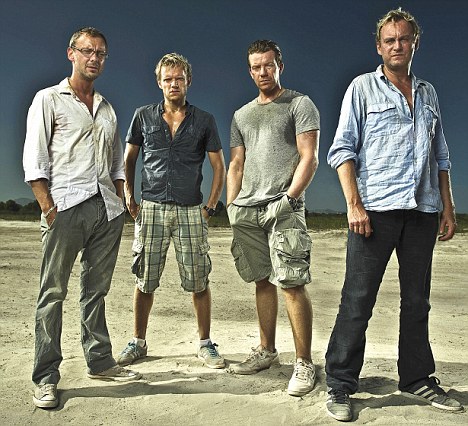
All of them exist in a state of disillusionment at the start of the series, whether it be with erstwhile partners, dull jobs or kids they've missed growing up...and so they agree to take a holiday trip out to Majorca to meet their old friend Alvo (Ben Chaplin). Alvo is rich beyond the wildest dreams of the other four, and they quickly end up embroiled in dangerous business after he is murdered in Season 1.
Season 2 and 3 then focuses on the after-effects of this disaster, and how the four hope to extricate themselves. Season 4 deals with the inevitable consequences of all that came before.
Now, all four actors are pretty much heavyweights of British drama, so you'd expect the script to pull the big punches too. The actors certainly play the characters very convincingly: but disappointingly, Cris Cole's writing seems to go nowhere over the course of the four seasons.
"Going nowhere": it's a prominent theme of the series. In every season, oddly melancholy and sinister billboards can be spotted in the background in some scenes showing a sad woman in makeup, or a creepy demonic face, prefaced with the slogans "road to nowhere" or "going nowhere" in foreign languages.
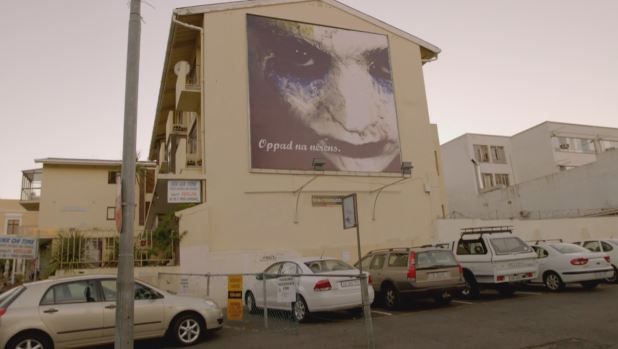
An example of one of the sinister billboards
It's a clever bit of foreshadowing that hints at the ultimate fates of the characters, but at the same time as the series drags on for four seasons without any real character development it becomes hard to see if the characters' lack of self-awareness is intentional or an oversight of bad writing.
Both in the first and last series the characters bicker with each other over stupid things. They get into a major fight in practically every series. And despite being offered the chance to leave behind all the bad things that happened to them, they repeatedly go back for more.
This isn't so much of a dealbreaker when you consider that it's likely that Cole intended for the narrative to feel like it's stuck on a loop: the show attempts to go for that Shakespearian tragedy feel of characters that are painfully unsure of themselves or even how to interact with their life-long friends. Characters who can't be grateful for what they have, and who always want the easy way out rather than facing up to fixing their lives.
However, other choices in the finale and from the halfway point of the third Season on feel very lazy and generic, almost as though the series was cut short.
There are several big plot strands in the last few episodes that are introduced and then dropped with no explanation, which I found highly irritating:
- Rick at one point finds a glass eye in a toilet seemingly at random: the object later prompts him to change his mind and risk his life when he could otherwise remain safe. No explanation is given for what the object might represent, or why he came to find it in the first place.
- The *third* CIA agent in the story seems amazingly incompetent, even given that Season 3's Lazaro was an absolute nutjob. Cole seems to have written her as an obligatory "zany" character, but she just comes across as really unprofessional and irritating. She then gets killed in a really stupid way, too, and we're expected to believe that a thirty-year veteran of the CIA would just turn up at random to a house siege and not even be prepared for a violent confrontation: ridiculous.
- Quinn's friend at the bar, the "connected" bald guy he shares many discussions with in Season 3, doesn't do anything. He does literally nothing over the course of the series except provide an ear for Quinn to talk into. I kept thinking he would turn up later and help the group out, but no.
- Mercedes, the female soldier who saves the four in Season 3, vanishes forever at the conclusion of S3 and isn't seen again. This is despite the group looking for the CIA's files on her, and finding that she mysteriously had none. It's repeatedly hinted that she is somehow a lot more important than she seems, but this never materialises.
- The fate of Woody's girlfriend and adopted kid is never answered.
Even more unforgivably, the choices the friends make at the end of the show are absolutely insane and show no forethought at all:
- Pursued by professional killers, they make no attempt to hide, contact the police or other authorities, or even just lay low at a hotel or something. Instead they drive out to a deserted beach (!)
- Quinn owns a bar and supposedly has lots of social connections, but mentions that "You can't just call people there, they don't give out numbers." If he owns the bar, why not just call the bartender and get his friends put on the line? That he doesn't even try to do this seems ludicrous.
- Woody ineffectually fires the group's only weapon (a shotgun) at a guy about 500 metres away, until he runs completely out of ammo. WTF?

Plot Summary:
Season 1: The group goes to Alvo's villa. Alvo is murdered by a group run by Dominic (a corrupt cop, English ex-pat), Maria (a CIA agent running narco-finance operations) and an old English dude named Mackenzie who is running the drug operations. The series ends with Maria dead and the very tense scene of Dominic walking up to the villa, about to kill an unsuspecting Quinn.
Season 2: The group promptly run Dominic over in a car and escape. There's a lot of well-plotted stuff with Mackenzie, who wants his cash back. The group is eventually cornered in Morocco by a militia force funded by the UK.
Season 3: The group is held in a blacksite prison, the CIA connection is explained, eventually they are sent to South Africa with new identities and they wriggle their way out of a CIA hitlist (though it's perplexing the CIA care about them so much, since they're essentially four civvies in the wrong place at the wrong time).
Season 4: This, for me, was where it started getting stupid. The group sells Alvo's villa, gets rich, decides to move back to Cape Town for no reason and promptly the whole lot of them get executed by Dominic's gang. The ending has them plunging off a metaphorical road to Hell.
I mean, just look at those summaries: we go from a plausible crime thriller in Season 1, to the Season 4 ending in which everyone dies and goes to straight to Hell, do not pass go, do not collect $200.
While the doom of the group was hinted at the whole way through, I was pretty disappointed at how it happened. It seemed completely avoidable had the group actually had half a brain, but the plot demanded they died in such a fashion and so they did.
Verdict
So, should you watch Mad Dogs? I'd say yes - just be prepared to be irritated by it towards the end.
The acting's good and Seasons 1-2 have some really good moments. Season 3 has some poignant scenes and purposeful plotlines, but for me Season 4 was when the show really seemed to lose sight of where it was going.
For the record, I don't mind ambiguous endings: and the ending of Mad Dogs is very surreal and very ambiguous. It's more the fact that you can assemble such a talented cast with such an interesting concept...and then do so very little with it and leave so much unexplained.
[*][*][*][ ][ ]
3/5
A show that's equal parts interesting and frustrating, and sadly descends into poorly written nonsense close to the end as it searches to be more profound than the sum of it's parts.
Saturday, 4 January 2014
Breaking Bad: Quick Thoughts So Far (Season 2)
So after a good friend pointed me to Breaking Bad a while ago, I have to say it's rapidly becoming my absolute favourite TV series since...well, since anything!
1. I'm a Chemist.
2. I like intelligent crime drama.
3. I like dark comedy.
4. I love media which depicts smartly written characters who have real motivations and personalities.
Breaking Bad satisfies all four in spades, with razor sharp writing and acting that I can only describe as absolutely spot-on.
I'm way behind, only now starting on watching right through after getting the box-set for Christmas. But the show is consistently fantastic so far.
I think the most fascinating aspect of the show thus far is easily the central shift of Walt's morality. Even more than his morality, actually: his humanity itself.
Walt starts Season 1 as a character who is almost unquestionably sympathetic. He's a decent man who, through a lack of assertiveness and simple bad fortune, has essentially been screwed out of everything he could have expected from life as a successful, honest scientist.
He's felt dead for a good chunk of his whole life. He has a stressful home life with a disabled son, a wife he struggles to express his emotions to...and biggest of all, a crushing sense that his brilliant understanding of Chemistry has got him nowhere but teaching to a bunch of uninterested, obnoxious teenagers. He's frequently too nice to offend others, and submits to pressure rather than pushing to put his desires and viewpoints across.
So when he's abruptly told he's dying of lung cancer (despite having never smoked, no less), it's understandable, even if certainly not condonable, that he begins to feel deeply sickened (and envious) when he sees the idiotic local drug pushers rolling around with more money than he's ever seen.
When he realises soon after he begins cooking that he must murder Krazy-8 to save his family from retribution, we see the despair and sadness wracking him terribly with guilt as tears flow down his cheeks.
Fast forward to Season 2, Episode 10, the episode I just finished. Walt's spent several episodes manipulating Jesse with Machiavellian grace, remorselessly lying to him and showing next to no compassion when Hank confiscated the funds he required to even have somewhere to live.
At the end of the episode, he has the following confrontation with a couple of up-and-coming meth peddlers he spots at the local DIY store. Going from the "silent partner" who very much prefers to force Jesse into getting his hands dirty, we see him suddenly assert himself as a street hardman directly:
It's like Walt has ceased to exist in this clip, with Heisenberg taking full control. Bryan Cranston is utterly convincing with his narrow eyes and ice-cold snarl - fabulous acting. The other guy may be bigger, but just look at that dangerous look in Walt's eyes, the thinly veiled disgust on his face, and you know immediately that he's not a guy you want to fuck with. At all.
After his "blowfish" discussion with Jesse, we see that Walt's toughness isn't bluster, either. He has nothing to fear from death, already possessing a death sentence.
Walt's disgusted look is doubly ironic considering that the big bald guy and his partner could almost be a mirror showing a more physically imposing Walt and a dirtier, more meth-y Jesse. A clever casting similarity I'm sure was deliberate.
I think the most heartbreaking thing is that as Walt becomes more adept at being Heisenberg, he starts losing everything that makes him Walt. In Season 1 he was a decent man making a lame effort at being a hardcore criminal. Now, he's sliding towards being a ruthlessly efficient hardcore criminal, but losing what makes him a likable, decent human being completely in the process.
Very interesting. And very funny. And very sad.
I love this show ;)
1. I'm a Chemist.
2. I like intelligent crime drama.
3. I like dark comedy.
4. I love media which depicts smartly written characters who have real motivations and personalities.
Breaking Bad satisfies all four in spades, with razor sharp writing and acting that I can only describe as absolutely spot-on.
I'm way behind, only now starting on watching right through after getting the box-set for Christmas. But the show is consistently fantastic so far.
I think the most fascinating aspect of the show thus far is easily the central shift of Walt's morality. Even more than his morality, actually: his humanity itself.
Walt starts Season 1 as a character who is almost unquestionably sympathetic. He's a decent man who, through a lack of assertiveness and simple bad fortune, has essentially been screwed out of everything he could have expected from life as a successful, honest scientist.
He's felt dead for a good chunk of his whole life. He has a stressful home life with a disabled son, a wife he struggles to express his emotions to...and biggest of all, a crushing sense that his brilliant understanding of Chemistry has got him nowhere but teaching to a bunch of uninterested, obnoxious teenagers. He's frequently too nice to offend others, and submits to pressure rather than pushing to put his desires and viewpoints across.
So when he's abruptly told he's dying of lung cancer (despite having never smoked, no less), it's understandable, even if certainly not condonable, that he begins to feel deeply sickened (and envious) when he sees the idiotic local drug pushers rolling around with more money than he's ever seen.
When he realises soon after he begins cooking that he must murder Krazy-8 to save his family from retribution, we see the despair and sadness wracking him terribly with guilt as tears flow down his cheeks.
Fast forward to Season 2, Episode 10, the episode I just finished. Walt's spent several episodes manipulating Jesse with Machiavellian grace, remorselessly lying to him and showing next to no compassion when Hank confiscated the funds he required to even have somewhere to live.
At the end of the episode, he has the following confrontation with a couple of up-and-coming meth peddlers he spots at the local DIY store. Going from the "silent partner" who very much prefers to force Jesse into getting his hands dirty, we see him suddenly assert himself as a street hardman directly:
"Stay OUT of my territory."
It's like Walt has ceased to exist in this clip, with Heisenberg taking full control. Bryan Cranston is utterly convincing with his narrow eyes and ice-cold snarl - fabulous acting. The other guy may be bigger, but just look at that dangerous look in Walt's eyes, the thinly veiled disgust on his face, and you know immediately that he's not a guy you want to fuck with. At all.
After his "blowfish" discussion with Jesse, we see that Walt's toughness isn't bluster, either. He has nothing to fear from death, already possessing a death sentence.
Walt's disgusted look is doubly ironic considering that the big bald guy and his partner could almost be a mirror showing a more physically imposing Walt and a dirtier, more meth-y Jesse. A clever casting similarity I'm sure was deliberate.
I think the most heartbreaking thing is that as Walt becomes more adept at being Heisenberg, he starts losing everything that makes him Walt. In Season 1 he was a decent man making a lame effort at being a hardcore criminal. Now, he's sliding towards being a ruthlessly efficient hardcore criminal, but losing what makes him a likable, decent human being completely in the process.
Very interesting. And very funny. And very sad.
I love this show ;)
Monday, 23 August 2010
Review: The Hills Have Eyes
So nothing else was on TV last night and I watched this from around halfway to the end.
Unfortunately the film had two things that always drive me crazy in horror films - psycho mutant hillbillies and utterly dumb characters.
Mutant hillbillies actually rank lower on my originality scale than zombies. At least zombies are menacing and their origins are generally not explained. Their properties and actions can be changed to suit a different type of story.
Mutant hillbillies are even more predictable - you just know that they'll live in some crappy shack, and they'll eat tourists, etc. etc.What's worse is they seem to be in about a third of all recent horror films.
Now, at about halfway in the film looked like it had some promise. Then the characters suddenly went into full-on idiot mode.
---------------------------------------------------------------------------------------------------------------
Let me pose some questions and see what you would pick in a mutant hillbilly situation, compared to the characters in this film.
Question 1: A group of mutants have kidnapped your baby and killed most of your family. You eventually find the kid, guarded by a bald, nasty looking woman in a chair. You have a baseball bat. Do you:
A: Sneak up behind the murderous kidnapper and beat her to death before sneaking out with the baby?
B: Sneak to the baby, pick her up (leaving you unable to use the bat), and then try to sneak out?
Question 2: You have a pistol with one magazine left. An unarmed crazy bloke is running towards you. Do you:
A: Take careful aim and shoot the guy dead?
B: Run away screaming while firing all of your bullets inaccurately over your shoulder?
Question 3: You are fighting a huge guy with a big axe. Eventually you stab him with the broken remains of your bat. Do you:
A: Keep hitting him with anything nearby until he's dead?
B: Stare for thirty seconds while he slowly pulls the splinters out and then starts walking towards you?
Question 4: A hillbilly comes very close to killing you in a fist fight, leaving you badly injured. You grab a shotgun when he's distracted, hit him three times in the face, and then shoot him twice in the chest. Do you:
A: Walk over to the body, pump the rest of your shells into it, and then throw it off of the nearby cliff for good measure?
B: Walk over to the body, smile, drop the loaded shotgun next to it, and then act horrified when he gets up and grabs it?
C: Wish someone in Hollywood could come up with a single original idea and stop watching shit like this?
---------------------------------------------------------------------------------------------------------------
If you answered A to the questions you're a normal, sensible human being. If you answered B you've got a guaranteed place in the movie making business, and would be agreat infuriating horror protaganist.
If you answered A to all of them and then C on Q4 as well, I am very much in agreement with you.
Final Rating:
I'm giving this film 1/5 for descending into the land of extremely lame cliche.
[*] [ ] [ ] [ ] [ ]
Unfortunately the film had two things that always drive me crazy in horror films - psycho mutant hillbillies and utterly dumb characters.
Mutant hillbillies actually rank lower on my originality scale than zombies. At least zombies are menacing and their origins are generally not explained. Their properties and actions can be changed to suit a different type of story.
Mutant hillbillies are even more predictable - you just know that they'll live in some crappy shack, and they'll eat tourists, etc. etc.What's worse is they seem to be in about a third of all recent horror films.
Now, at about halfway in the film looked like it had some promise. Then the characters suddenly went into full-on idiot mode.
---------------------------------------------------------------------------------------------------------------
Let me pose some questions and see what you would pick in a mutant hillbilly situation, compared to the characters in this film.
Question 1: A group of mutants have kidnapped your baby and killed most of your family. You eventually find the kid, guarded by a bald, nasty looking woman in a chair. You have a baseball bat. Do you:
A: Sneak up behind the murderous kidnapper and beat her to death before sneaking out with the baby?
B: Sneak to the baby, pick her up (leaving you unable to use the bat), and then try to sneak out?
Question 2: You have a pistol with one magazine left. An unarmed crazy bloke is running towards you. Do you:
A: Take careful aim and shoot the guy dead?
B: Run away screaming while firing all of your bullets inaccurately over your shoulder?
Question 3: You are fighting a huge guy with a big axe. Eventually you stab him with the broken remains of your bat. Do you:
A: Keep hitting him with anything nearby until he's dead?
B: Stare for thirty seconds while he slowly pulls the splinters out and then starts walking towards you?
Question 4: A hillbilly comes very close to killing you in a fist fight, leaving you badly injured. You grab a shotgun when he's distracted, hit him three times in the face, and then shoot him twice in the chest. Do you:
A: Walk over to the body, pump the rest of your shells into it, and then throw it off of the nearby cliff for good measure?
B: Walk over to the body, smile, drop the loaded shotgun next to it, and then act horrified when he gets up and grabs it?
C: Wish someone in Hollywood could come up with a single original idea and stop watching shit like this?
---------------------------------------------------------------------------------------------------------------
If you answered A to the questions you're a normal, sensible human being. If you answered B you've got a guaranteed place in the movie making business, and would be a
If you answered A to all of them and then C on Q4 as well, I am very much in agreement with you.
Final Rating:
I'm giving this film 1/5 for descending into the land of extremely lame cliche.
[*] [ ] [ ] [ ] [ ]
Subscribe to:
Posts (Atom)