Sometimes, when I look at modern games, I actually sort of feel like we're taking backwards steps even for all the fancy graphics and gameplay mechanisms we now have.
These feelings usually come to me after booting up an ancient copy of System Shock 2 (from 1999 - almost 12 years ago!).
No matter what "modern" game I've been playing, Shock 2 always feels like a breath of fresh air. I've finished it at least 10 times and yet every playthrough it still feels like it could have been a new release.
The graphics are a little outdated now (though they have been given a large overhaul by the game's community, which remains very much alive to this day) but the game as a whole is fantastic.
The game was pretty much the first to use "audio logs" to tell a story, a concept many games have recreated - but never with the same competency. The story itself is really great and the progression through audio is at times genuinely horrifying.
Eric Brosius. the sound engineer who worked on the game, is a very, very skilled musician. The Shock 2 soundtrack is a mix of "conventionally" creepy tunes in certain levels, but also uneasy cyberpunk techno beats in others.
If you'd asked me to feel scared by a techno track, I would have laughed before Shock 2. Then you play it, and the frenzied, frantic nature of some of the tunes mingled with the feeling that something ex-human is always lurking round the corner, poised to rip you to pieces, creates a really powerful atmosphere.
Yes, atmosphere. Something else Shock 2 nailed better than any game I've played since.
Take the "Hybrid", the first (and most common) enemy you encounter in the game. Hybrids are humans recently infected by the alien parasites who have overwhelmed the spaceship on which the game is set.
They are typically musclebound crewmembers stripped to the waist aside from a bloodstained vest or jacket. Most of their hair is missing, they have an unnatural yellow tinge to their eyes, somewhat contorted facial features and a large worm burrowed into one side of their head and looped round into their chest.
Gross and disturbing? Yes. Their dialogue is their most horrifying feature however.
You'll be wandering along a dark, corpse-strewn corridor and then suddenly a faint moaning whisper will drift to your ears.
"We are...we are, we are...we are..."
Then you notice the figure standing aimlessly inside an office, twitching slightly and clutching a lead pipe. He reaches for his head and sways.
"What happened to...me?" He turns and sees you and his voice morphs into a pained bellow as his body moves without his will.
"They seeeeeeeeeeeeee you! Run! RUUUUUUUNNN!" And you do.
"I'm...sorry..." The Hybrid moans pitifully as he chases you, pipe raised. "Kill...me!" And then you shoot him, and with a gasping cry he crumples mercifully to the ground.
What game since has managed to make me feel revulsion, horror and yet sadness for an enemy? Even Bioshock (the "spiritual successor" to the Shock franchise) and it's Splicers don't come close.
I could continue on about how the character development paths are very open ended, how the combat is simple enough to be intuitive and yet far superior to Bioshock's clunky Plasmid obsession, how the game rewards exploration and has intelligent puzzles, how the mini-games for hacking and repairing are not frustrating...I could, but that would make this post far too long.
The gameplay feels right, the story is engaging, the atmosphere is very very creepy and the whole package together is really neat.
I will close simply by saying that if you're a gamer sick and tired of shallow and cloned modern games, you truly cannot go wrong with Shock 2.
Google it, look up any compatability fixes (mail me or comment if you need some help), love it!

Showing posts with label Action. Show all posts
Showing posts with label Action. Show all posts
Saturday, 22 January 2011

Saturday, 18 December 2010
First Impressions: Just Cause 2
Just Cause 1 was a very strange game. It had great ideas, such as the whole game being based around outlandish stunts and fun rather strict realism, but I don't think it quite pulled it off.
The story was tedious to the extreme, the scenery was pretty but the combat was awful and there were many confusing controls for simple actions.
Just Cause 2 seems to be the game the original should have been.
I've played for 2 hours so far, and in that time I've accomplished the following tasks in no particular order:
- Swung from a moving helicopter one-handed.
- Commandeered said helicopter for myself.
- Destroyed an enormous base.
- Engaged in a car chase by standing on the roof of a speeding vehicle.
- Caused a chasing Jeep to roll over spectacularly before exploding.
- Hooked an unfortunate baddie by his foot to a moving car.
- Hooked a bad guy's moving bike to a tree.
- BASE jumped from a mountain.
- Had a Raiders of the Lost Ark style punch-up with the driver of a car.
- Ridden on the roof of an airliner.
Only a couple of these things have happened in scripted missions, and to be honest I've spent most of my playtime either laughing or grinning like a fool.
The story itself is still terrible, but now in a good way. I couldn't work out if the first game was trying to parody action films or was just really cheesy. The sequel is definitely the former.
During one cutscene Rico (the protagonist) is chatting to a guy he's rescuing from some soldiers. He pauses briefly mid-sentence to casually scoop up a live grenade from the floor and throw it back without even looking, and sure enough there is a scream off-screen as it blows up.
So I'm very surprised so far, and pleasantly at that. I'll come up with some kind of review once I've gained more of a lasting impression.
In other news, I'm going to try and post up some of my Blood Bowl opinions and teams, my habit for movie reviewing has taken the blog in quite a different direction!
Monday, 13 December 2010
Movie Review: Gladiator
I fancied watching an old favourite film of mine recently: Gladiator.
Having first watched it 10 years ago, I remember thinking how wonderful the battle sequences looked, and how perfect the ending to the film was.
10 years on, I have to say my feelings haven't changed. In fact, I think they've grown stronger.
The Action and Aesthetics
You know how every second film in recent years seems to have CGI for the hell of it? One of the most refreshing elements of Gladiator is that Director Ridley Scott knows when to use CGI (the awe-inspiring huge battle sequences) and when to scale back on the technology and use live action filmed with real stunt men (the up-close action sequences).
The difference is immediately noticable. Watch "300", a far inferior film in my opinion, and look at all of the battle sequences closely as they happen.
You'll notice immediately that when King Leonidas is slicing and dicing enemy troops, all the blood present is in bizarre diamond shapes, obviously computer generated, and never settles on the ground. This is combined with all the enemies on screen being CGI too (the whole enemy army was made of "man in mask" clones who don't cast shadows?!) and some really ridiculous CGI stunts (hurling a full grown man over your head with a shield bash?...Riiight-o!).
Then watch Gladiator. The actors are gritty and realistic, the fights look believable and have a concussive impact to them. The effects, particularly the blood and dust effects, were obviously performed using squibs and real machinery - and they look fantastic.
In this new(er) age of obsession with computer generated pixel men falling over with crappy over-the-top animations, it's a breath of fresh air to see real horses and men performing stunts.
The difference in budget between these two films? $30 million. Gladiator had a $100 million budget, 300 had a $70 million budget. Yet Scott extracts immense value from that pretty small gap in budget and makes a far more believable picture.
The Story
The story is at heart a revenge story. However, it touches on many themes: greed, lust for power, deception and the moral ambiguity of war. The film is also a really interesting look at Roman society.
Despite some minor factual errors that history buffs will spot immediately (such as the rather dubious fighting tactics of the Roman Legions shown), the film doesn't often compromise accuracy needlessly - aside from the clearly fictional elements of the story, that is.
One of my favourite qualities in the film is how it's themes are universal and unpolitical: good and evil, the triumph of the human spirit against all odds.
Like Touching the Void and The Shawshank Redemption, the film gives us a really splendid glance into not only the darkest pits of despair, but also the brilliant highs of being a human being. Despite a bittersweet ending that almost always gets the throat choking up, Gladiator finishes on an up note.
Acting across the board is top notch. Russell Crowe is excellent as the grizzled, valiant Maximus, Djimon Hounsou provides a calm balance in the form of his friend Juba and Oliver Reed, Joaquin Phoenix and Connie Nielson are all top notch.
Ralf Moller deserves a special mention for his performance as Hagen, a huge Germanic barbarian who looks more like a shaved bear than a man.
Final Word
Unlike Braveheart, a "similar" film (which I loathe!), Gladiator isn't interested in distorting events of history or making sweeping moral generalisations and passing it off as "real". Instead it uses a loose framework of history to weave a compelling fictional story.
And it does it successfully with every crashing sword, roaring chariot, hushed whisper and epic orchestral score.
Speaking of music, this film's soundtrack is also sublime - just listening to it is enough to provoke shivers:
http://www.youtube.com/watch?v=d8v2TUQomZU&feature=related
http://www.youtube.com/watch?v=FgCevpO18t4&feature=related
http://www.youtube.com/watch?v=ZAOTSO9ioZk
Overall, Gladiator is like a hybrid of what made old "epic" films great, combined with modern ideas and techniques, all mixed together with the heart of a good old morality play.
5/5.
[*][*][*][*][*]
Wednesday, 10 November 2010
Movie Review: Harry Brown
*May contain spoilers*
Harry Brown is a weird film. That's about the best way to describe it.
It starts out like a hard-hitting realistic drama, and then morphs about halfway through into a vengeance-fuelled killing spree that seems lifted from the pages of a comic book.
Similarly, the film flits between chillingly accurate portrayals of British 'hoods', and an apparent alternate universe Britain where total anarchy reigns.
Whether the film is in one mood or not, at any given point it is very, very dark indeed. It has an almost unique quality to be bleak from beginning to end.
Harry Brown is a reaction to increasing street crime and yob culture in Britain, but it does not offer any solutions. Perhaps that is what the film intends - there are no easy solutions. Even the main protaganist seems to become slowly consumed by the hellish things that happen in his home area throughout the film.
First of all, the film gets off to an intimidating start. Opening scenes of the film are very powerful, and had me hooked to the screen immediately. Filmed on a mobile phone, they depict a gang of hooded youths initiating a new member to their gang. They shove drugs in his mouth and force him to smoke them for an extended time, and then with the spine-chilling words "This is how we roll", someone hands him a loaded pistol.
The next scene shows the same group roaring around on mopeds from a passenger perspective. They harass pedestrians and eventually begin firing their weapons, ending with the 'accidental' murder of a woman walking her young son in the park.
As they flee the scene, they crash violently into a truck at a junction. Fade to black.
Wow. The filmography during these first scenes is gritty, frenzied and pretty disturbing in itself, which is quite an accomplishment as usually I moan about such camerawork making me nauseous.
From there on we meet Harry Brown (who is in bed listening to news of the killing on the radio. Pretty neat linking trick there). Played by Michael Caine (an actor who varies very much in his work, but he's definitely solid here), Brown is an ageing ex-Marine previously posted in Northern Ireland during the height of the Troubles.
Caine conveys the loneliness of Brown's life wonderfully. Brown goes through a morning routine of sitting at his kitchen table, silently drinking tea, eating his breakfast, and then visiting his comatose elderly wife at the hospital.
In the evenings, he plays chess with a friend named Leonard (David Bradley, who you will immediately recognise as Filch from the Harry Potter films), the only person who seems to be there for him.
In between these activites, the estate he lives on is constantly plagued by violent, replusive young criminals who care nothing about the police or the law. Leonard in particular is constantly victimised.
It doesn't take long for things to quickly spiral downwards, and at around halfway into the film a broken Brown tools himself up and warms up the old military training.
Sean Harris puts in a notable performance as a drug-addled pimp-slash-gun dealer. His husky, hoarse voice and absolute lack of morals make him one of the most menacing and watchable characters to appear (however briefly) in the film.
The "twist" at the end of the film was not to my liking (it felt a little like it was added on for the sake of it) and the film steadily gets more ludicrous as it progresses.
My biggest issue, strangely enough, is with Harry's very first killing. The police don't realise he's the vigilante until right at the end, but I saw a glaring error immediately. Harry gets ambushed by a knife-wielding mugger, and when the guy goes to stab him, he instinctively turns the knife back on him without thinking, stabbing him in the heart.
The guy dies and Harry shuffles off home, destroying his clothes and wiping up the blood in a shock.
However, surely his prints would be all over the knife? Game over. Except not in movies :\
Final Word:
The villains (aside from Harris anyway) are sadly one dimensional. They spout the foulest language imaginable and do some very repulsive things.
The scenes in which the villains work best is in those in which Harry simply observes them from a distance harrassing and terrorising others- behaviour which is carried off with horrifying authenticity.
Intense verbal abuse of a female police officer was perhaps the most disturbing thing in the film, coupled with sexual abuse of a gang member by a drug dealer. Both were pretty shocking, though the second scene felt more exploitative, as if it had been included purely to shock.
The movie is also pretty violent, and there are several rather nasty uses of gore throughout. Overall I'd say the swearing is definitely the worst thing though. Expect to hear the "mother of all swears" multiple times.
My 'favourite' scene was probably when Harry confides in a dying criminal one of his most upsetting memories of the Troubles, that he never told to anyone else before, not even Leonard or his wife. A member of his unit was shot in a similar way to the criminal, and Harry recalls that they couldn't call in a medic to help him, and instead watched him die.
After Harry has finished speaking, there's a very short but poignant moment before Harry finishes him off where the weakened scumbag seems almost to finally realise what a wretched human being he's been...but far, far too late.
Similarly, that little window gives a perfect insight into just how much Harry has become like those he crusades against with his use of extreme violence - and there definitely lies the most interesting part of the film.
3/5
[*][*][*][ ][ ]
Sunday, 26 September 2010
Movie Review: Collateral
*This review contains some minor spoilers*
There are two ingredients I've noticed are almost always present in good Thriller films, and I think they're the fundamental difference between a Thriller and an Action film - theme and tension.
Action films are a genre that I personally find tedious and stale the great majority of the time. Musclebound stars making tiresome quips as they mow down Faceless Baddie #79451 get me frowning. Even more so when the plot can usually be summed up in three words. Man gets revenge. Man kills things. Manmade gratuitous explosions.
That's all old tat. So back to Thrillers and themes.
To use an example: No Country For Old Men, a thriller that holds a fond place in my heart, has themes which encompass greed, guilt, the breakdown of social morals and fate. These themes combine with a terrifying use of tension to create an edge-of-seat experience. Guns don't fire every five seconds, but when they do it almost always means a character we care about is in dire peril.
Collateral is a similar film, in that although it does have action-filled scenes, it also cranks up the tension, and focuses on characterisation far more than gunfire and explosions.

Set in L.A., the plot primarily features cab driver Max (Jamie Foxx), who has been planning for a long time to start his own Limousine business, but somehow has never got around to it. Early in the film he meets a high-profile lawyer named Annie (Jada Pinkett Smith) when she rides in the back of his cab.
It's clear the two like each other, but unlike many films, where vulgar lines start getting hurled around immediately, the scene comes across as pretty natural and realistic. The two simply chat and get on well. Max starts to become a character we can empathise with, due to both a good script and an admirable performance from Foxx.
Annie leaves him with her card and departs. The next fare Max has is a strange man named Vincent (Tom Cruise), who dresses in a sharp suit, but sports a messy stubbled look. He is friendly, but also cynical of human nature.
He tells a story of a man dying on the LA metro, and his corpse only being noticed six hours later despite passengers sitting next to him in all that time. This theme of social apathy and urban dehumanisation continues throughout the film, even influencing the plot at several key points.
It soon turns out that Vincent is a hired killer, and a good one at that. I'm not usually a huge fan of Tom Cruise, but here he plays Vincent perfectly. He is both disturbingly cold and yet endearingly animated at the same time, striking a mix between likable intelligence and frightening ruthlessness.
Vincent offers Max $600 to drive him to several different spots around the city. Max drops him off at an apartment first, and then is horrified when a body suddenly lands on top of the taxi from a window above.
Vincent is quite calm, and forces Max at gunpoint to clean the taxi and stow the corpse in the boot of the car.
From there on the film proceeds at a menacing but measured pace, with Max strongarmed into taking Vincent to the rest of his victims. Following the trail of bodies is LAPD officer Fanning (Mark Ruffalo), who believes members of the FBI are wrong to suspect Max as the murderer.
Between killings Vincent and Max talk to each other in the car, and gradually more is revealed about both. Unexpected and very tense scenes occur. One has the police pulling over the taxi for its broken windscreen.
Another has the duo meeting a jazz club owner (Barry Shabaka Henley) and having an intriguing (and very sad) conversation.
In a particularly good scene, Max is required to pose as Vincent to Vincent's criminal client Felix (Javier Bardem). He explains they've never met him in person before, and so Max can take his place if he can improvise well enough. If not, they'll probably kill him. Either way Vincent is able to sit safely outside in the car.
Javier Bardem is a very skilled actor. In No Country For Old Men, he put in an iconic performance as the unstoppable psychotic Anton Chigurh.
Here, in his portrayal of the laid back but intimidating Felix, he switches instantly from friendly chit-chat to weighting every word with solid malice.

There are two ingredients I've noticed are almost always present in good Thriller films, and I think they're the fundamental difference between a Thriller and an Action film - theme and tension.
Action films are a genre that I personally find tedious and stale the great majority of the time. Musclebound stars making tiresome quips as they mow down Faceless Baddie #79451 get me frowning. Even more so when the plot can usually be summed up in three words. Man gets revenge. Man kills things. Manmade gratuitous explosions.
That's all old tat. So back to Thrillers and themes.
To use an example: No Country For Old Men, a thriller that holds a fond place in my heart, has themes which encompass greed, guilt, the breakdown of social morals and fate. These themes combine with a terrifying use of tension to create an edge-of-seat experience. Guns don't fire every five seconds, but when they do it almost always means a character we care about is in dire peril.
Collateral is a similar film, in that although it does have action-filled scenes, it also cranks up the tension, and focuses on characterisation far more than gunfire and explosions.
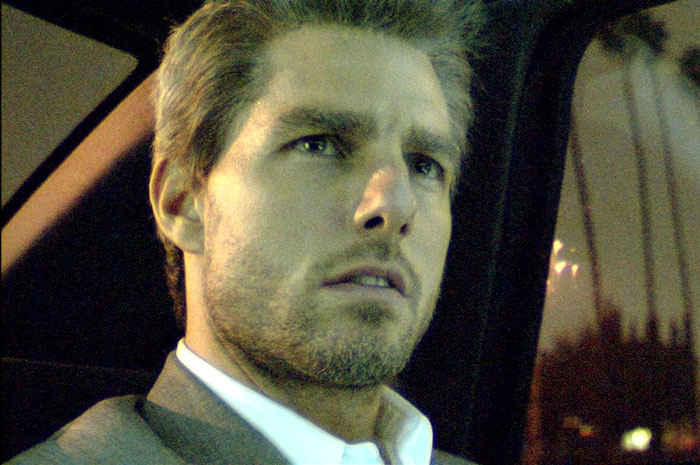
Don't make him angry
Set in L.A., the plot primarily features cab driver Max (Jamie Foxx), who has been planning for a long time to start his own Limousine business, but somehow has never got around to it. Early in the film he meets a high-profile lawyer named Annie (Jada Pinkett Smith) when she rides in the back of his cab.
It's clear the two like each other, but unlike many films, where vulgar lines start getting hurled around immediately, the scene comes across as pretty natural and realistic. The two simply chat and get on well. Max starts to become a character we can empathise with, due to both a good script and an admirable performance from Foxx.
Annie leaves him with her card and departs. The next fare Max has is a strange man named Vincent (Tom Cruise), who dresses in a sharp suit, but sports a messy stubbled look. He is friendly, but also cynical of human nature.
He tells a story of a man dying on the LA metro, and his corpse only being noticed six hours later despite passengers sitting next to him in all that time. This theme of social apathy and urban dehumanisation continues throughout the film, even influencing the plot at several key points.
It soon turns out that Vincent is a hired killer, and a good one at that. I'm not usually a huge fan of Tom Cruise, but here he plays Vincent perfectly. He is both disturbingly cold and yet endearingly animated at the same time, striking a mix between likable intelligence and frightening ruthlessness.
Vincent offers Max $600 to drive him to several different spots around the city. Max drops him off at an apartment first, and then is horrified when a body suddenly lands on top of the taxi from a window above.
Vincent is quite calm, and forces Max at gunpoint to clean the taxi and stow the corpse in the boot of the car.
From there on the film proceeds at a menacing but measured pace, with Max strongarmed into taking Vincent to the rest of his victims. Following the trail of bodies is LAPD officer Fanning (Mark Ruffalo), who believes members of the FBI are wrong to suspect Max as the murderer.
Between killings Vincent and Max talk to each other in the car, and gradually more is revealed about both. Unexpected and very tense scenes occur. One has the police pulling over the taxi for its broken windscreen.
Another has the duo meeting a jazz club owner (Barry Shabaka Henley) and having an intriguing (and very sad) conversation.
In a particularly good scene, Max is required to pose as Vincent to Vincent's criminal client Felix (Javier Bardem). He explains they've never met him in person before, and so Max can take his place if he can improvise well enough. If not, they'll probably kill him. Either way Vincent is able to sit safely outside in the car.
Javier Bardem is a very skilled actor. In No Country For Old Men, he put in an iconic performance as the unstoppable psychotic Anton Chigurh.
Here, in his portrayal of the laid back but intimidating Felix, he switches instantly from friendly chit-chat to weighting every word with solid malice.

"If Santa Claus were to make a list...and [his assistant] were to lose it...how f***ing furious do you think Santa Claus would be?"
From there on the film ploughs ahead, with several surprising twists. The film manages to remain firmly in the realm of plausibility. There is a car crash not followed by an explosion, something which stunned me.
In fact, I don't think the film contains any explosions, and it's a very refreshing change indeed.
Vincent is one of the most interesting movie 'villains' I have seen in a recent film. His rationalisation of his job ("Millions of galaxies of hundreds of millions of stars, in a speck on one in a blink. That's us, lost in space.") raises some very interesting questions on morality. Does morality even exist in a purely atheist, scientific outlook on life, or is Vincent simply a sociopath? Why does it matter, ultimately?
The ending is a final release of the tension throughout the movie, and neatly sums up the themes in the film as things seem to go full-circle.
Final Word:
I went into Collateral expecting your typical crappy explosion fest, but left with a satisfied smile on my face. The film balances action with a fresh cast of characters and a plot that really does introduce some interesting questions. Performances all around are solid.
I'm going to give the film 5 stars, not because it is perfect (no film is), but because it is a very entertaining piece of cinema.
One thing I noticed throughout the film was the pleasing lack of swearing. F-bombs are dropped, but they are not generally used in casual conversation, and not to anywhere near the level I've seen in other films recently. It's amazing how much more impact they have when they're not coming out of someone's mouth every two seconds. Definitely a plus.
One thing I noticed throughout the film was the pleasing lack of swearing. F-bombs are dropped, but they are not generally used in casual conversation, and not to anywhere near the level I've seen in other films recently. It's amazing how much more impact they have when they're not coming out of someone's mouth every two seconds. Definitely a plus.
[*] [*] [*] [*] [*]
5/5
Subscribe to:
Posts (Atom)