*CONTAINS SPOILERS*
I caught Saving Private Ryan in a DVD sale recently and decided to watch it again for the first time in ages.
First thing that struck me is how powerful the film remains all these years later. There are scenes all the way through that will shock, sadden and occasionally also intrigue and uplift.
Most of all, though, it is great in the same way that Touching the Void is - it shows us the incredible hardships human beings will endure for a cause, whether that be survival or something else entirely.
The opening scene shows an aged man approaching a white cross (from the familiar harrowing seas of white crosses used as war graves). He becomes emotional as he looks down at it, and the camera zooms to his eyes to take us back in time.
Next, the Omaha Beach scene occupies the first 30 minutes of the film. It gives us a mere hellish taste of how horrific such a scenario would have been. Men are cut down again and again, mortars severing limbs of those trying to hide from the bullets. There is a non-stop chorus of screaming and shooting.
Tom Hanks plays the captain of a squad of Rangers landing there, and he is "lucky" enough to survive the initial landing. We see the rest of the destruction from his viewpoint more or less, but the filming style is chaotic and disjointed.
Several scenes really stick with you, as I still remember them from the first time I saw the film years ago. In one, a soldier missing an arm staggers around the beach in shock, paying no attention to the bullets all around him. Eventually, he picks up his severed limb and wanders slowly off-screen with it, apparently unsure what he was going to do with it.
Hanks himself said that even though he knew that everything he saw on the set was comprised of special effects, even he found himself shocked when actors nearby were suddenly collapsing all around.
The film is commendable for it's portrayal of both sides. While seen from an Allied perspective, both sides are seen to be capable of equal cruelty and mercy. Allied soldiers execute surrendering German soldiers at several points throughout the film (and in fact, one of the film's largest moral dilemnas hinges on this). Germans kill the wounded without hesitation. It's a huge moral grey-area, frequently crossing into ugly and very murky territory.
I think a very interesting statement is made by Wade, Hanks' squad medic, played by Giovanni Ribisi. He announces he has "stopped the bleeding" on a casualty, only for the wounded man to be killed by more bullets seconds afterwards. "Just give us a fucking chance!" he screams. It's peculiar but understandable that "fairness" be expected in warfare, but it's interesting to wonder at just where the line should be drawn, or if there is a line at all.
After the beach is taken, we see the squad progress on a new mission to bring home the titular "Private Ryan", whose 3 brothers have all died in service, in order to save his mother an absolutely horrendous blow and the US Government a public embarrassment.
Barry Pepper, one of my favourite actors for this role in particular, plays Jackson, a very religious sniper in Hanks' squad. Jackson is quite poetic in voicing his opinions and has a tendency to kiss his cross and begin religious prayers whenever looking through the scope of his gun.
That a character takes comfort from God when seemingly violating the Commandments is the obvious point of interest for the role. However, it's also compared in the film to the "God is on our side" propaganda of the time, and how appropriate or inappropriate that was to the war situation.
Medic Wade was perhaps my favourite character of the film however. The film makes time for even the more "minor" characters, which contributes to the idea that all these men are equally valuable both to the plot and to us as an audience.
He has a quiet reflection upon his past in one of the film's quieter moments, describing how his mother would always work late, and he would try to stay up as a child to talk to her, but often fall asleep. Then he mentions that sometimes she would get home early, stand in the doorway, but he would pretend to be asleep.
There is a long pause, and then he says "I don't know why I did that."
I think there's something we can all identify with in that line - something we did or even still do to deny ourselves what we actually want in order to prove some kind of "point" perhaps. When it comes to what's important, we suddenly realise how foolish and petty that was. Wade realises that he was denying himself something very important at that moment, just with that simple line of dialogue, and indeed that he might never see his mother again.
Later in the film, Wade is fatally wounded off-screen. His death is perhaps the most high-impact of any in the film. As a medic, he tries to assess his own injuries while the others attempt to stop him bleeding, eventually crying out with horrendous despair "Oh God, it's my liver!"
He asks for more morphine to "fix himself", and the squad realise that he simply wants to dull his pain and die. As he fades away, he cries out for his mother, tragically highlighting his past musings.
This desire for the presence of a mother figure apparently occurred a lot when men really died during the war (in fact, a man is seen shouting the same thing on Omaha beach earlier in the film). The film reflects that in much of the character's speech.
As an example, I think another one of the most touching bits of dialogue comes from the rebellious Private Reiben (Edward Burns), who describes a mischievious and rude encounter with an older lady. He mentions how he was helping her try on a dress he knew was too small for her, and laughs when recalling her breasts.
His story builds up to be more and more crude, with his colleagues laughing at the situation, until he retells what she said to him upon noticing his wandering eyes:
""Now when you're over there, if you see anything that upsets you, if you're ever scared, I want you to close your eyes and think of these. You understand?" So I said, "Yes, ma'am.""
Instantly the mood changes - the laughter and grins drop immediately and the soldiers suddenly become self-conscious and silent. Spielberg masterfully turns something apparently shallow and without meaning into something that really hits at human vulnerability in an oddly poignant manner.
The film presents many other fascinating characters, and I have merely scratched the surface with my observations here, but it's a thoroughly rewarding and expansive film that will make you think that maybe you now understand just a tiny, tiny bit better the terrible struggle soldiers went (and still do go) through.
5/5
[*][*][*][*][*]

Showing posts with label War Film. Show all posts
Showing posts with label War Film. Show all posts
Sunday, 4 September 2011

Saturday, 30 October 2010
Movie Review and Analysis: Full Metal Jacket
Yes, not the Bourne Identity still. I know. I'll watch it soon!
*This review contains spoilers*
Full Metal Jacket is a film that, despite famous lines of dialogue and the impressive performance of R. Lee Ermey, I only recently got around to seeing.
Let me say this now - I thought The Shining, also directed by Kubrick, was a good horror film. It is.
Even so Full Metal Jacket is an even more effective horror film despite being a different genre altogether. It has to be one of the most openly anti-war films I have seen.
The first half or so of the film centres on some green US Marine Corp recruits being trained up for deployment in the ongoing Vietnam War.
R. Lee Ermey plays Sergeant Hartman, a tough, intimidating and yet generally fair Drill Sergeant. Kubrick apparently allowed Ermey to improvise his lines, something which he almost never allowed his actors to do. It was a wise move - the ad-lib nature of the lines (many of which are profanity filled and repulsive) allows Ermey's performance to shine given his real background as a drill instructor. The actors actually look scared and uncertain the minute he opens his mouth.

There are many moments of dark humour in the first half of the film, most often through Ermey's creative put-downs of his recruits. These are interspersed with some profoundly disturbing scenes, most of which centre around Leonard Lawrence (Vincent D'Onofrio), or as Hartman calls him, "Gomer Pyle".
Lawrence is an unfit and mentally slow recruit who has an almost childlike innocent demeanour. Hartman's relentless abuse of him during numerous failed training drills, and the other recruits' bitter (and even violent) resentment towards his ineptitude is shocking but captivating.
Other main characters include Joker (Matthew Modine) and Cowboy (Arliss Howard), who form a friendship while at the barracks.

Joker attempts to help Lawrence with aspects of the training that he struggles with (even helping him dress smartly), but slowly becomes exasperated. After one particularly bad foul-up in which Lawrence gets the entire group punished, he is gagged and then beaten with bars of soap in the middle of the night by his fellow recruits.
Joker eventually caves into the frustration along with the others, and joins in the beating of the helpless Lawrence. One of the most haunting shots of the film shows Cowboy, the only recruit not to join in, lying in his bunk and covering his ears to drown out Lawrence's cries.
Ironically this harsh kind of treatment transforms Lawrence into a model soldier, and he becomes one of the best in the unit at the various discipline drills. Then Joker notices that he is holding conversations with his rifle in private.
From there things get worse and worse, eventaully building to a tense crescendo. In the dead of night, the unhinged Lawrence loads his rifle with live ammunition. Joker walks into a shower room to find him screaming drill commands and shouldering the gun. Horrified, Joker is powerless to calm him down.
Hartman wakes up and attempts to defuse the situation, but his ultimate lack of emotional understanding proves fatal. Lawrence shoots him dead when he begins to shout orders at him. Grinning uncontrollably, he considers killing Joker too, but eventually sits down on a toilet seat.
Before the stunned Joker can do anything Lawrence lifts the rifle and promptly commits suicide - an act which brings the first half of the film to a chilling conclusion.

How close is a "model marine" to a psychopath in a system which encourages loss of emotion and dehumanisation? The film makes a powerful and uncomfortable argument that the line is very blurred indeed.
Is the system of mentally breaking recruits to form new soldiers as inhumane and cruel as war itself? Or even worse?
The second half of the film covers the actual war, in which Joker is assigned a journalistic role. He frequently writes semi-propaganda stories for army media to appease his superiors.
A lot of reviews I've read rate FMJ highly, but state that the film loses cohesion after the first half. Here I agree, but I don't think it's to the detriment of the film.
The rest of the movie has a kind of organised chaos about it. We move rapidly from location to location with Joker, again culminating at the end of the film in a prolonged tension-laden scene. We see fleeting pieces of the war with Joker's eyes and start to build up our opinions as he does.
This half of the film is of course home the infamous comic relief scene with "Da Nang Hooker", which popularised the whole "me so horny" thing that you still hear occasionally today.
The film throws us another interesting scene here. On the way to his next assignment (which coincidentally causes him to run into Cowboy's squad) he flies in a helicopter.
The door gunner, firing the machinegun at enemy troops, repeats almost constantly under his breath:
"Get some. Get some. Get some, get some. Get some. Get some."
Apparently unaware he is even muttering it, the camera pans round to reveal that he is actually gunning down civilians below indiscrimately. Joker notices this, and asks the soldier incredulously how he can shoot women and children.
The gunner boasts of his kill count (157 people and around 50 water buffalo, apparently equivalent in his view) and explains that shooting women and children is easy. "You just don't lead 'em so much."
This scene is never laid to rest, which is partly what makes it so uncomfortable. Joker doesn't respond, we never see any kind of conclusion to such a dark moment, the film simply moves on.
It's hard to sum all of the characters up, but easily one of the most prominent from here on is "Animal Mother" (Adam Baldwin), a heavy-machinegun toting soldier in Cowboy's squad. He is renowned for being brave and aggressive while under fire, and we see numerous times that he is.
However, he is simultaneously cold and emotionally hollow, his feelings apparently burnt away by the fighting. When Joker questions his motives for what he does, he explains that all that matters is "winning". Being right doesn't matter, and it was never about that. His whole motivation comes from surviving the next battle, and the prostitutes they all frequent afterwards.

From then on Joker finds himself in the thick of combat (and is widely criticised by his peers for having never killed anyone before). This all changes in the final act of the film.
Cowboy is forced to lead the squad after the previous leader is killed by a booby trap. Eventually the squad advances through an urban area, where a deadly sniper picks off several more squad members. Animal Mother suppresses the sniper and leads the squad forward.
Cowboy himself is sniped and wounded while answering the radio. His last words echo weakly from training: "I can hack it." The others can do nothing to help him but whisper words of encouragement, and he bleeds to death.
Finally they settle on killing the sniper as payback. They sneak into the building and Joker is the first to encounter him - or more precisely her. The sniper is a young girl dressed in a dusty uniform. Joker's gun jams as he goes to fire on her, and he cowers behind a pillar as she shoots at him.
Eventually she is gunned down by Joker's friend, who tastelessly whoops with joy as she lays dying on the ground. The Marines gather around her and she starts whispering something.
Eventually Joker's friend stops cheering, everything becomes silent and someone asks what she's saying.
"She's praying." Joker says. Animal Mother reasons to leave her "for the rats", but Joker insists that they must put her out of her misery.
She begins quietly begging them to kill her, and AM tells Joker that he'll let her die quickly - but only if Joker himself does the deed, and so gets his first kill.
Joker hesistates for a long time, grimacing and staring at the floor, but eventually he pulls the trigger. No-one speaks for a while, and then everyone but Joker begins whooping and cheering again, who just stares down at the corpse pale-faced and vacant eyed.
The closing scene of the film shows the soldiers marching across the landscape and singing, and Joker narrates that he "is in a world of shit, yes. But I am alive. And I am not afraid."
This very ambiguous statement is all we get in way of closure, and it works perfectly. Has Joker found some kind of meaning in the horrors he has witnessed? Is that what his last quote refers to? Or has he finally lost his grip on humanity, like so many other characters in the film?
The "world of shit" quote is particularly interesting. Early in the film, Hartman informs the Marines that "No Marine dies without permission", because doing so lands them in "a world of shit".
One of the last things that the mentally broken Lawrence says to Joker in his final scene, is that he is "in a world....of shit."
Does Joker's use of the term imply that he has also lost that "spark" that makes us people? Or has he become stronger, having overcome that initial shock, and understood what Lawrence meant in his final moments?
Final Word:
So this has been a long review/analysis, and I could rattle on more (I won't fortunately ;) ) but FMJ is a film that really gets you thinking. Every few moments something comes along that really feels masterfully planned and executed, and the whole film drips with themes.
The ending, and scenes such as the soap beating generate a kind of emotional reaction that movies so regularly fail to nail. That alone makes FMJ more disturbing than any horror film and many times more poignant than lots of other films in the same genre.
If you want to see an occasionally amusing, frequently chilling film which has a hefty layer of meaning on top, I highly recommend this film. Just make sure you're suitably hardened for the harsher bits before you turn it on.
5/5
[*][*][*][*][*]
*This review contains spoilers*
Full Metal Jacket is a film that, despite famous lines of dialogue and the impressive performance of R. Lee Ermey, I only recently got around to seeing.
Let me say this now - I thought The Shining, also directed by Kubrick, was a good horror film. It is.
Even so Full Metal Jacket is an even more effective horror film despite being a different genre altogether. It has to be one of the most openly anti-war films I have seen.
The first half or so of the film centres on some green US Marine Corp recruits being trained up for deployment in the ongoing Vietnam War.
R. Lee Ermey plays Sergeant Hartman, a tough, intimidating and yet generally fair Drill Sergeant. Kubrick apparently allowed Ermey to improvise his lines, something which he almost never allowed his actors to do. It was a wise move - the ad-lib nature of the lines (many of which are profanity filled and repulsive) allows Ermey's performance to shine given his real background as a drill instructor. The actors actually look scared and uncertain the minute he opens his mouth.
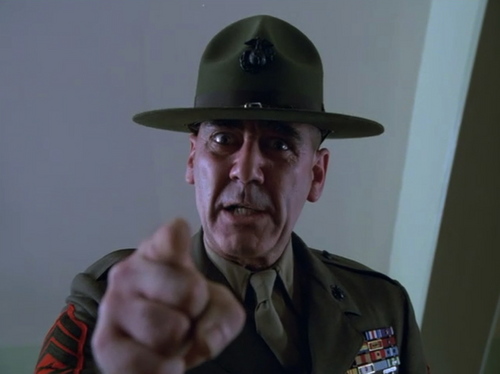
That's SERGEANT R. Lee Ermey, you scum-sucking waste of space!
There are many moments of dark humour in the first half of the film, most often through Ermey's creative put-downs of his recruits. These are interspersed with some profoundly disturbing scenes, most of which centre around Leonard Lawrence (Vincent D'Onofrio), or as Hartman calls him, "Gomer Pyle".
Lawrence is an unfit and mentally slow recruit who has an almost childlike innocent demeanour. Hartman's relentless abuse of him during numerous failed training drills, and the other recruits' bitter (and even violent) resentment towards his ineptitude is shocking but captivating.
Other main characters include Joker (Matthew Modine) and Cowboy (Arliss Howard), who form a friendship while at the barracks.

Joker
Joker attempts to help Lawrence with aspects of the training that he struggles with (even helping him dress smartly), but slowly becomes exasperated. After one particularly bad foul-up in which Lawrence gets the entire group punished, he is gagged and then beaten with bars of soap in the middle of the night by his fellow recruits.
Joker eventually caves into the frustration along with the others, and joins in the beating of the helpless Lawrence. One of the most haunting shots of the film shows Cowboy, the only recruit not to join in, lying in his bunk and covering his ears to drown out Lawrence's cries.
Ironically this harsh kind of treatment transforms Lawrence into a model soldier, and he becomes one of the best in the unit at the various discipline drills. Then Joker notices that he is holding conversations with his rifle in private.
From there things get worse and worse, eventaully building to a tense crescendo. In the dead of night, the unhinged Lawrence loads his rifle with live ammunition. Joker walks into a shower room to find him screaming drill commands and shouldering the gun. Horrified, Joker is powerless to calm him down.
Hartman wakes up and attempts to defuse the situation, but his ultimate lack of emotional understanding proves fatal. Lawrence shoots him dead when he begins to shout orders at him. Grinning uncontrollably, he considers killing Joker too, but eventually sits down on a toilet seat.
Before the stunned Joker can do anything Lawrence lifts the rifle and promptly commits suicide - an act which brings the first half of the film to a chilling conclusion.

Lawrence, mid break-down
How close is a "model marine" to a psychopath in a system which encourages loss of emotion and dehumanisation? The film makes a powerful and uncomfortable argument that the line is very blurred indeed.
Is the system of mentally breaking recruits to form new soldiers as inhumane and cruel as war itself? Or even worse?
The second half of the film covers the actual war, in which Joker is assigned a journalistic role. He frequently writes semi-propaganda stories for army media to appease his superiors.
A lot of reviews I've read rate FMJ highly, but state that the film loses cohesion after the first half. Here I agree, but I don't think it's to the detriment of the film.
The rest of the movie has a kind of organised chaos about it. We move rapidly from location to location with Joker, again culminating at the end of the film in a prolonged tension-laden scene. We see fleeting pieces of the war with Joker's eyes and start to build up our opinions as he does.
This half of the film is of course home the infamous comic relief scene with "Da Nang Hooker", which popularised the whole "me so horny" thing that you still hear occasionally today.
The film throws us another interesting scene here. On the way to his next assignment (which coincidentally causes him to run into Cowboy's squad) he flies in a helicopter.
The door gunner, firing the machinegun at enemy troops, repeats almost constantly under his breath:
"Get some. Get some. Get some, get some. Get some. Get some."
Apparently unaware he is even muttering it, the camera pans round to reveal that he is actually gunning down civilians below indiscrimately. Joker notices this, and asks the soldier incredulously how he can shoot women and children.
The gunner boasts of his kill count (157 people and around 50 water buffalo, apparently equivalent in his view) and explains that shooting women and children is easy. "You just don't lead 'em so much."
This scene is never laid to rest, which is partly what makes it so uncomfortable. Joker doesn't respond, we never see any kind of conclusion to such a dark moment, the film simply moves on.
It's hard to sum all of the characters up, but easily one of the most prominent from here on is "Animal Mother" (Adam Baldwin), a heavy-machinegun toting soldier in Cowboy's squad. He is renowned for being brave and aggressive while under fire, and we see numerous times that he is.
However, he is simultaneously cold and emotionally hollow, his feelings apparently burnt away by the fighting. When Joker questions his motives for what he does, he explains that all that matters is "winning". Being right doesn't matter, and it was never about that. His whole motivation comes from surviving the next battle, and the prostitutes they all frequent afterwards.

Animal Mother in a tough situation
From then on Joker finds himself in the thick of combat (and is widely criticised by his peers for having never killed anyone before). This all changes in the final act of the film.
Cowboy is forced to lead the squad after the previous leader is killed by a booby trap. Eventually the squad advances through an urban area, where a deadly sniper picks off several more squad members. Animal Mother suppresses the sniper and leads the squad forward.
Cowboy himself is sniped and wounded while answering the radio. His last words echo weakly from training: "I can hack it." The others can do nothing to help him but whisper words of encouragement, and he bleeds to death.
Finally they settle on killing the sniper as payback. They sneak into the building and Joker is the first to encounter him - or more precisely her. The sniper is a young girl dressed in a dusty uniform. Joker's gun jams as he goes to fire on her, and he cowers behind a pillar as she shoots at him.
Eventually she is gunned down by Joker's friend, who tastelessly whoops with joy as she lays dying on the ground. The Marines gather around her and she starts whispering something.
Eventually Joker's friend stops cheering, everything becomes silent and someone asks what she's saying.
"She's praying." Joker says. Animal Mother reasons to leave her "for the rats", but Joker insists that they must put her out of her misery.
She begins quietly begging them to kill her, and AM tells Joker that he'll let her die quickly - but only if Joker himself does the deed, and so gets his first kill.
Joker hesistates for a long time, grimacing and staring at the floor, but eventually he pulls the trigger. No-one speaks for a while, and then everyone but Joker begins whooping and cheering again, who just stares down at the corpse pale-faced and vacant eyed.
The closing scene of the film shows the soldiers marching across the landscape and singing, and Joker narrates that he "is in a world of shit, yes. But I am alive. And I am not afraid."
This very ambiguous statement is all we get in way of closure, and it works perfectly. Has Joker found some kind of meaning in the horrors he has witnessed? Is that what his last quote refers to? Or has he finally lost his grip on humanity, like so many other characters in the film?
The "world of shit" quote is particularly interesting. Early in the film, Hartman informs the Marines that "No Marine dies without permission", because doing so lands them in "a world of shit".
One of the last things that the mentally broken Lawrence says to Joker in his final scene, is that he is "in a world....of shit."
Does Joker's use of the term imply that he has also lost that "spark" that makes us people? Or has he become stronger, having overcome that initial shock, and understood what Lawrence meant in his final moments?
Final Word:
So this has been a long review/analysis, and I could rattle on more (I won't fortunately ;) ) but FMJ is a film that really gets you thinking. Every few moments something comes along that really feels masterfully planned and executed, and the whole film drips with themes.
The ending, and scenes such as the soap beating generate a kind of emotional reaction that movies so regularly fail to nail. That alone makes FMJ more disturbing than any horror film and many times more poignant than lots of other films in the same genre.
If you want to see an occasionally amusing, frequently chilling film which has a hefty layer of meaning on top, I highly recommend this film. Just make sure you're suitably hardened for the harsher bits before you turn it on.
5/5
[*][*][*][*][*]
Subscribe to:
Posts (Atom)