So I watched Scorsese's Taxi Driver last night and I think it is now on my list of favourite films.
There are two reasons I like it so much:
1. Travis Bickle is likely to be the most complicated protagonist I've seen in a film.
2. The cinematography actually contributes a lot of foreshadowing and metaphors to the plot of the film.
I think I've seen the film around 3-4 times now and yet I still notice new things each time. It also doesn't seem to be in any kind of genre - it's simply the inner dialogue of a lonely (and eventually disturbed) man who is actually presented in a way much easier to empathise with than any of the "normal" characters until his complete mental "snap".
Bickle is a 26 year old Vietnam Veteran. Next to nothing is mentioned of his career as a soldier (merely the fact that he was one) but throughout the film it is gradually revealed that the experience quite possibly had a profoundly damaging effect on his mind.
Not only this, but he admits himself that he feels immensely isolated from society. He mentions that he has felt alone his whole life (whether his "whole life" includes before his war experiences or not is ambiguous) and frequently refers to normal society as "them", the people who apparently don't care about him or have any interest in his existence.
One of the strangest aspects of Travis' character is that he is more moral at core (and also seemingly more intelligent) than many of the people he socialises with and observes, despite the fact that he also engages in sleazy practices that would befit someone of lesser morals.
By night he spends all his time driving people around in the roughest city districts (and he rapidly develops a disgust, even a hatred, for his fares) and yet by day he sits in run-down theatres watching pornography. Yet he doesn't seem to watch it because he enjoys it at all, but because his life is so directionless and other cab drivers suggested he do it.
Before entering one theatre he makes a polite attempt to engage with the girl behind the till, but is brushed off. He loathes the films but has a morbid fascination with them, like a moth drawn to a flame.
There is a definite parallel between his observation of the dirty pictures and the people he drives around and how he despises both. This is highlighted once he becomes particularly disturbed and is shown sitting in a cinema, this time pointing his fingers at the "actors" on the screen as if to shoot them.
Furthermore, he repeatedly makes statements such as "Some day a real rain will come and wash all the scum from the streets.", foreshadowing his violent killing spree at the end of the film (which doesn't impact the "scum" much at all) but also showing again this hatred of what he sees in humanity all around him.
A very interesting aspect of Bickle is also his apparent racist views that he doesn't even realise he has - in fact, his actions suggest that he is fairly tolerant of other people. At one point he narrates that he picks up any passengers, regardless of who they are or their race. He also says that many other cab drivers don't pick up black people, but he is not like them.
Except, he doesn't say "black people", he uses a racially offensive term without even realising. Later in the film, the camera takes several very disorientating and apparently out of place angles when he looks at "stereotypical" racial minorities - even at one point another cab driver who he frequently socialises with. The camera follows their movement for an excessive time, as though Travis is staring or confused.
Many of these stereotypes are figures of the sleaze he sees (pimps, etc.) but all of them are racially different to Travis. Does seeing someone that looks different to him just particularly highlight his feelings of isolation, or does he also have deep rooted racist tendencies that he doesn't even know about? It's never fully explained.
I mentioned the cinematography, and there are several shots in the film that really stand out. There is obviously the above "staring effect", which is used several times to transport us into Bickle's confusion.
My personal favourite is from the scene in which Travis is making a pitiful attempt to reconcile with a girl he likes (Betsy, who he eventually decides "is just like them...cold and unfeeling") via payphone. It's almost painful listening to him being rejected yet again...and then suddenly, half-way through the call, the camera moves sideways to focus on a long, empty hallway.
Travis continues speaking off-screen, and the shot just stares down that hallway, as though his whole life is now stretching in one direction only. At the end of the hall is a single door to the street, back to the sleaze he wants to escape from and the violent conclusion of the film.
Other particularly noticable techniques are used during Travis' demented ramblings towards the end of the film. While obsessively growling the entrance to his enraged rant ("Listen you f**kers, you screwheads..") he turns towards a mirror slowly and then suddenly a frame skips, as though there was a mistake in the filming and we see him perform the exact same movement again and repeat the line.
It creates a very disturbing effect, sort of like a cog in Bickle's mind slipped mid-way through the sentence.
Other shots are more standard, but still very powerful. The use of mirrors as Bickle prepares to go on his violent spree are prominent - he points the guns directly at the camera (and from the mirror, also himself) and smirks in a fashion that is truly creepy.
All in all, while I've avoided plot details quite a bit here, I think it's a film that's worth seeing if you haven't. It's very disturbing in places and very open to interpretation, much more than some recent films.
Even the existence of the ending is ambiguous, what recent film can make that claim of its plot?

Saturday, 29 January 2011

Saturday, 22 January 2011
My favourite game of all time: System Shock 2
Sometimes, when I look at modern games, I actually sort of feel like we're taking backwards steps even for all the fancy graphics and gameplay mechanisms we now have.
These feelings usually come to me after booting up an ancient copy of System Shock 2 (from 1999 - almost 12 years ago!).
No matter what "modern" game I've been playing, Shock 2 always feels like a breath of fresh air. I've finished it at least 10 times and yet every playthrough it still feels like it could have been a new release.
The graphics are a little outdated now (though they have been given a large overhaul by the game's community, which remains very much alive to this day) but the game as a whole is fantastic.
The game was pretty much the first to use "audio logs" to tell a story, a concept many games have recreated - but never with the same competency. The story itself is really great and the progression through audio is at times genuinely horrifying.
Eric Brosius. the sound engineer who worked on the game, is a very, very skilled musician. The Shock 2 soundtrack is a mix of "conventionally" creepy tunes in certain levels, but also uneasy cyberpunk techno beats in others.
If you'd asked me to feel scared by a techno track, I would have laughed before Shock 2. Then you play it, and the frenzied, frantic nature of some of the tunes mingled with the feeling that something ex-human is always lurking round the corner, poised to rip you to pieces, creates a really powerful atmosphere.
Yes, atmosphere. Something else Shock 2 nailed better than any game I've played since.
Take the "Hybrid", the first (and most common) enemy you encounter in the game. Hybrids are humans recently infected by the alien parasites who have overwhelmed the spaceship on which the game is set.
They are typically musclebound crewmembers stripped to the waist aside from a bloodstained vest or jacket. Most of their hair is missing, they have an unnatural yellow tinge to their eyes, somewhat contorted facial features and a large worm burrowed into one side of their head and looped round into their chest.
Gross and disturbing? Yes. Their dialogue is their most horrifying feature however.
You'll be wandering along a dark, corpse-strewn corridor and then suddenly a faint moaning whisper will drift to your ears.
"We are...we are, we are...we are..."
Then you notice the figure standing aimlessly inside an office, twitching slightly and clutching a lead pipe. He reaches for his head and sways.
"What happened to...me?" He turns and sees you and his voice morphs into a pained bellow as his body moves without his will.
"They seeeeeeeeeeeeee you! Run! RUUUUUUUNNN!" And you do.
"I'm...sorry..." The Hybrid moans pitifully as he chases you, pipe raised. "Kill...me!" And then you shoot him, and with a gasping cry he crumples mercifully to the ground.
What game since has managed to make me feel revulsion, horror and yet sadness for an enemy? Even Bioshock (the "spiritual successor" to the Shock franchise) and it's Splicers don't come close.
I could continue on about how the character development paths are very open ended, how the combat is simple enough to be intuitive and yet far superior to Bioshock's clunky Plasmid obsession, how the game rewards exploration and has intelligent puzzles, how the mini-games for hacking and repairing are not frustrating...I could, but that would make this post far too long.
The gameplay feels right, the story is engaging, the atmosphere is very very creepy and the whole package together is really neat.
I will close simply by saying that if you're a gamer sick and tired of shallow and cloned modern games, you truly cannot go wrong with Shock 2.
Google it, look up any compatability fixes (mail me or comment if you need some help), love it!
These feelings usually come to me after booting up an ancient copy of System Shock 2 (from 1999 - almost 12 years ago!).
No matter what "modern" game I've been playing, Shock 2 always feels like a breath of fresh air. I've finished it at least 10 times and yet every playthrough it still feels like it could have been a new release.
The graphics are a little outdated now (though they have been given a large overhaul by the game's community, which remains very much alive to this day) but the game as a whole is fantastic.
The game was pretty much the first to use "audio logs" to tell a story, a concept many games have recreated - but never with the same competency. The story itself is really great and the progression through audio is at times genuinely horrifying.
Eric Brosius. the sound engineer who worked on the game, is a very, very skilled musician. The Shock 2 soundtrack is a mix of "conventionally" creepy tunes in certain levels, but also uneasy cyberpunk techno beats in others.
If you'd asked me to feel scared by a techno track, I would have laughed before Shock 2. Then you play it, and the frenzied, frantic nature of some of the tunes mingled with the feeling that something ex-human is always lurking round the corner, poised to rip you to pieces, creates a really powerful atmosphere.
Yes, atmosphere. Something else Shock 2 nailed better than any game I've played since.
Take the "Hybrid", the first (and most common) enemy you encounter in the game. Hybrids are humans recently infected by the alien parasites who have overwhelmed the spaceship on which the game is set.
They are typically musclebound crewmembers stripped to the waist aside from a bloodstained vest or jacket. Most of their hair is missing, they have an unnatural yellow tinge to their eyes, somewhat contorted facial features and a large worm burrowed into one side of their head and looped round into their chest.
Gross and disturbing? Yes. Their dialogue is their most horrifying feature however.
You'll be wandering along a dark, corpse-strewn corridor and then suddenly a faint moaning whisper will drift to your ears.
"We are...we are, we are...we are..."
Then you notice the figure standing aimlessly inside an office, twitching slightly and clutching a lead pipe. He reaches for his head and sways.
"What happened to...me?" He turns and sees you and his voice morphs into a pained bellow as his body moves without his will.
"They seeeeeeeeeeeeee you! Run! RUUUUUUUNNN!" And you do.
"I'm...sorry..." The Hybrid moans pitifully as he chases you, pipe raised. "Kill...me!" And then you shoot him, and with a gasping cry he crumples mercifully to the ground.
What game since has managed to make me feel revulsion, horror and yet sadness for an enemy? Even Bioshock (the "spiritual successor" to the Shock franchise) and it's Splicers don't come close.
I could continue on about how the character development paths are very open ended, how the combat is simple enough to be intuitive and yet far superior to Bioshock's clunky Plasmid obsession, how the game rewards exploration and has intelligent puzzles, how the mini-games for hacking and repairing are not frustrating...I could, but that would make this post far too long.
The gameplay feels right, the story is engaging, the atmosphere is very very creepy and the whole package together is really neat.
I will close simply by saying that if you're a gamer sick and tired of shallow and cloned modern games, you truly cannot go wrong with Shock 2.
Google it, look up any compatability fixes (mail me or comment if you need some help), love it!
Saturday, 18 December 2010
First Impressions: Just Cause 2
Just Cause 1 was a very strange game. It had great ideas, such as the whole game being based around outlandish stunts and fun rather strict realism, but I don't think it quite pulled it off.
The story was tedious to the extreme, the scenery was pretty but the combat was awful and there were many confusing controls for simple actions.
Just Cause 2 seems to be the game the original should have been.
I've played for 2 hours so far, and in that time I've accomplished the following tasks in no particular order:
- Swung from a moving helicopter one-handed.
- Commandeered said helicopter for myself.
- Destroyed an enormous base.
- Engaged in a car chase by standing on the roof of a speeding vehicle.
- Caused a chasing Jeep to roll over spectacularly before exploding.
- Hooked an unfortunate baddie by his foot to a moving car.
- Hooked a bad guy's moving bike to a tree.
- BASE jumped from a mountain.
- Had a Raiders of the Lost Ark style punch-up with the driver of a car.
- Ridden on the roof of an airliner.
Only a couple of these things have happened in scripted missions, and to be honest I've spent most of my playtime either laughing or grinning like a fool.
The story itself is still terrible, but now in a good way. I couldn't work out if the first game was trying to parody action films or was just really cheesy. The sequel is definitely the former.
During one cutscene Rico (the protagonist) is chatting to a guy he's rescuing from some soldiers. He pauses briefly mid-sentence to casually scoop up a live grenade from the floor and throw it back without even looking, and sure enough there is a scream off-screen as it blows up.
So I'm very surprised so far, and pleasantly at that. I'll come up with some kind of review once I've gained more of a lasting impression.
In other news, I'm going to try and post up some of my Blood Bowl opinions and teams, my habit for movie reviewing has taken the blog in quite a different direction!
The story was tedious to the extreme, the scenery was pretty but the combat was awful and there were many confusing controls for simple actions.
Just Cause 2 seems to be the game the original should have been.
I've played for 2 hours so far, and in that time I've accomplished the following tasks in no particular order:
- Swung from a moving helicopter one-handed.
- Commandeered said helicopter for myself.
- Destroyed an enormous base.
- Engaged in a car chase by standing on the roof of a speeding vehicle.
- Caused a chasing Jeep to roll over spectacularly before exploding.
- Hooked an unfortunate baddie by his foot to a moving car.
- Hooked a bad guy's moving bike to a tree.
- BASE jumped from a mountain.
- Had a Raiders of the Lost Ark style punch-up with the driver of a car.
- Ridden on the roof of an airliner.
Only a couple of these things have happened in scripted missions, and to be honest I've spent most of my playtime either laughing or grinning like a fool.
The story itself is still terrible, but now in a good way. I couldn't work out if the first game was trying to parody action films or was just really cheesy. The sequel is definitely the former.
During one cutscene Rico (the protagonist) is chatting to a guy he's rescuing from some soldiers. He pauses briefly mid-sentence to casually scoop up a live grenade from the floor and throw it back without even looking, and sure enough there is a scream off-screen as it blows up.
So I'm very surprised so far, and pleasantly at that. I'll come up with some kind of review once I've gained more of a lasting impression.
In other news, I'm going to try and post up some of my Blood Bowl opinions and teams, my habit for movie reviewing has taken the blog in quite a different direction!
Monday, 13 December 2010
Movie Review: Gladiator
I fancied watching an old favourite film of mine recently: Gladiator.
Having first watched it 10 years ago, I remember thinking how wonderful the battle sequences looked, and how perfect the ending to the film was.
10 years on, I have to say my feelings haven't changed. In fact, I think they've grown stronger.
The Action and Aesthetics
You know how every second film in recent years seems to have CGI for the hell of it? One of the most refreshing elements of Gladiator is that Director Ridley Scott knows when to use CGI (the awe-inspiring huge battle sequences) and when to scale back on the technology and use live action filmed with real stunt men (the up-close action sequences).
The difference is immediately noticable. Watch "300", a far inferior film in my opinion, and look at all of the battle sequences closely as they happen.
You'll notice immediately that when King Leonidas is slicing and dicing enemy troops, all the blood present is in bizarre diamond shapes, obviously computer generated, and never settles on the ground. This is combined with all the enemies on screen being CGI too (the whole enemy army was made of "man in mask" clones who don't cast shadows?!) and some really ridiculous CGI stunts (hurling a full grown man over your head with a shield bash?...Riiight-o!).
Then watch Gladiator. The actors are gritty and realistic, the fights look believable and have a concussive impact to them. The effects, particularly the blood and dust effects, were obviously performed using squibs and real machinery - and they look fantastic.
In this new(er) age of obsession with computer generated pixel men falling over with crappy over-the-top animations, it's a breath of fresh air to see real horses and men performing stunts.
The difference in budget between these two films? $30 million. Gladiator had a $100 million budget, 300 had a $70 million budget. Yet Scott extracts immense value from that pretty small gap in budget and makes a far more believable picture.
The Story
The story is at heart a revenge story. However, it touches on many themes: greed, lust for power, deception and the moral ambiguity of war. The film is also a really interesting look at Roman society.
Despite some minor factual errors that history buffs will spot immediately (such as the rather dubious fighting tactics of the Roman Legions shown), the film doesn't often compromise accuracy needlessly - aside from the clearly fictional elements of the story, that is.
One of my favourite qualities in the film is how it's themes are universal and unpolitical: good and evil, the triumph of the human spirit against all odds.
Like Touching the Void and The Shawshank Redemption, the film gives us a really splendid glance into not only the darkest pits of despair, but also the brilliant highs of being a human being. Despite a bittersweet ending that almost always gets the throat choking up, Gladiator finishes on an up note.
Acting across the board is top notch. Russell Crowe is excellent as the grizzled, valiant Maximus, Djimon Hounsou provides a calm balance in the form of his friend Juba and Oliver Reed, Joaquin Phoenix and Connie Nielson are all top notch.
Ralf Moller deserves a special mention for his performance as Hagen, a huge Germanic barbarian who looks more like a shaved bear than a man.
Final Word
Unlike Braveheart, a "similar" film (which I loathe!), Gladiator isn't interested in distorting events of history or making sweeping moral generalisations and passing it off as "real". Instead it uses a loose framework of history to weave a compelling fictional story.
And it does it successfully with every crashing sword, roaring chariot, hushed whisper and epic orchestral score.
Speaking of music, this film's soundtrack is also sublime - just listening to it is enough to provoke shivers:
http://www.youtube.com/watch?v=d8v2TUQomZU&feature=related
http://www.youtube.com/watch?v=FgCevpO18t4&feature=related
http://www.youtube.com/watch?v=ZAOTSO9ioZk
Overall, Gladiator is like a hybrid of what made old "epic" films great, combined with modern ideas and techniques, all mixed together with the heart of a good old morality play.
5/5.
[*][*][*][*][*]
Having first watched it 10 years ago, I remember thinking how wonderful the battle sequences looked, and how perfect the ending to the film was.
10 years on, I have to say my feelings haven't changed. In fact, I think they've grown stronger.
The Action and Aesthetics
You know how every second film in recent years seems to have CGI for the hell of it? One of the most refreshing elements of Gladiator is that Director Ridley Scott knows when to use CGI (the awe-inspiring huge battle sequences) and when to scale back on the technology and use live action filmed with real stunt men (the up-close action sequences).
The difference is immediately noticable. Watch "300", a far inferior film in my opinion, and look at all of the battle sequences closely as they happen.
You'll notice immediately that when King Leonidas is slicing and dicing enemy troops, all the blood present is in bizarre diamond shapes, obviously computer generated, and never settles on the ground. This is combined with all the enemies on screen being CGI too (the whole enemy army was made of "man in mask" clones who don't cast shadows?!) and some really ridiculous CGI stunts (hurling a full grown man over your head with a shield bash?...Riiight-o!).
Then watch Gladiator. The actors are gritty and realistic, the fights look believable and have a concussive impact to them. The effects, particularly the blood and dust effects, were obviously performed using squibs and real machinery - and they look fantastic.
In this new(er) age of obsession with computer generated pixel men falling over with crappy over-the-top animations, it's a breath of fresh air to see real horses and men performing stunts.
The difference in budget between these two films? $30 million. Gladiator had a $100 million budget, 300 had a $70 million budget. Yet Scott extracts immense value from that pretty small gap in budget and makes a far more believable picture.
The Story
The story is at heart a revenge story. However, it touches on many themes: greed, lust for power, deception and the moral ambiguity of war. The film is also a really interesting look at Roman society.
Despite some minor factual errors that history buffs will spot immediately (such as the rather dubious fighting tactics of the Roman Legions shown), the film doesn't often compromise accuracy needlessly - aside from the clearly fictional elements of the story, that is.
One of my favourite qualities in the film is how it's themes are universal and unpolitical: good and evil, the triumph of the human spirit against all odds.
Like Touching the Void and The Shawshank Redemption, the film gives us a really splendid glance into not only the darkest pits of despair, but also the brilliant highs of being a human being. Despite a bittersweet ending that almost always gets the throat choking up, Gladiator finishes on an up note.
Acting across the board is top notch. Russell Crowe is excellent as the grizzled, valiant Maximus, Djimon Hounsou provides a calm balance in the form of his friend Juba and Oliver Reed, Joaquin Phoenix and Connie Nielson are all top notch.
Ralf Moller deserves a special mention for his performance as Hagen, a huge Germanic barbarian who looks more like a shaved bear than a man.
Final Word
Unlike Braveheart, a "similar" film (which I loathe!), Gladiator isn't interested in distorting events of history or making sweeping moral generalisations and passing it off as "real". Instead it uses a loose framework of history to weave a compelling fictional story.
And it does it successfully with every crashing sword, roaring chariot, hushed whisper and epic orchestral score.
Speaking of music, this film's soundtrack is also sublime - just listening to it is enough to provoke shivers:
http://www.youtube.com/watch?v=d8v2TUQomZU&feature=related
http://www.youtube.com/watch?v=FgCevpO18t4&feature=related
http://www.youtube.com/watch?v=ZAOTSO9ioZk
Overall, Gladiator is like a hybrid of what made old "epic" films great, combined with modern ideas and techniques, all mixed together with the heart of a good old morality play.
5/5.
[*][*][*][*][*]
Sunday, 28 November 2010
Movie Review: Touching the Void
Put simply, Touching the Void tells one of the most incredible stories you're ever likely to hear - doubly so because it's true.
It's a movie-slash-documentary recreation of a real-life disasterous mountain climb in Peru, undertaken by two British adventurers in the mid twenties.
The two guys, Joe and Simon, along with their support man Richard (who remained back at camp) return to intersperse the on-screen action with interviews about their thoughts and feelings throughout the events in the film.
I may as well reveal the events - the film delivers the story in such a simple but spectacular fashion that knowing "what happens" doesn't do anything to change what you'll feel when you see it. You will still be amazed by the survivors' retelling of events.
We know both Joe and Simon survived, because obviously they give us the interviews. What we can't get until they explain is the ordeal they went through, and the enormous impact that has on the human body and spirit.
After successfully reaching the summit, the two begin their descent. Joe, moving first but blinded by a snow storm, slips down the side of a vertical drop and breaks his leg.
That sounds painful enough, but Joe recalls that his shin bone had splintered, and actually grated right over the top of his knee. Simon refused to leave his friend to die despite their lack of supplies, and the two slowly and painfully began threading down the mountain.
Such a drastic event is only the beginning of their troubles. In the next scene, Joe slides too far over a cliff edge. Unable to hear or see him, Simon didn't know how far the drop was and couldn't do anything to help. Stuck for hours in a wind chill factor of "around -80", Simon felt the snow under him giving way, and eventually cut the rope to save both of them from falling.
Quite what you must feel after slicing away your friend's lifeline I don't know. That's not the end. Joe survives the 150 foot fall into a dark, hellish crevasse. He then goes on to escape his icy prison by lowering himself deeper into it.
Without food or water and completely alone he nonetheless crawled and hopped across around 5 miles of cliff-ridden snow and rocklands to safety over the next 4 days. His leg was so agonisingly painful he was nearly blacking out with every movement. Unsurprisingly, he was completely delirious by the end of his journey.
The cinematography is superb, great landscape shots. The recreation is well filmed, and the story itself I must admit had me close to tears by the end. That a man can endure so much is almost more surreal than most fiction.
Final word:
Highly recommended, a truly excellent film.
5/5.
[*][*][*][*][*]
It's a movie-slash-documentary recreation of a real-life disasterous mountain climb in Peru, undertaken by two British adventurers in the mid twenties.
The two guys, Joe and Simon, along with their support man Richard (who remained back at camp) return to intersperse the on-screen action with interviews about their thoughts and feelings throughout the events in the film.
I may as well reveal the events - the film delivers the story in such a simple but spectacular fashion that knowing "what happens" doesn't do anything to change what you'll feel when you see it. You will still be amazed by the survivors' retelling of events.
We know both Joe and Simon survived, because obviously they give us the interviews. What we can't get until they explain is the ordeal they went through, and the enormous impact that has on the human body and spirit.
After successfully reaching the summit, the two begin their descent. Joe, moving first but blinded by a snow storm, slips down the side of a vertical drop and breaks his leg.
That sounds painful enough, but Joe recalls that his shin bone had splintered, and actually grated right over the top of his knee. Simon refused to leave his friend to die despite their lack of supplies, and the two slowly and painfully began threading down the mountain.
Such a drastic event is only the beginning of their troubles. In the next scene, Joe slides too far over a cliff edge. Unable to hear or see him, Simon didn't know how far the drop was and couldn't do anything to help. Stuck for hours in a wind chill factor of "around -80", Simon felt the snow under him giving way, and eventually cut the rope to save both of them from falling.
Quite what you must feel after slicing away your friend's lifeline I don't know. That's not the end. Joe survives the 150 foot fall into a dark, hellish crevasse. He then goes on to escape his icy prison by lowering himself deeper into it.
Without food or water and completely alone he nonetheless crawled and hopped across around 5 miles of cliff-ridden snow and rocklands to safety over the next 4 days. His leg was so agonisingly painful he was nearly blacking out with every movement. Unsurprisingly, he was completely delirious by the end of his journey.
The cinematography is superb, great landscape shots. The recreation is well filmed, and the story itself I must admit had me close to tears by the end. That a man can endure so much is almost more surreal than most fiction.
Final word:
Highly recommended, a truly excellent film.
5/5.
[*][*][*][*][*]
Wednesday, 10 November 2010
Movie Review: Harry Brown
*May contain spoilers*
Harry Brown is a weird film. That's about the best way to describe it.
It starts out like a hard-hitting realistic drama, and then morphs about halfway through into a vengeance-fuelled killing spree that seems lifted from the pages of a comic book.
Similarly, the film flits between chillingly accurate portrayals of British 'hoods', and an apparent alternate universe Britain where total anarchy reigns.
Whether the film is in one mood or not, at any given point it is very, very dark indeed. It has an almost unique quality to be bleak from beginning to end.
Harry Brown is a reaction to increasing street crime and yob culture in Britain, but it does not offer any solutions. Perhaps that is what the film intends - there are no easy solutions. Even the main protaganist seems to become slowly consumed by the hellish things that happen in his home area throughout the film.
First of all, the film gets off to an intimidating start. Opening scenes of the film are very powerful, and had me hooked to the screen immediately. Filmed on a mobile phone, they depict a gang of hooded youths initiating a new member to their gang. They shove drugs in his mouth and force him to smoke them for an extended time, and then with the spine-chilling words "This is how we roll", someone hands him a loaded pistol.
The next scene shows the same group roaring around on mopeds from a passenger perspective. They harass pedestrians and eventually begin firing their weapons, ending with the 'accidental' murder of a woman walking her young son in the park.
As they flee the scene, they crash violently into a truck at a junction. Fade to black.
Wow. The filmography during these first scenes is gritty, frenzied and pretty disturbing in itself, which is quite an accomplishment as usually I moan about such camerawork making me nauseous.
From there on we meet Harry Brown (who is in bed listening to news of the killing on the radio. Pretty neat linking trick there). Played by Michael Caine (an actor who varies very much in his work, but he's definitely solid here), Brown is an ageing ex-Marine previously posted in Northern Ireland during the height of the Troubles.
Caine conveys the loneliness of Brown's life wonderfully. Brown goes through a morning routine of sitting at his kitchen table, silently drinking tea, eating his breakfast, and then visiting his comatose elderly wife at the hospital.
In the evenings, he plays chess with a friend named Leonard (David Bradley, who you will immediately recognise as Filch from the Harry Potter films), the only person who seems to be there for him.
In between these activites, the estate he lives on is constantly plagued by violent, replusive young criminals who care nothing about the police or the law. Leonard in particular is constantly victimised.
It doesn't take long for things to quickly spiral downwards, and at around halfway into the film a broken Brown tools himself up and warms up the old military training.
Sean Harris puts in a notable performance as a drug-addled pimp-slash-gun dealer. His husky, hoarse voice and absolute lack of morals make him one of the most menacing and watchable characters to appear (however briefly) in the film.
The "twist" at the end of the film was not to my liking (it felt a little like it was added on for the sake of it) and the film steadily gets more ludicrous as it progresses.
My biggest issue, strangely enough, is with Harry's very first killing. The police don't realise he's the vigilante until right at the end, but I saw a glaring error immediately. Harry gets ambushed by a knife-wielding mugger, and when the guy goes to stab him, he instinctively turns the knife back on him without thinking, stabbing him in the heart.
The guy dies and Harry shuffles off home, destroying his clothes and wiping up the blood in a shock.
However, surely his prints would be all over the knife? Game over. Except not in movies :\
Final Word:
The villains (aside from Harris anyway) are sadly one dimensional. They spout the foulest language imaginable and do some very repulsive things.
The scenes in which the villains work best is in those in which Harry simply observes them from a distance harrassing and terrorising others- behaviour which is carried off with horrifying authenticity.
Intense verbal abuse of a female police officer was perhaps the most disturbing thing in the film, coupled with sexual abuse of a gang member by a drug dealer. Both were pretty shocking, though the second scene felt more exploitative, as if it had been included purely to shock.
The movie is also pretty violent, and there are several rather nasty uses of gore throughout. Overall I'd say the swearing is definitely the worst thing though. Expect to hear the "mother of all swears" multiple times.
My 'favourite' scene was probably when Harry confides in a dying criminal one of his most upsetting memories of the Troubles, that he never told to anyone else before, not even Leonard or his wife. A member of his unit was shot in a similar way to the criminal, and Harry recalls that they couldn't call in a medic to help him, and instead watched him die.
After Harry has finished speaking, there's a very short but poignant moment before Harry finishes him off where the weakened scumbag seems almost to finally realise what a wretched human being he's been...but far, far too late.
Similarly, that little window gives a perfect insight into just how much Harry has become like those he crusades against with his use of extreme violence - and there definitely lies the most interesting part of the film.
3/5
[*][*][*][ ][ ]
Harry Brown is a weird film. That's about the best way to describe it.
It starts out like a hard-hitting realistic drama, and then morphs about halfway through into a vengeance-fuelled killing spree that seems lifted from the pages of a comic book.
Similarly, the film flits between chillingly accurate portrayals of British 'hoods', and an apparent alternate universe Britain where total anarchy reigns.
Whether the film is in one mood or not, at any given point it is very, very dark indeed. It has an almost unique quality to be bleak from beginning to end.
Harry Brown is a reaction to increasing street crime and yob culture in Britain, but it does not offer any solutions. Perhaps that is what the film intends - there are no easy solutions. Even the main protaganist seems to become slowly consumed by the hellish things that happen in his home area throughout the film.
First of all, the film gets off to an intimidating start. Opening scenes of the film are very powerful, and had me hooked to the screen immediately. Filmed on a mobile phone, they depict a gang of hooded youths initiating a new member to their gang. They shove drugs in his mouth and force him to smoke them for an extended time, and then with the spine-chilling words "This is how we roll", someone hands him a loaded pistol.
The next scene shows the same group roaring around on mopeds from a passenger perspective. They harass pedestrians and eventually begin firing their weapons, ending with the 'accidental' murder of a woman walking her young son in the park.
As they flee the scene, they crash violently into a truck at a junction. Fade to black.
Wow. The filmography during these first scenes is gritty, frenzied and pretty disturbing in itself, which is quite an accomplishment as usually I moan about such camerawork making me nauseous.
From there on we meet Harry Brown (who is in bed listening to news of the killing on the radio. Pretty neat linking trick there). Played by Michael Caine (an actor who varies very much in his work, but he's definitely solid here), Brown is an ageing ex-Marine previously posted in Northern Ireland during the height of the Troubles.
Caine conveys the loneliness of Brown's life wonderfully. Brown goes through a morning routine of sitting at his kitchen table, silently drinking tea, eating his breakfast, and then visiting his comatose elderly wife at the hospital.
In the evenings, he plays chess with a friend named Leonard (David Bradley, who you will immediately recognise as Filch from the Harry Potter films), the only person who seems to be there for him.
In between these activites, the estate he lives on is constantly plagued by violent, replusive young criminals who care nothing about the police or the law. Leonard in particular is constantly victimised.
It doesn't take long for things to quickly spiral downwards, and at around halfway into the film a broken Brown tools himself up and warms up the old military training.
Sean Harris puts in a notable performance as a drug-addled pimp-slash-gun dealer. His husky, hoarse voice and absolute lack of morals make him one of the most menacing and watchable characters to appear (however briefly) in the film.
The "twist" at the end of the film was not to my liking (it felt a little like it was added on for the sake of it) and the film steadily gets more ludicrous as it progresses.
My biggest issue, strangely enough, is with Harry's very first killing. The police don't realise he's the vigilante until right at the end, but I saw a glaring error immediately. Harry gets ambushed by a knife-wielding mugger, and when the guy goes to stab him, he instinctively turns the knife back on him without thinking, stabbing him in the heart.
The guy dies and Harry shuffles off home, destroying his clothes and wiping up the blood in a shock.
However, surely his prints would be all over the knife? Game over. Except not in movies :\
Final Word:
The villains (aside from Harris anyway) are sadly one dimensional. They spout the foulest language imaginable and do some very repulsive things.
The scenes in which the villains work best is in those in which Harry simply observes them from a distance harrassing and terrorising others- behaviour which is carried off with horrifying authenticity.
Intense verbal abuse of a female police officer was perhaps the most disturbing thing in the film, coupled with sexual abuse of a gang member by a drug dealer. Both were pretty shocking, though the second scene felt more exploitative, as if it had been included purely to shock.
The movie is also pretty violent, and there are several rather nasty uses of gore throughout. Overall I'd say the swearing is definitely the worst thing though. Expect to hear the "mother of all swears" multiple times.
My 'favourite' scene was probably when Harry confides in a dying criminal one of his most upsetting memories of the Troubles, that he never told to anyone else before, not even Leonard or his wife. A member of his unit was shot in a similar way to the criminal, and Harry recalls that they couldn't call in a medic to help him, and instead watched him die.
After Harry has finished speaking, there's a very short but poignant moment before Harry finishes him off where the weakened scumbag seems almost to finally realise what a wretched human being he's been...but far, far too late.
Similarly, that little window gives a perfect insight into just how much Harry has become like those he crusades against with his use of extreme violence - and there definitely lies the most interesting part of the film.
3/5
[*][*][*][ ][ ]
Saturday, 30 October 2010
Movie Review and Analysis: Full Metal Jacket
Yes, not the Bourne Identity still. I know. I'll watch it soon!
*This review contains spoilers*
Full Metal Jacket is a film that, despite famous lines of dialogue and the impressive performance of R. Lee Ermey, I only recently got around to seeing.
Let me say this now - I thought The Shining, also directed by Kubrick, was a good horror film. It is.
Even so Full Metal Jacket is an even more effective horror film despite being a different genre altogether. It has to be one of the most openly anti-war films I have seen.
The first half or so of the film centres on some green US Marine Corp recruits being trained up for deployment in the ongoing Vietnam War.
R. Lee Ermey plays Sergeant Hartman, a tough, intimidating and yet generally fair Drill Sergeant. Kubrick apparently allowed Ermey to improvise his lines, something which he almost never allowed his actors to do. It was a wise move - the ad-lib nature of the lines (many of which are profanity filled and repulsive) allows Ermey's performance to shine given his real background as a drill instructor. The actors actually look scared and uncertain the minute he opens his mouth.

There are many moments of dark humour in the first half of the film, most often through Ermey's creative put-downs of his recruits. These are interspersed with some profoundly disturbing scenes, most of which centre around Leonard Lawrence (Vincent D'Onofrio), or as Hartman calls him, "Gomer Pyle".
Lawrence is an unfit and mentally slow recruit who has an almost childlike innocent demeanour. Hartman's relentless abuse of him during numerous failed training drills, and the other recruits' bitter (and even violent) resentment towards his ineptitude is shocking but captivating.
Other main characters include Joker (Matthew Modine) and Cowboy (Arliss Howard), who form a friendship while at the barracks.

Joker attempts to help Lawrence with aspects of the training that he struggles with (even helping him dress smartly), but slowly becomes exasperated. After one particularly bad foul-up in which Lawrence gets the entire group punished, he is gagged and then beaten with bars of soap in the middle of the night by his fellow recruits.
Joker eventually caves into the frustration along with the others, and joins in the beating of the helpless Lawrence. One of the most haunting shots of the film shows Cowboy, the only recruit not to join in, lying in his bunk and covering his ears to drown out Lawrence's cries.
Ironically this harsh kind of treatment transforms Lawrence into a model soldier, and he becomes one of the best in the unit at the various discipline drills. Then Joker notices that he is holding conversations with his rifle in private.
From there things get worse and worse, eventaully building to a tense crescendo. In the dead of night, the unhinged Lawrence loads his rifle with live ammunition. Joker walks into a shower room to find him screaming drill commands and shouldering the gun. Horrified, Joker is powerless to calm him down.
Hartman wakes up and attempts to defuse the situation, but his ultimate lack of emotional understanding proves fatal. Lawrence shoots him dead when he begins to shout orders at him. Grinning uncontrollably, he considers killing Joker too, but eventually sits down on a toilet seat.
Before the stunned Joker can do anything Lawrence lifts the rifle and promptly commits suicide - an act which brings the first half of the film to a chilling conclusion.

How close is a "model marine" to a psychopath in a system which encourages loss of emotion and dehumanisation? The film makes a powerful and uncomfortable argument that the line is very blurred indeed.
Is the system of mentally breaking recruits to form new soldiers as inhumane and cruel as war itself? Or even worse?
The second half of the film covers the actual war, in which Joker is assigned a journalistic role. He frequently writes semi-propaganda stories for army media to appease his superiors.
A lot of reviews I've read rate FMJ highly, but state that the film loses cohesion after the first half. Here I agree, but I don't think it's to the detriment of the film.
The rest of the movie has a kind of organised chaos about it. We move rapidly from location to location with Joker, again culminating at the end of the film in a prolonged tension-laden scene. We see fleeting pieces of the war with Joker's eyes and start to build up our opinions as he does.
This half of the film is of course home the infamous comic relief scene with "Da Nang Hooker", which popularised the whole "me so horny" thing that you still hear occasionally today.
The film throws us another interesting scene here. On the way to his next assignment (which coincidentally causes him to run into Cowboy's squad) he flies in a helicopter.
The door gunner, firing the machinegun at enemy troops, repeats almost constantly under his breath:
"Get some. Get some. Get some, get some. Get some. Get some."
Apparently unaware he is even muttering it, the camera pans round to reveal that he is actually gunning down civilians below indiscrimately. Joker notices this, and asks the soldier incredulously how he can shoot women and children.
The gunner boasts of his kill count (157 people and around 50 water buffalo, apparently equivalent in his view) and explains that shooting women and children is easy. "You just don't lead 'em so much."
This scene is never laid to rest, which is partly what makes it so uncomfortable. Joker doesn't respond, we never see any kind of conclusion to such a dark moment, the film simply moves on.
It's hard to sum all of the characters up, but easily one of the most prominent from here on is "Animal Mother" (Adam Baldwin), a heavy-machinegun toting soldier in Cowboy's squad. He is renowned for being brave and aggressive while under fire, and we see numerous times that he is.
However, he is simultaneously cold and emotionally hollow, his feelings apparently burnt away by the fighting. When Joker questions his motives for what he does, he explains that all that matters is "winning". Being right doesn't matter, and it was never about that. His whole motivation comes from surviving the next battle, and the prostitutes they all frequent afterwards.

From then on Joker finds himself in the thick of combat (and is widely criticised by his peers for having never killed anyone before). This all changes in the final act of the film.
Cowboy is forced to lead the squad after the previous leader is killed by a booby trap. Eventually the squad advances through an urban area, where a deadly sniper picks off several more squad members. Animal Mother suppresses the sniper and leads the squad forward.
Cowboy himself is sniped and wounded while answering the radio. His last words echo weakly from training: "I can hack it." The others can do nothing to help him but whisper words of encouragement, and he bleeds to death.
Finally they settle on killing the sniper as payback. They sneak into the building and Joker is the first to encounter him - or more precisely her. The sniper is a young girl dressed in a dusty uniform. Joker's gun jams as he goes to fire on her, and he cowers behind a pillar as she shoots at him.
Eventually she is gunned down by Joker's friend, who tastelessly whoops with joy as she lays dying on the ground. The Marines gather around her and she starts whispering something.
Eventually Joker's friend stops cheering, everything becomes silent and someone asks what she's saying.
"She's praying." Joker says. Animal Mother reasons to leave her "for the rats", but Joker insists that they must put her out of her misery.
She begins quietly begging them to kill her, and AM tells Joker that he'll let her die quickly - but only if Joker himself does the deed, and so gets his first kill.
Joker hesistates for a long time, grimacing and staring at the floor, but eventually he pulls the trigger. No-one speaks for a while, and then everyone but Joker begins whooping and cheering again, who just stares down at the corpse pale-faced and vacant eyed.
The closing scene of the film shows the soldiers marching across the landscape and singing, and Joker narrates that he "is in a world of shit, yes. But I am alive. And I am not afraid."
This very ambiguous statement is all we get in way of closure, and it works perfectly. Has Joker found some kind of meaning in the horrors he has witnessed? Is that what his last quote refers to? Or has he finally lost his grip on humanity, like so many other characters in the film?
The "world of shit" quote is particularly interesting. Early in the film, Hartman informs the Marines that "No Marine dies without permission", because doing so lands them in "a world of shit".
One of the last things that the mentally broken Lawrence says to Joker in his final scene, is that he is "in a world....of shit."
Does Joker's use of the term imply that he has also lost that "spark" that makes us people? Or has he become stronger, having overcome that initial shock, and understood what Lawrence meant in his final moments?
Final Word:
So this has been a long review/analysis, and I could rattle on more (I won't fortunately ;) ) but FMJ is a film that really gets you thinking. Every few moments something comes along that really feels masterfully planned and executed, and the whole film drips with themes.
The ending, and scenes such as the soap beating generate a kind of emotional reaction that movies so regularly fail to nail. That alone makes FMJ more disturbing than any horror film and many times more poignant than lots of other films in the same genre.
If you want to see an occasionally amusing, frequently chilling film which has a hefty layer of meaning on top, I highly recommend this film. Just make sure you're suitably hardened for the harsher bits before you turn it on.
5/5
[*][*][*][*][*]
*This review contains spoilers*
Full Metal Jacket is a film that, despite famous lines of dialogue and the impressive performance of R. Lee Ermey, I only recently got around to seeing.
Let me say this now - I thought The Shining, also directed by Kubrick, was a good horror film. It is.
Even so Full Metal Jacket is an even more effective horror film despite being a different genre altogether. It has to be one of the most openly anti-war films I have seen.
The first half or so of the film centres on some green US Marine Corp recruits being trained up for deployment in the ongoing Vietnam War.
R. Lee Ermey plays Sergeant Hartman, a tough, intimidating and yet generally fair Drill Sergeant. Kubrick apparently allowed Ermey to improvise his lines, something which he almost never allowed his actors to do. It was a wise move - the ad-lib nature of the lines (many of which are profanity filled and repulsive) allows Ermey's performance to shine given his real background as a drill instructor. The actors actually look scared and uncertain the minute he opens his mouth.
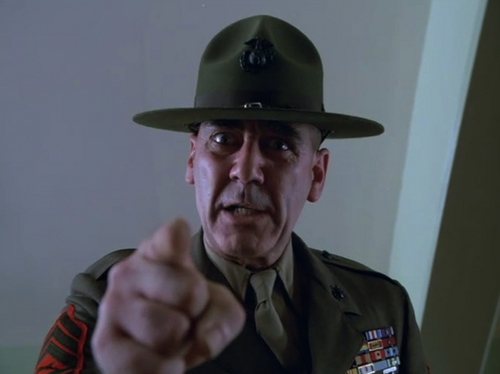
That's SERGEANT R. Lee Ermey, you scum-sucking waste of space!
There are many moments of dark humour in the first half of the film, most often through Ermey's creative put-downs of his recruits. These are interspersed with some profoundly disturbing scenes, most of which centre around Leonard Lawrence (Vincent D'Onofrio), or as Hartman calls him, "Gomer Pyle".
Lawrence is an unfit and mentally slow recruit who has an almost childlike innocent demeanour. Hartman's relentless abuse of him during numerous failed training drills, and the other recruits' bitter (and even violent) resentment towards his ineptitude is shocking but captivating.
Other main characters include Joker (Matthew Modine) and Cowboy (Arliss Howard), who form a friendship while at the barracks.

Joker
Joker attempts to help Lawrence with aspects of the training that he struggles with (even helping him dress smartly), but slowly becomes exasperated. After one particularly bad foul-up in which Lawrence gets the entire group punished, he is gagged and then beaten with bars of soap in the middle of the night by his fellow recruits.
Joker eventually caves into the frustration along with the others, and joins in the beating of the helpless Lawrence. One of the most haunting shots of the film shows Cowboy, the only recruit not to join in, lying in his bunk and covering his ears to drown out Lawrence's cries.
Ironically this harsh kind of treatment transforms Lawrence into a model soldier, and he becomes one of the best in the unit at the various discipline drills. Then Joker notices that he is holding conversations with his rifle in private.
From there things get worse and worse, eventaully building to a tense crescendo. In the dead of night, the unhinged Lawrence loads his rifle with live ammunition. Joker walks into a shower room to find him screaming drill commands and shouldering the gun. Horrified, Joker is powerless to calm him down.
Hartman wakes up and attempts to defuse the situation, but his ultimate lack of emotional understanding proves fatal. Lawrence shoots him dead when he begins to shout orders at him. Grinning uncontrollably, he considers killing Joker too, but eventually sits down on a toilet seat.
Before the stunned Joker can do anything Lawrence lifts the rifle and promptly commits suicide - an act which brings the first half of the film to a chilling conclusion.

Lawrence, mid break-down
How close is a "model marine" to a psychopath in a system which encourages loss of emotion and dehumanisation? The film makes a powerful and uncomfortable argument that the line is very blurred indeed.
Is the system of mentally breaking recruits to form new soldiers as inhumane and cruel as war itself? Or even worse?
The second half of the film covers the actual war, in which Joker is assigned a journalistic role. He frequently writes semi-propaganda stories for army media to appease his superiors.
A lot of reviews I've read rate FMJ highly, but state that the film loses cohesion after the first half. Here I agree, but I don't think it's to the detriment of the film.
The rest of the movie has a kind of organised chaos about it. We move rapidly from location to location with Joker, again culminating at the end of the film in a prolonged tension-laden scene. We see fleeting pieces of the war with Joker's eyes and start to build up our opinions as he does.
This half of the film is of course home the infamous comic relief scene with "Da Nang Hooker", which popularised the whole "me so horny" thing that you still hear occasionally today.
The film throws us another interesting scene here. On the way to his next assignment (which coincidentally causes him to run into Cowboy's squad) he flies in a helicopter.
The door gunner, firing the machinegun at enemy troops, repeats almost constantly under his breath:
"Get some. Get some. Get some, get some. Get some. Get some."
Apparently unaware he is even muttering it, the camera pans round to reveal that he is actually gunning down civilians below indiscrimately. Joker notices this, and asks the soldier incredulously how he can shoot women and children.
The gunner boasts of his kill count (157 people and around 50 water buffalo, apparently equivalent in his view) and explains that shooting women and children is easy. "You just don't lead 'em so much."
This scene is never laid to rest, which is partly what makes it so uncomfortable. Joker doesn't respond, we never see any kind of conclusion to such a dark moment, the film simply moves on.
It's hard to sum all of the characters up, but easily one of the most prominent from here on is "Animal Mother" (Adam Baldwin), a heavy-machinegun toting soldier in Cowboy's squad. He is renowned for being brave and aggressive while under fire, and we see numerous times that he is.
However, he is simultaneously cold and emotionally hollow, his feelings apparently burnt away by the fighting. When Joker questions his motives for what he does, he explains that all that matters is "winning". Being right doesn't matter, and it was never about that. His whole motivation comes from surviving the next battle, and the prostitutes they all frequent afterwards.

Animal Mother in a tough situation
From then on Joker finds himself in the thick of combat (and is widely criticised by his peers for having never killed anyone before). This all changes in the final act of the film.
Cowboy is forced to lead the squad after the previous leader is killed by a booby trap. Eventually the squad advances through an urban area, where a deadly sniper picks off several more squad members. Animal Mother suppresses the sniper and leads the squad forward.
Cowboy himself is sniped and wounded while answering the radio. His last words echo weakly from training: "I can hack it." The others can do nothing to help him but whisper words of encouragement, and he bleeds to death.
Finally they settle on killing the sniper as payback. They sneak into the building and Joker is the first to encounter him - or more precisely her. The sniper is a young girl dressed in a dusty uniform. Joker's gun jams as he goes to fire on her, and he cowers behind a pillar as she shoots at him.
Eventually she is gunned down by Joker's friend, who tastelessly whoops with joy as she lays dying on the ground. The Marines gather around her and she starts whispering something.
Eventually Joker's friend stops cheering, everything becomes silent and someone asks what she's saying.
"She's praying." Joker says. Animal Mother reasons to leave her "for the rats", but Joker insists that they must put her out of her misery.
She begins quietly begging them to kill her, and AM tells Joker that he'll let her die quickly - but only if Joker himself does the deed, and so gets his first kill.
Joker hesistates for a long time, grimacing and staring at the floor, but eventually he pulls the trigger. No-one speaks for a while, and then everyone but Joker begins whooping and cheering again, who just stares down at the corpse pale-faced and vacant eyed.
The closing scene of the film shows the soldiers marching across the landscape and singing, and Joker narrates that he "is in a world of shit, yes. But I am alive. And I am not afraid."
This very ambiguous statement is all we get in way of closure, and it works perfectly. Has Joker found some kind of meaning in the horrors he has witnessed? Is that what his last quote refers to? Or has he finally lost his grip on humanity, like so many other characters in the film?
The "world of shit" quote is particularly interesting. Early in the film, Hartman informs the Marines that "No Marine dies without permission", because doing so lands them in "a world of shit".
One of the last things that the mentally broken Lawrence says to Joker in his final scene, is that he is "in a world....of shit."
Does Joker's use of the term imply that he has also lost that "spark" that makes us people? Or has he become stronger, having overcome that initial shock, and understood what Lawrence meant in his final moments?
Final Word:
So this has been a long review/analysis, and I could rattle on more (I won't fortunately ;) ) but FMJ is a film that really gets you thinking. Every few moments something comes along that really feels masterfully planned and executed, and the whole film drips with themes.
The ending, and scenes such as the soap beating generate a kind of emotional reaction that movies so regularly fail to nail. That alone makes FMJ more disturbing than any horror film and many times more poignant than lots of other films in the same genre.
If you want to see an occasionally amusing, frequently chilling film which has a hefty layer of meaning on top, I highly recommend this film. Just make sure you're suitably hardened for the harsher bits before you turn it on.
5/5
[*][*][*][*][*]
Subscribe to:
Posts (Atom)