Saturday, 4 January 2014

Breaking Bad: Quick Thoughts So Far (Season 2)

So after a good friend pointed me to Breaking Bad a while ago, I have to say it's rapidly becoming my absolute favourite TV series since...well, since anything!

1. I'm a Chemist.
2. I like intelligent crime drama.
3. I like dark comedy.
4. I love media which depicts smartly written characters who have real motivations and personalities.

Breaking Bad satisfies all four in spades, with razor sharp writing and acting that I can only describe as absolutely spot-on.

I'm way behind, only now starting on watching right through after getting the box-set for Christmas. But the show is consistently fantastic so far.

I think the most fascinating aspect of the show thus far is easily the central shift of Walt's morality. Even more than his morality, actually: his humanity itself.

Walt starts Season 1 as a character who is almost unquestionably sympathetic. He's a decent man who, through a lack of assertiveness and simple bad fortune, has essentially been screwed out of everything he could have expected from life as a successful, honest scientist.

He's felt dead for a good chunk of his whole life. He has a stressful home life with a disabled son, a wife he struggles to express his emotions to...and biggest of all, a crushing sense that his brilliant understanding of Chemistry has got him nowhere but teaching to a bunch of uninterested, obnoxious teenagers. He's frequently too nice to offend others, and submits to pressure rather than pushing to put his desires and viewpoints across.

So when he's abruptly told he's dying of lung cancer (despite having never smoked, no less), it's understandable, even if certainly not condonable, that he begins to feel deeply sickened (and envious) when he sees the idiotic local drug pushers rolling around with more money than he's ever seen.

When he realises soon after he begins cooking that he must murder Krazy-8 to save his family from retribution, we see the despair and sadness wracking him terribly with guilt as tears flow down his cheeks.

Fast forward to Season 2, Episode 10, the episode I just finished. Walt's spent several episodes manipulating Jesse with Machiavellian grace, remorselessly lying to him and showing next to no compassion when Hank confiscated the funds he required to even have somewhere to live.

At the end of the episode, he has the following confrontation with a couple of up-and-coming meth peddlers he spots at the local DIY store. Going from the "silent partner" who very much prefers to force Jesse into getting his hands dirty, we see him suddenly assert himself as a street hardman directly:


"Stay OUT of my territory." 

It's like Walt has ceased to exist in this clip, with Heisenberg taking full control. Bryan Cranston is utterly convincing with his narrow eyes and ice-cold snarl - fabulous acting. The other guy may be bigger, but just look at that dangerous look in Walt's eyes, the thinly veiled disgust on his face, and you know immediately that he's not a guy you want to fuck with. At all.

After his "blowfish" discussion with Jesse, we see that Walt's toughness isn't bluster, either. He has nothing to fear from death, already possessing a death sentence.

Walt's disgusted look is doubly ironic considering that the big bald guy and his partner could almost be a mirror showing a more physically imposing Walt and a dirtier, more meth-y Jesse. A clever casting similarity I'm sure was deliberate.

I think the most heartbreaking thing is that as Walt becomes more adept at being Heisenberg, he starts losing everything that makes him Walt. In Season 1 he was a decent man making a lame effort at being a hardcore criminal. Now, he's sliding towards being a ruthlessly efficient hardcore criminal, but losing what makes him a likable, decent human being completely in the process.

Very interesting. And very funny. And very sad.

I love this show ;)

Wednesday, 11 September 2013

Horror And Atmosphere: Condemned: Criminal Origins

One of my favourite horror games of all time has to be Condemned: Criminal Origins. After playing and completing the excellent Amnesia: A Machine For Pigs recently, I realised that I've missed solid horror games and reinstalled it.

Condemned nails (more accurately than the sequel, in my opinion) exactly what is unnerving about really good psychological horror: characters we can identify with, a setting that is plausible yet disturbing and the ability to turn the mundane into something terrifying.

Have you ever been walking the streets of a major city and seen or been approached by someone who clearly isn't "all there" mentally? I have met several people like this just wandering the streets, and often it's a frightening experience that makes one feel rather insecure.

To give but a few examples: I've seen a dishevelled bearded guy just walking around staring at people in the street and lunging about alarmingly. I've been approached by a woman convinced she was "shouted at and assaulted" (though after crying about it she simply walked into an off-license and bought a load of alcohol) and I've even been asked "Do you love Jesus?" by a stranger who reached into his waistcoat while awaiting my response.

The last guy in particular made me genuinely worried that I was about to get stabbed or otherwise attacked, and at the time I remember getting ready to give him a good punching if the hand came out of the coat with anything dangerous. Thank God he walked past after I answered (telling him that I "guessed I did").

Well, Condemned essentially takes these sorts of real-life unnerving experiences and dials them up to 11. Needless to say, such a method of generating horror is very effective.

You play an FBI investigator in the fictional "Metro City", a US city apparently suffering from severe urban decay.

Almost all of the game takes place inside run-down and/or abandoned buildings, which is fitting since you are hunting a serial killer who murders people in such isolated areas. However, as the game progresses, you start to get the sense that the murders you're following are almost irrelevant in the grand scheme of things - the city itself seems to be devolving into a cesspool of mindless violence and chaos all around you.

You are attacked frequently by homeless people and assorted dishevelled thugs who appear to be drugged up or otherwise rendered utterly insane. They spit at you, scream obscenities, stagger around hurling chairs and shelves at you and even try to headbutt and bite you in a frenzy if disarmed.

What makes this really disturbing is that aside from subtle environmental hints, this maelstrom of insanity is never truly explained, and other characters only mention it in passing. That the entire area seems to be filled with violent lunatics and your colleagues neither understand nor attempt to address why suggests that society has practically undergone some kind of complete breakdown without anyone even noticing.

Then you get to thinking...people like this really exist. Psychotic people with nowhere to live, nowhere to turn. Could elements of society one day be overwhelmed by these kinds of people in dense residential areas? How many lurk in the shadows without our knowledge?

For all the screaming madmen (and women) in the game, Condemned has smart layers of creepiness that hint further at this decline into lawlessness. One level, set in an otherwise fairly well-maintained subway station at night, has an official notice in one of the corridors.

"Always travel safely", it advises, "If a train stops anywhere other than a platform, do not leave unless a uniformed Metro Police officer is present. Criminal trespass incidents have been reported, and individuals within tunnels may prove a significant threat to your wellbeing. Authorities are working on resolving this on-going issue."

I honestly hope they make a Condemned 3. Condemned 2 unfortunately increased the violence and went far too supernatural, turning the protagonist into a thug no better than the maniacs around him while also ruining the mysteries of the original.

So if a sequel ever comes around, I hope the developers take a good look at what makes the original so horrifying (an ambiguous but very real threat, the natural terror of serious mental illness, breakdown of social order in a "civilised" area) and cut the silly sci-fi present in the sequel out.

Thursday, 18 July 2013

Spec Ops: The Line Review

*Contains minor thematic spoilers*

So I bought "Spec Ops: The Line" on Steam sale two days ago. It was a third-person action game I'd been lining up to get for a while.

I'll open this review by saying I'm a "Battlefield 3" person when it comes to action gaming. I love BF3, but really went off CoD after Modern Warfare 1.

Now, when I first saw Spec Ops flash up on Steam, I immediately started rolling my eyes when I saw the cover picture:

How generic does that look? It's almost like someone copy-pasted the typical "Cool CoD pose" soldier and put it on a new game.

Exactly. Because once you play Spec Ops, you realise that's just what the developers were going for. You start the game, expecting to be playing Call of Duty: America Saves The World Again and instead you get something quite different.

Quite different indeed. Because Spec Ops: The Line has much more in common with a horror game than an action shoot-'em-up.

Set in Dubai in the near future, the city has been ravaged for months by a gigantic sandstorm. The US government completely loses contact with a Colonel and his troops sent in to evacuate the populace (Colonel Konrad and his 33rd Battalion). The result is that the player (Captain Martin Walker) and his two underlings (Lugo and Adams) are sent into Dubai to assess the situation and report back.

Initial gameplay is disarmingly generic. Lugo is your typical "Sniper with a sense of humour", and wisecracks constantly. Adams is the painfully stereotypical "black guy heavy weapons specialist". As you walk towards the ruined city, you get all the usual bullshit "America, hell yeah!" nationalism spouting out, as you'd expect in CoD or even BF 3.

The first enemies are foreign insurgents. Again, so far, so "Battlefield of Duty". Then, before you know it you're killing fellow American soldiers, witnessing genuinely shocking war crimes...and even committing barbaric acts yourself.

It's as the game progresses that the tone takes this subtle but continuous dark slide, finishing up in an abyss of despair that I don't think any previous action shooter has even thought of venturing to.

This shift of mood is shown amazingly well in not only the well-acted cutscenes, but also the mannerisms and appearance of the squad and player character during actual gameplay.

Walker himself starts the game clean-shaven, macho and confident of his heroic ability to save the day. When you order Lugo and Adams to take down enemies, he's precise and efficient. By the end of the game, however, he's scarred and broken, his eyes displaying a prominent thousand-yard-stare.

The orders you give your men start to sound borderline psychotic, and even the finishing moves you perform on wounded enemies progress from mercy killings to sadistic, unhinged executions. Your own squad becomes frightened of you.

As an example: early on Walker might say: "Lugo, neutralise that sniper." This becomes: "Lugo, kill that guy." and finally morphs into an enraged gravelly scream of "Lugo, I want that motherfucker DEAD! NOW!"

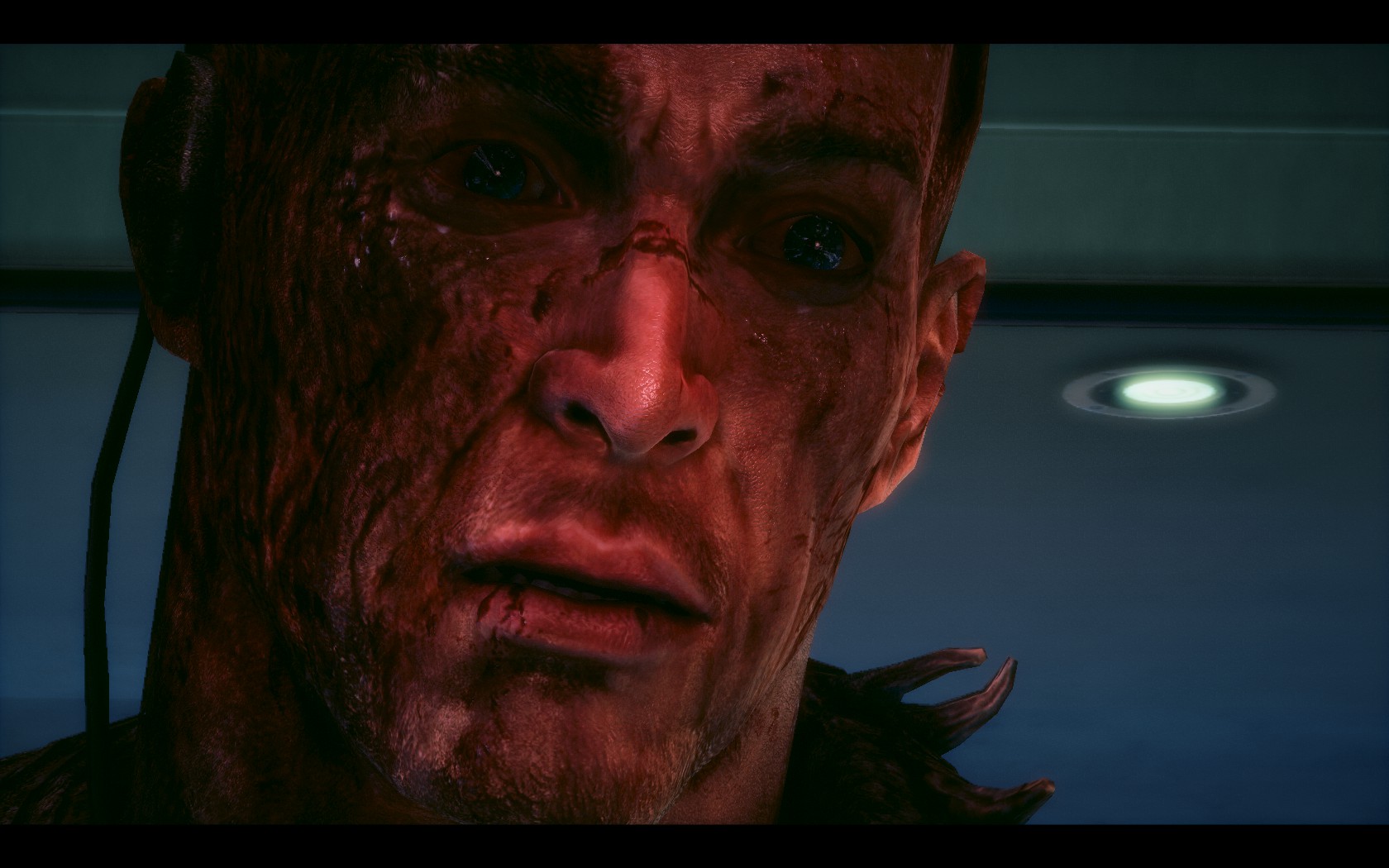
But what triggers this disturbing change in personality? Well, from the moment you arrive in Dubai, it's evident things are very, very bad there. As the game progresses, the excellent story gives you some really tough choices. Almost every choice you make, regardless of your intentions, becomes a bad one; this culminates in a horrifying decision you're forced to go through with that has appalling moral consequences.

It was this particular event that actually made me pause the game with discomfort. I'd crossed the titular "line", through no real fault of my own (other than wanting to play a good game I'd paid money for), and it felt horrible in the best possible way. The game had made an emphatic moral statement, directly to me, the player.

Following on, the ending is a masterstroke: a twist revelation that heartbreakingly undermines not only your character's obsessive glory-seeking, but that of your own desire for "glory and fun" through entertainment too.

Interestingly, for me the most shocking moment of the game wasn't any particular "forced" sequence, but instead a pretty standard on-rails shooter sequence. Given the opportunity of finally leaving a huge group of hostile soldiers behind and escaping in a helicopter, your character shouts that he doesn't want to leave as you begin to fly away.

Completely confused, your pilot almost begs you to just let him fly out of there as the enemy gunfire begins to hit the chopper. "No.", Walker growls, steadying a mini-gun mounted to the fuselage. "I want to see what this gun can do!"

The following shooting sequence, which most games play for fun, suddenly becomes a drawn-out foray into needless carnage that made me more uncomfortable than even the harshest of the "scripted horrors" the game had laid out for me previously.

--
Summary:

While I've said little of actual gameplay here, I think this echoes the focus of the game. Spec Ops is primarily story-driven, and truly has a fantastic narrative that will get you thinking not only about the rights and wrongs of warfare, but also how we unthinkingly lap it up as exciting entertainment in the media these days.

The gameplay itself is reminiscent of Gears of War - if you like 3rd person shooters with cover elements, you will be happy here. It doesn't particularly innovate (there are no truly unique gameplay features), but the shooting on offer is very solid and I didn't find myself frustrated by even the most challenging segments.

Graphics are universally very good. Dubai has a bunch of varied, colourful interiors (a huge aquarium penthouse was my favourite) and the characters look fantastic. Animations are smooth too.

"The horror...the horror."
 

Final word:
If you want an interesting shooter with varied environments that will give you scope to make your own decisions (and live with the consequences), give Spec Ops a try. Even if you don't typically like 3rd Person Shooters, it's worth a look for the mature and compelling story.

Just be aware that the road to Hell is paved with good intentions.

Score: 5/5
[*][*][*][*][*]

Friday, 12 July 2013

Prison Architect: First Impressions

Down below in the courtyard, the inmates are tiny orange specks to my omniscient eye-in-the-sky. Their chunky jump-suited bodies mill around, the pleasant hum-drum of conversation bubbling through my headphones.

My guards, meanwhile, are ambling along the perimeter. Ever watchful, their cute cartoonish eyes are all narrowed slightly, as if inherently suspicious.

But at present, the atmosphere remains totally calm. I continue watching my workers, as they lay a strip of cabling to the small brick building being constructed at the edge of the facility. The execution room.

This mission, the first and only mission the game currently has (more of a tutorial, really), has you tasked with building an electric chair inside an established prison.

When the cabling is complete, my view is suddenly drawn away from my colourful guards and prisoners, to one small cell. Inside this cell, the condemned man, Edward, awaits his death sentence. A Priest appears to comfort him.

In a sort of stationary storyboard cutscene, a hand drawn (and much more realistic) picture of Edward and the Priest in the cell appears, the holy man laying a forgiving hand on Edward's head. The goofy visuals the game usually sports contrast sharply with the stark detail of the adult-comic style presentation of this "cutscene".

Intrigued, I watch Edward's last walk to the execution room I built myself. Along the way, the prison guards recount his story.

Suddenly we're inside Edward's mind. We see a cutesy-graphics representation of his house, to which he is returning...with a gun. Completely dissonant with the graphics, cries of lustful pleasure fill the speakers, and sinister music builds in the background. Edward walks to his bedroom door, and the screen is again peppered with hand-drawn pictures. This time they show his wife, and the man she's cheating with, caught in the middle of sex. A distraught Edward raises the gun and mercilessly kills both.

In the "cutesy" graphics display of the scene, the two naked (but undetailed) characters are suddenly smeared with pools of ugly red blood. The words "DEAD" flash above them, over and over again.

Jesus.

For a moment I stare, surprised...shocked, even, that the cutesy game I was playing could convey such adult sentiment.

--

In just this one scene (and the rather depressing execution that follows), we are offered a powerful and unexpected look into the rights, wrongs and grey areas of the death penalty.

Now admittedly, when I first heard of Prison Architect, I wasn't interested. I thought it'd be another shitty "Prison Tycoon" game.

Then I saw it was by Introversion, the same developer that made Defcon and Uplink, two of my favourite games, competent for not only having deep game mechanics but also in exploring greater moral themes relevant to reality through gameplay.

Uplink explores the freedom of information, corporate society and whether it's morally right to even have personal information databases if skilled people can hack into them and misuse our data. Defcon is like a playable simulation of the detached horror of nuclear war.

So that sold it to me. I bought into the paid Alpha of the game.

--

Sure enough, Prison Architect has everything you'd expect from a management game, but even in this early stage of development it shows a really interesting psychological angle even outside of the story scenes already in the game.

Take my first prison: I tried to build it as a medium-security installation, in which I'd keep the prisoners happy and well entertained, ruling them through respect rather than force and deterrent.

To that end I built a spacious yard, larger cells, a sanitary shower and a nice entertainment room. Prisoners were allowed family visits, and all seemed to be happy.

Within a few days, they decided to smash it all up.

Oddly, I actually found myself feeling slightly annoyed - which I then realised is the brilliance of the game. I'd tried my best to cater to the needs of these people, to keep them at least comfortable in their place of incarceration. They'd all been listed as "happy".

They'd repaid me by ruining the equipment I provided to them in a fit of meaningless violence.

I watched with dismay as my guards began brawling with them. The inmates beat the prison's Chef unconscious, badly hurt a builder and before it was all over a prisoner had been stabbed to death in the shower block with a knife lifted from the Kitchen; the blood stubbornly staining the floor was a damning indictment of my failure.

Without the money for a Janitor (it was all spent on repairs), that blood stayed there for days afterwards, the floors and walls around it turning grimy from lack of cleaning. With each in-game day representing around a year, that means that dried blood simply stayed on that floor for a good 5 years, a stubborn reminder of that horrible incident.

Faced with a lack of Recreation (thanks to the fun stuff being broken), the prisoners started fighting again. And the vicious circle continued.

My latest prisons have learned: more guards, less focus on appeasing the prisoners, more on containing and controlling them.

Cells are built to house maximum numbers of prisoners, not to comfort them. Entrances are barred with multiple checkpoints. The relaxation rooms are patrolled by guards.

Then you start thinking of your prisoners as enemies, not people entrusted to you. You start seeing them as vicious bastards that will happily murder you, your staff and even each other.

So yeah...I've only just started playing, but already it's providing an interesting comment (and perhaps even insight, if accurate) on the mind-set of those who actually run these large federal institutions.

Saturday, 22 June 2013

Binary Morals in Games: Dishonoured

So I'm doing a re-play of Dishonoured (British spelling, I know) lately to try and bag the Achievement for not killing anyone in the whole game.

While it's proving enjoyably challenging so far early through my progress, I think Dishonoured in general really highlights the inherent flaws (and they're some pretty damn big ones) in adding the moral choice of lethality to your game without really fleshing out the gameplay side of things to make playing as Gandhi fun.

Dishonoured itself is set in a really fascinating world. It's a well-crafted, extremely grim dystopia of plague, madness and betrayal. The aesthetic is fantastic.

Then we have the gameplay: extremely dynamic, varied, inventive, brutal and fun. Well...that's if you're okay with killing baddies, anyway.

If you're playing as a pacifist protagonist like me, you have a whole two ways of dealing with bad guys non lethally:

1. Grabbing them in a chokehold and squeezing them unconscious.
2. Sleep-darting them with your crossbow.

Additionally, you'll spend a good number of minutes carefully moving their bodies afterwards so nothing can kill them inadvertently (still counts as you committing murder if they fall in water, for example).

So...we have a game with roughly 30 hours of gameplay if you're going through it thoroughly. If you're playing as a "good guy", you'll spend those 30 hours simply choking people or sleep-darting them over and over...and over again.

Additionally, since fighting only gives you lethal attacks (beyond the sleep darts), you'll never get to have an exciting fight with baddies to break up all the stealth. Instead you just reload the game. This can get really bloody tedious.

By comparison, what do we have for a character simply playing to take down enemies, either non-lethally or fatally?

Well, we have both the non-lethal options above. Then we also have:

1. Spring razor mines, that send blades flying everywhere and cut enemies to bits spectacularly.
2. Swarms of supernatural rats that dramatically eat baddies alive.
3. Huge gusts of magical wind that crush enemies against walls and throw them out of windows.
4. A flintlock pistol.
5. Lethal crossbow bolts.
6. Special "adrenaline"-fuelled combat execution moves.
7. Grenades.
8. A freaking awesome spring-loaded sword that Corvo (the protagonist) adeptly spins around and flicks open every time you get it out. You can fight with it, or dramatically stealth kill baddies with a whole load of different animations.
10. The ability to leap off a building and skewer someone fatally with the sword (so convenient, it's worth it's own number).

Look at the two lists. The lethal one gives you the game's bad ending, has almost no Achievements associated with it, and is absolutely amazing good fun. A bad guy spots you? Just have a really badass swordfight. Or stop time, sprint-slide under a table and hurl a grenade that will blow up in their faces when time un-pauses.

Or counter-attack and send severed heads flying everywhere with your sword. Or summon a swarm of rats to help you escape...or...

Well, you get the picture. The other list, the non-lethal one, gives you the good ending. The game encourages you to follow it. A guard spots you? Well, son, I hope you have the quickload button hotkeyed, because you ain't gonna be going apeshit with any of those amazing lethal toys you've been collecting.

I don't understand why game developers do this. Why spend hours upon hours making all these incredible game mechanics, then chastise the player for daring to use them? Why make the lethal route so much more fun, if it's the "morally wrong" thing for Corvo to do?

You could argue the non-killy route is made less fun deliberately, to entice the player to be "bad", and make being "good" more rewarding. But that'd be bollocks game design. Because if you want to encourage the player to persevere with being good, the game should be harder to play non-lethally (it is, already), but equally fun as being a murdering bastard.

Why can't Corvo leap off a roof and kick a guard in the face? Or grab a guard in a headlock and punch him senseless? Or have knockout gas bombs? Why are there no amazing non-lethal combat takedowns? Imagine Corvo could block a sword strike, then break a guard's leg with a vicious kick, like you can in the original Assassin's Creed. It would be incredibly badass!

But no, you just have the crappy chokehold, which has one animation. One, as opposed to the sword, which can kill guards in about 30 different ways. You must ignore the awesome blade entirely for the whole game, it unsprings in Corvo's hand like the Forbidden Fruit.

--

In conclusion, if you're going to make morals ALL GOOD or ALL EVIL in your game, for heaven's sake actually make playing both ways really good fun. Don't make players miserable by giving them a huge array of toys, but making 90% of them useless with a certain playing style. It's like putting a huge ham in front of a chained, starving dog.

Fingers crossed the inevitable Dishonoured 2 doesn't repeat this very irritating design choice.

Thursday, 27 September 2012

Let's Play Intro: Dwarf Fortress

Greetings, Human.

Throughout my travels I have met many of your tall, lanky kind. While the majority of you prove ignorant of the merit of a day's labour and have a bemusing fondness for outdoor spaces, you remain a race we Dwarves can at least maintain cordial relations with.

This is more than can be said than for many other residents of this world. Never trust a long-ear, son, you'll get nowhere in a hurry but t'grave!

But forgive my meanderings, beardless one. Your interest in my previous employment as Administrator of a frontier Dwarven city is highly curious. On the one hand you show great respect - desire to learn from one's elders is a traditional Dwarven virtue.  On the other I must disclose my suspicions that you want this information for nefarious purposes - let me iterate this now; you're never going to find out where we stashed our riches, and that's that.

In the following documents I enclose my full work log, with comments. Please get back to me with your thoughts, and I apologise in advance for any creative embellishment.

My assistant Hakrag is most insistent that I must make use of lavish descriptions in order to hold the attention of any impatient cretins that you may pass these documents onto. His beard is tufted and unkempt, and as I write this I am making a mental note to slap the young fool soundly about the ears.

Yours most gracefully,

Mac Luggins
- Senior Records Dwarf/Ex-Administrator of Extremely High Importance

Monday, 20 August 2012

Sniper Elite V2

So I picked Sniper Elite V2 up on Steam sale. I thought I'd post up my impressions.

For £10, I have to say the game + DLC was good value really. Still though, I'm finding it to be one of those "wasted potential" games that prove highly irritating at times.

Set in WWII, SEV2 places you in the boots of a US black ops sniper deep behind enemy lines. You are assigned at the beginning a mission to assassinate 5 Nazi scientists who founded the V2 rocket programme before they can defect to Russia and prove a future threat.

First up, I have to echo a point made in Yahtzee's Zero Punctuation review (see here: http://www.escapistmagazine.com/videos/view/zero-punctuation/5745-Sniper-Elite-V2 ) - what is up with picking on the Russians in games lately?!

It's like the Cold War never ended or something. Every single war-time American made game in the last 2 years seems to feature Russia as the baddies. In this game, it's revealed that Russia is planning to launch nerve agent filled V2 Rockets at major European cities and pass it off as a desperation attack by the Nazis.

While it makes for a "plot twist", I think it's a bit lame considering that Russia was aligned against the Reich in the period the game is set, Stalin or not. It's not even clarified why Russia would want to do such a thing, because presumably the only way they would profit would be in a full scale invasion afterwards (hardly subtle).

The protagonist doesn't seem to show much love for the Russians either, referring to them constantly as "Reds", "Ivans" and even at one point "crafty Red bastards".This seems a rather odd McCarthy-esque 1950-60's attitude.

Historical inaccuracy and demonisation of Russia aside, much debate has gone on over the game's "X-Ray Killcam", namely a cutscene that triggers upon a good shot that shows the bullet impact its target in slow motion, shattering bones and damaging internal organs.

Frankly, it was taken off of Mortal Kombat which did pretty much an identical thing earlier, and I think really the developers only added it for the "shock factor".

Personally, I think the game isn't particularly violent in the grand scheme of things - a game like Gears of War is easily worse. It's true that the x-ray deaths can be very graphic (I shot one unfortunate soldier in the back - the bullet severed his spine, went through his lungs and then yanked off 3 of his fingers upon exit), but actual evidence of violence on the character model is non-existent.

Look at the soldier above after his death, and he has no signs of missing fingers or huge gory holes in his back - he just has one tiny red entrance and exit wound on his chest, like any other "PG game". The game also doesn't feature much in way of blood decals, so really the X-Ray system is just a detailed gimmick to highlight specific kills.

You could argue it's a little tasteless (as is the "KILL HITLER" DLC imo) since the game depicts a real conflict, but at the same time I think if one approaches the game in a mature fashion the x-ray kills if anything simply make the player a little uncomfortable. And perhaps it's good that's the case, because in a way it gives your enemies a human depth you don't see in other games.

It's easy to pull the trigger on someone in Battlefield 3, you don't even see the impact your bullet makes at long range. But sending a rifle round through the eye socket of an unfortunate German lookout, you feel like an amoral instrument of death. You're killing people, and the details are not pleasant.

In terms of gameplay, the team nailed the feeling of sniping spot on. On the hardest difficulty you must control your breathing, the distance of a shot and any weather effects such as wind on the bullet. You feel disconnected and far from your targets, like a hunter, which completely contrasts with the jarringly personal zoom of the killcam.

Landing a successful shot feels like a satisfying reward of patience and skill. There's just one glaring problem - the game hardly ever gives you a chance to just use your freaking rifle. Almost always you're forced down one linear path full of cramped corridors and bunkers that are completely inappropriate for you to use your rifle in, forcing you to use a pistol or SMG (which feel far less fun to use, thanks to the dev team really focussing on optimising the rifles primarily).

Combat also takes place at silly close ranges sometimes, ususally withing 50-200m. If you build a whole game around allowing us to SNIPE THINGS, why do we have to fight within bloody running distance constantly?

Enemy snipers seem to be implemented in a highly annoying manner, at least on the hardest "Sniper Elite" difficulty. These guys apparently possess the vision of a hawk, the sonic ears of a bat and have railguns with auto-targeting. They never miss if you're in the open, even if you're sprinting at full pace and have a huge distance from them.

Similarly, inch around a corner that seems out of their sight radius and they'll INSTANTLY shoot at you, spinning on the spot to do so. You have binoculars, but you can't even use those to spot them because they will immediately shoot at you the second you look around the corner. It feels very stupid at times, because you practically have to find them via death trial-and-error - you can forget cunningly exposing them or looking round corners with mirrors, Private Ryan style.

So it's a flawed game that offers excellent sniping mechanics, but sadly forces the player to only break out the rifle when it suits the game. There are also irritations with difficulty and the ability of the enemy to detect the player near instantaneously.

Overall, I'd give it:

***
3/5.