Saturday, 21 May 2022

[Top 10] Battle Brothers Best Perks That Are Great

[Top 10] Battle Brothers Best Perks That Are Great

To get a crack squad of elite Middle Ages mercenaries, you're going to need to pick the right Perks when they level up! Check out my guide below and you'll be well on your way to the end-game.


https://www.gamersdecide.com/articles/battle-brothers-best-perks

[Top 10] Battle Brothers Best Backgrounds That Are Great

 [Top 10] Battle Brothers Best Backgrounds That Are Great


Get your game of Battle Brothers off to the best possible start by reading through my Origins/Backgrounds guide!


Battle Brothers Best Origins – Which to Choose?

 Battle Brothers Best Origins – Which to Choose?

If you're new to Battle Brothers and trying to figure out how to best start your first game, check out this guide below and kickstart your adventure!


[Top 5] Battle Brothers Best 2H Weapons (And How To Get Them)


[Top 5] Battle Brothers Best 2H Weapons (And How To Get Them)

If you're new to Battle Brothers and want to get to grips with the wide array of weapons in this great RPG/Strategy title, check out my article below for a review of 5 of the best two-handed weapons and why they're useful.


 [Top 10] Battle Brothers Best Weapons (And How To Get Them)

Battle Brothers is a fantastic RPG/Strategy game that I can highly recommend to fans of the genre. Check out their official website here: http://battlebrothersgame.com/

Linked below is an article I wrote for Gamers Decide, in which we discuss some of the 10 best weapons in the game, and how you can get your hands on them!


https://www.gamersdecide.com/articles/battle-brothers-best-weapons

Tuesday, 4 June 2019

"Subversion of Expectations" is Being Misused to Defend Terrible Writing

**CONTAINS GAME OF THRONES SPOILERS**

Since The Last Jedi came out (a movie which, in my opinion, is terribly flawed and has awful writing throughout) it's become extremely popular for creators and fandoms to defend writing in shows and films with "It's great at subverting audience expectations! You just hate it because you weren't expecting those things to happen!"

With the release of Season 8 of Game of Thrones and the awful massacre of that show's story and characters, it seems like people are jumping on this same bandwagon. "But it was so subversive!"

The idea, it would seem, is that writing is great merely by virtue of having unexpected things happen. If the audience is surprised with something you did as a writer, you are inherently a genius and your scripts are fantastic.

I'm going to be blunt.

This is a complete fallacy and the people using this reasoning are completely intellectually bankrupt when it comes to telling a good story.

Honestly, this whole line of reasoning is pure unadulterated nonsense.

Imagine you're watching Pulp Fiction. Marsellus Wallace is talking to Butch about throwing the boxing match. Suddenly, his head violently and gorily explodes everywhere and Willis reels in shock.

Cut to next scene. Vincent has just saved Mia from OD'ing. He takes her back to the house, smiles, and then he pulls out his pistol and shoots her dead.

Final scene. Travolta and Jackson are in the restaurant. Roth and Plummer talk about robbing the place, reach for their guns...and then decide that actually, no they won't. They just walk out, roll credits.

All three of these scenes are examples of completely subverting an audience's expectations. We don't expect Wallace's head to explode with no foreshadowing or apparent reasoning. We don't expect Vincent to randomly murder Mia, and we don't expect a robbery set-up from the start of the movie to suddenly lead to absolutely nothing.

Did these changes feel satisfying? Does it make absolutely any sense that Wallace suddenly just dies? Why would the film set up the cafe robbery for the whole run-time and then just ignore it in such a frustrating way?

No, these three examples are examples of terrible writing and would render Pulp Fiction an awful film. The expectations of the audience are "subverted" in these examples purely out of laziness or the desire to be "shocking" and unexpected. This destroys the story.

By contrast, there is actually a scene in Pulp Fiction in which a character's head suddenly explodes, subverting our expectations. However, this scene is both funny and horrifying, and is subtly foreshadowed in the form of Vincent's incompetence throughout the whole story. It also leads to a major plot dilemma which the characters successfully resolve using logic.

To cut a long explanation short; this character's sudden and "subversive" death is clever. It's not a stupid subversion for the sake of it.

Subverting an audience's expectations is not inherently bad. 

But doing it out of laziness, out of stupidity or out of simply forgetting key plot points is not good writing.

Game of Thrones Season 8 is a perfect example of the worst, laziest, most idiotic "subversion". Jon Snow is set up for the entire show as a Targaryen - it's a huge reveal that means he is the rightful King of Westeros.

This is massive. This is a show all about the throne of this Kingdom and people scheming to sit on it. Jon is a protagonist we have followed right from the very beginning and is the favourite character for many people (myself included). He is revealed as the man who should be King, by right of his blood.

Yet in Season 8, Jon is suddenly meek, timid, weak, repetitive and stupid. And worse, his entire backstory and his heritage is completely ignored. The writers end the show by just giving him...nothing. He's pointless.

Arguably the biggest main character in the show becomes utterly redundant, his claim to the Kingdom is completely glossed over and he's basically deleted from the script. Instead, total randomer Bran becomes King for...no real reason whatsoever.

This is inexcusably terrible writing. To utterly ignore a central character's entire arc that you have been building for 8 seasons of television to this one incredibly important moment purely to "subvert expectations" is moronic beyond belief, not the sign of scriptwriting genius.

To round up:

Anyone can write a totally "random" story which ignores Chekhov's Gun and in which expected pay-offs are completely ignored in favour of "unexpected" twists. Children often write extremely simplistic stories like this, because they don't understand writing conventions. Does that mean children are excellent screenwriters now?

Subverting expectations in and of itself is not a mark of an excellent writer.

Wednesday, 3 April 2019

There Will Be Blood: The Duality of Eli and Daniel

After meaning to watch it for years, I finally got around to There Will Be Blood. It's a solid film with a lot of subtle meaning and I believe there is a lot more to the ending than first meets the eye.

Perhaps the most interesting thematic aspects of There Will Be Blood lie within the ironic parallels between Eli Sunday and Daniel Plainview.

Daniel is a consummate hyper-capitalist. It is his failing to have a real family (despite acting as a father to HW, that is essentially what he is doing; acting) that causes his misery, and his prioritisation of his own personal capitalistic wealth above all else that leads to both his huge wealth and completely hollow personal life.

Perhaps the greatest irony of Daniel's existence is that he murders the man who is posing as his half-brother. He himself has posed as H.W.'s father for many years, and yet he feels he is owed the boy's loyalty even after showing him callous disregard on numerous occasions. Yet he judges someone pulling the same thing on him so harshly as to merit a death sentence, demonstrating shallow emotional insight and hypocrisy.

One of the most interesting insights into Daniel's character is when he is watching a burning oil well, shortly after H.W. is deafened by a gas blast that caused the fire. Aware that his son is seriously injured, Daniel turns to a worker and says "What are you looking so miserable for? There's a whole ocean of oil beneath us, and no one can get at it but ME!"

In that very line, Daniel crystallises his approach to business in a single word. Not us. ME. Daniel has developed such an egocentric world-view that he even believes his workers should inexplicably be as happy as he is when he is making massive profits, because to him the whole world revolves around himself and his quest for oil. He claims several times to want to share wealth with his workers and the community, but in reality he has at this point become a selfish soul who wants only to accumulate vast profits for himself. Even as he says this, he is neglecting his son's well-being in order to focus on his money.

On the other hand, Eli is a consummate hyper-evangelist. He, in many ways, represents everything wrong with organised religion in the same way that Daniel represents many of the problems with extreme capitalism. In one of Daniel's more reasonable and more human moments, he agrees to allow Eli to bless his oil well, despite clearly feeling dubious about it himself and having no religious faith of his own. He does this out of good will (and perhaps also a desire to appear attractive to the community).

Eli responds that his name must be spoken during the blessing. Instead, Daniel blesses the well with the name of Eli's sister Mary in front of Eli and the community (apparently doing this without thinking anything of it, as he still says the other words Eli wanted). This clearly antagonises Eli at the time, as he smiles through pursed lips, even though the prayer was said to God as he asked.

When an accident later occurs at the well, Eli claims it was because the blessing was carried out improperly (the implication being that because his name was not said, the blessing was not "holy"). This shows a real blasphemous arrogance on Eli's part - he considers himself the sole voice and messenger of God's will. Religion is a commodity he thinks he owns. Eli claims that his religious community is his family, but as with Daniel's relationship with money over his son, Eli prioritises his own religious "wealth" above all else, and feels himself superior to his "flock".

Later, when Eli is revealed to have become a shallow radio evangelist interested only in self-promotion, he meets Daniel and breaks down. His focus on the cult-of-himself has resulted in both a lack of money (something Daniel does not experience, with his rational focus on material wealth) but also a similar lack of "soul" to Daniel.

Daniel, gripped by madness, kills Eli at the end of the film after humiliating him. But it's that last line that really throws us back to the duality of the two: "I'm finished."

Thinking of the two characters as two mirror images, Daniel as the materialistic capitalist incapable of human connection due to his own arrogance; Eli as the false prophet, incapable of human connection due to his own arrogance...this last line takes on an interesting significance to me.

What if Daniel has realised his duality with Eli? A man for whom he holds utter contempt? What if his murder of Eli is his own disgusted suicide-by-proxy? He kills the man he has contempt for, because he realises this man is a mirrored shadow of himself. Afterwards, he is just as broken and pathetic as Eli himself was, despite having everything he could seem to want.

"I'm finished" is not merely a statement of legal repercussions or a fourth-wall breaking comment on the film. No, Daniel is commenting on both how he has engineered his own emotional destruction through his mistreatment of H.W. and his annihilation of his own "other self", Eli.

Note how Eli himself is obsessed with money throughout the film. He wants $10,000 for the church; not because he cares for his "flock" or his family, but because he wants money. He asks Daniel for $5,000, essentially trying to trade a "proper" blessing of the well for money. Eli regards the death of an oil worker as a convenience for bargaining with Daniel, in the same twisted way Daniel adopts a dead worker's son in order to conveniently bargain with investors.

Eli's career as a radio evangelist is again designed to trade religious faith for money. In the end, what does Eli renounce his religion for and trade in his dignity to get? Money. The film is not about materialism versus spirituality, it's about the convergence of materialism and materialism posing as spirituality. The greedy oil barons and the greedy false prophets are the same.

In many ways, Eli is therefore a more repulsive character than even Daniel. Because Daniel Plainview says what he means and does what he says. He trades a physical commodity for money, even though he is ruthless and often cruel. Eli, however, trades on falsities and his own ego for cash; he is Daniel, but with a bible instead of a barrel of crude.

Daniel pretends he is a family man to make money. Eli pretends he is the voice of God to make money. Which is more unethical?

It is therefore my opinion that There Will Be Blood is a musing on the duality of capitalism and organised religion; how the two mingle and become indistinguishable when abused, and how neglect of the family and a lack of self-awareness brings an inevitable collapse regardless of material prosperity or religious "faith".

Sunday, 17 March 2019

BBC's "Warren" - How To Make A Completely Unlikable Protagonist

I wanted to like "Warren". The BBC's new prime-time sitcom stars Martin Clunes, the ever reliable funny-faced favourite and the advertising leads the viewer to believe that the show is going to be Clunes playing a grumpy, self-righteous driving instructor.

He snarks, he rolls his eyes, he makes sarky comments, and it all seems rather funny. I was looking forward to tuning in.

And there is some grain of truth intact from that trailer - Clunes does indeed portray the titular character Warren as a grumpy, self-righteous driving instructor. Unfortunately, the characterisation doesn't stop there, though. After 1 episode of the full show, it becomes immediately apparent that Warren isn't so much grumpy as he is a misanthropic sociopath and he isn't so much self-righteous as he is a completely unbearable bastion of ignorance.

That the writing team made the title character around which the whole sitcom is based so utterly unlikable to the point that he actually comes across as an abusive narcissist with controlling tendencies is perplexing.

The characterisation of the protagonist is so egregiously grating that I felt the show was deserving of a blog post - merely as an example of how NOT to write a character.

Why is my reaction so extreme? Well, to begin with, Warren is perpetually pissed off - with everything. Everything from his two stepsons (whom he almost invariably refers to as "tosser" or "wanker" in every breath), to his wife (who he eyerolls his way through his conversations with) to his work rivals (who he relentlessly and baselessly slanders).

I've heard many people comparing this to Victor Meldrew from One Foot in the Grave and Basil Fawlty from Fawlty Towers. The problem is, Warren has none of the righteous anger or vulnerable charm of these characters.

Victor Meldrew is not merely a grumpy bastard, as many vacuously characterised him as when the show first aired. No, Victor Meldrew is a sane man in an insane world. He lives an existence plagued by petty criminals, shysters, cruel employers, cruel rich people, muggers, inconsiderate and ignorant neighbours and (topping it all off) he experiences extraordinary runs of terrible luck.

Thus when he explodes "I don't BELIEVE it!" the audience laughs not just at him, but with him. When Victor is screaming at someone for failing to fix his car for the third month in a row, or raging at a car turning up dumped in a refuse skip he hired, we laugh because we understand his frustration.

Similarly, when Victor is wrong about something or crosses a line, he is frequently ashamed or apologises - a humanising and endearing trait that drives the more serious dramatic scenes of the sitcom too.

Once again this pattern is repeated with Basil Fawlty. He is rude, obnoxious and at times even aggressive towards people - but he is charmingly pathetic and vulnerable too. He is dominated by his equally obnoxious wife Sybil, his hotel is a rather crappy establishment despite his best efforts to improve it and he has hilarious delusions of grandeur, erroneously viewing himself as a member of the upper class rather than the jumped up working class man he really is. Again, his weaknesses are painfully human.

Warren, by contrast, has no such virtues or human flaws. He is merely unpleasant to everyone else in the show all the time, for no reason. Most of those he hurls abuse at are nicer or more likable characters than he is! And we are, somehow, supposed to laugh.

"Dad, can we get broadband?" His stepson asks patiently in one episode.
"Don't be such a NERD." Warren retorts. Ha. Ha. Ha?

Warren is also just a complete dick with his actual actions in the world too. In Episode 1 he decides to fly-tip a ton of rubbish out of the back of his car.

In most shows a protagonist doing something immoral like this would result in his embarrassment or humbling and a change in his or her character. Not in Warren. He is arrested at the end of the show but is as defiant, smug and unperturbed as ever...and it's never mentioned in the next episode.

When we see Warren giving driving lessons, he outright abuses his students. He tells one guy to "Piss off" and dumps him out of the car just because the guy raises a fair complaint, and then spends his time forcing another kid to drive him to a garden centre and pay for the privilege. This is the same garden centre where he abuses his stepson's boss and screams at him unpleasantly over a discount until he is dragged from the store.

I wish I was making this up. A reminder: this is supposed to be a comedy. This is the protagonist of said comedy. A man who just acts like, for lack of a better word, a complete c*** for the entire show for no reason.

On top of this God-awful soulless characterisation, the show actually has a total lack of internal consistency and bad writing across the board too. This tired joke of Warren somehow being the only man still on dial-up internet is followed by his son accessing several websites very quickly in order to further the (excuse for) plot.  Because apparently 56k is indeed just as fast as broadband in this universe, and the writers don't even care that it shouldn't be.

A good show would show Warren getting ironically frustrated at the slow internet in this scene, and have his son mock him for not upgrading. Therefore, of course, the show doesn't do this at all.

Perhaps the most cringeworthy example of the terrible writing is Warren's wife, Anne. First of all, it's implausible that Warren is even married to her. He has literally no redeeming features, so it's beyond bizarre that she married him in the first place.

Secondly, Anne is just written as thick to the point of caricature. She is so dense (and portrayed in such a constrastingly dozy, gentle tone) that it becomes unbelievable that she has enough neurons to remember to breathe.

For me, the moment the show became unbearable was when Warren "ran over a cat" in Episode 2.

He's driving down the road with Anne in the passenger seat (fully awake and aware I might add) when he slowly drives up to a dead cat lying in the road. At this point Warren gets out and picks it up, suddenly and uncharacteristically turning into a big soppy animal lover full of sadness. This jarring transition of his character is so out of keeping with the rest of the show I was sat waiting for the sarcastic punchline that never came. The writers cannot even write Warren as a kind character convincingly!

However, then comes the most idiotic moment of the show. A family comes out and assumes Warren has killed their cat by running it over. Warren protests. Anne then pipes up, and admonishes Warren for running the cat over.

This isn't just Anne making a single mistake of perception. She repeatedly and stupidly utters to the family that they will pay for the cat, since Warren ran it over. SHE LITERALLY SAW HIM DRIVE THE CAR SLOWLY OVER TO AN ALREADY DEAD CAT. She was in the car two seconds ago seeing all of this! How the fuck does it make any sense that she now thinks her husband ran it over?

Truly the laziest writing I've ever seen in a sitcom. They sat around a table, decided the joke was that Warren gets wrongly accused of running over a cat, someone explained "But that doesn't make any sense, because Anne knows he didn't do it." and then someone else waved their hand and said "Fuck it, just say that she saw him run it over for some reason."

In conclusion, Warren is a textbook example of how not to write a protagonist and how not to write a show. If you want to see Martin Clunes starring in what could sadly be a career-truncating car crash I recommend it, but if you want a show that keeps the wheels on the road I recommend you park this one in the garage.

Thursday, 4 January 2018

A Dissection of Logan Paul's Exploitation of a Suicide Victim

This week brought with it one of the most sickening and outright ridiculous YouTube dramas I've ever witnessed: namely the publishing of a video by YouTube "star" Logan Paul depicting a suicide victim in a Japanese forest.

One of the two Paul brothers, Logan and his brother Jake make some of the most popular (if arguably immature and self-idolising) content on the website. Logan has a substantial following of children. He is primarily a channel for children, in fact. And he posted an entire video on YouTube about a suicide hotspot in Japan, complete with barely censored footage of a hanging corpse.

With the stupid escalation of YouTube "pranks" and the compulsive need of vloggers to field more "extreme" content, I guess it was only a matter of time before a red line like this got crossed. But to see it crossed like this is still distasteful in the extreme.

In the blog post below I am now going to detail a numbered bullet list of exactly what about the video was so damn inappropriate and why I think Logan is completely insincere in his behaviour and, frankly, comes across as borderline sociopathic. At the very least his fame has made him delusional when it comes to selecting appropriate content and expressing his own emotions.

--

1. Logan's intent behind this video is incredibly shady.

If you make daily vlogs and you KNOW an area is a renowned suicide hotspot, why on Earth would you go to that hotspot to make content for a children's channel?

There's a 30% chance on any given day that someone will have killed themselves in this area of forest. That means at least a 30% chance you will find a corpse while walking there, higher than that when multiple people die on one day or if a body is not found for a day.

Logan has a whole team behind him and will have thought this through before he went there. It would seem his actual intent was to find a dead body the whole time - either this or he is so naive he is utterly brain dead. Extremely unethical video planning, with this dubious intent supported by his deliberate inclusion of the dead body in his thumbnail.

2. The video is completely inappropriate in terms of tone.

We have Logan running around wooping and cheering, laughing, shouting nonsense phrases and pulling stupid faces. His friends stand around grinning and snickering. His female companion is particularly obnoxious: her face flits between total boredom and excitement that they've found a corpse. At times she can barely contain her boundless mirth and laughter at someone's tragic death and struggles to cover her mouth as she has a huge smile on her face.

This is all bad enough in Logan's normal vlog, where this sort of stuff comes across as irritating if you've been on this planet longer than 12 years. In a video in which he is literally stood a meter away from someone who took their own life out of despair, it's absolutely insane.

As if all this wasn't enough, he spends the whole video wearing a bright green Toy Story Alien hat. He never takes this off at any point, or even thinks to take it off. Again, what the hell was his intent when he chose to wear that?

3. Combined with sketchy editing practices, the reaction and behaviour of everyone in the video seem staged, fake, and completely vile as a result.

Logan's "discovery" of the body seems incongruous with what is otherwise going on in the video before that point. It's clearly not chronological. First they enter the forest. Then we cut suddenly to some time later, with Logan running up to the camera shouting and gurning idiotically while saying that he's found a dead body.

The way it's all filmed and Logan's odd behaviour strongly makes it seem like they actually found the dead body before filming, and then re-filmed Logan's "reaction". He doesn't seem scared, repulsed, or saddened. He seems excited and is acting like he's doing his fake happy vlog persona at maximum power.

There's even a fake "WOW" face and voice, you can see his eyes flicking back and forward to the camera as if he's on a TV show. It genuinely comes across as bad acting rather than shock or emotion, even when viewed as dispassionately as possible.

As they all approach the body, Logan's companions all line up perfectly in camera-shot all pulling the same fake over the top "WOW" faces. Logan keeps the gaudy, stupid hat on. The whole thing feels like they found the body thirty minutes ago and have then come back to approach it in synchronised timing while faking their reactions. It's just sickening.

To make it even worse, they make several comments about how it was "fate" that this man died SO THAT THEY COULD FILM HIM. What the actual heck, people. Can you be more insensitive?

And then to top it all off Logan's aforementioned female companion looks at the camera with a huge grin and begins shouting "WE FOUND...A DEAD BODY!" as if she's just won the lottery. Moments after the shot where she was laughing her head off at the edge of the screen. To which Logan responds with "YEEEEEEEP! HAHAHAHAHA!"

It's not like the recognisable effects of some sort of shock, it's just as if they have no conscience and see all of this as "funny", "wacky" content for the vlog. It's just utterly beyond belief.


4. Logan's first apology comes across as a narcissistic love letter to himself.

Logan Paul's first idea for an apology was a rambling text post in which he praises himself for creating a daily vlog for a year and how hard he works. He then refers to this as the first and only mistake he's ever made!

He makes no mention of the suicide victim that he filmed whatsover and that basically ends with the incredibly vacuous "I love everyone, I love people, #LOGANG" and a peace emoji.

It's incredibly self-serving and arrogant and makes him come across, yet again, as a total conscience-free fame-seeking dickhead.

5. It's literally impossible to tell if his followup apology video is sincere.

Logan then released a video apology in which he is much more down to Earth and apologies seemingly more sincerely.

Perhaps the only unequivocally correct point he makes in the video is that his fans should stop defending his actions. Otherwise, while some small modicum of respect is deserved for making a proper apology, from a man who makes a career from acting it feels hollow and meaningless.

6. This will seemingly not impact Paul's career because his fanbase is largely mindless.

The Pauls have a disturbingly brainwashed fanbase. The suicide forest video had hundreds of thousands of likes from immature kids even before it was pulled  (and pulled voluntarily by Paul himself...not YouTube...), and Paul fans continue to defend him without pause even after he has asked them not to do so.

7. YouTube has showcased disgusting favouritism with their handling of the video

Finally, YouTube themselves have shown some very ugly behaviour regarding this video. While re-uploads of the video were pulled immediately by YouTube for "inappropriate content", they did nothing to pull the original video and even willingly promoted it to their "trending" page.

This is nothing short of outrageous when other YouTubers have faced career-ending YouTube and sponsor pulls for for lesser violations of common decency (such as PewDiePie's silly but ultimately far less disturbing "Nazi" joke).

The reason for this is simple: the Pauls make a lot of money for YouTube, and it seems they're not above sheltering them and giving them ridiculous special privileges when they would dump on other YouTubers - unacceptable.

--

And with that I think I'm done with highlighting exactly how messed up this is.

Many have hailed this as a hopeful "teachable moment", as if the Pauls may grab hold of this controversy and do something with it, pull a lesson from it and not be such massive dicks in the future...but sadly, as they have proved time and time again that they are crass blockheads, I can't see that happening.

Sunday, 17 December 2017

The Walking Dead: The Gregory Character is Driving Me Crazy

One major character in The Walking Dead for several seasons now has been Gregory. In my opinion, Gregory is pretty much a summary of why the show is terminally stupid and literally makes no logical sense.

Gregory is the ruler of the Hilltop Colony. He is the leader of a whole group of survivors. What else do we know about Gregory?

1. He's cowardly and useless at combat.

Gregory has never killed any other humans before. On top of this, we saw last Season that he hasn't even killed a single zombie before!

That's right, in THREE YEARS of the whole world being infested with deadly zombies, he has not once grown the balls to kill a single one. When he tries to do so he almost dies and has to be saved!

In the most recent episode, he fled when the preacher attempted to save him from a zombie horde, leaving his saviour in a potentially fatal situation - again showing what a massive dick he is.

2. He's a traitorous, sycophantic scumbag.

Gregory has sold the group out to Negan's men more times than can be counted. We've seen him doing this in dozens of repetitive scenes.

Every single "negotiation" he makes with them makes him look incredibly weak and completely passive. He will happily trade the lives and well-being of his friends for his own life.

3. He's useless at administration and apparently rather dimwitted.

Not only is Gregory worthless in the field, he never makes any sensible decisions about running Hilltop either! The people are poorly equipped, not trained for combat and are barely scraping by.

4. He constantly asserts his authority over Hilltop and grows angry every time he is reprimanded for his useless incompetence.

He shouts at Maggie, threatens her and in general threatens characters much tougher and more competent than he is with constant regularity. He does this merely because they bring up sensible solutions to problems that he couldn't think of himself.

5. He's even hinted to be an alcoholic.

As if all his other flaws weren't enough... 

----

So given that Gregory is stupid, cowardly, deceitful, physically weak and not even good at book work, this leaves one glaring question: how is he still alive? And how is he running Hilltop?!

In an apocalypse I'd like to think I'd be a pretty good person where possible in terms of morality. And yet I can tell you right now, Gregory would be a person whose skull I would not hesitate to smash in with a crowbar the first time he provoked me. Or at least I'd forcibly exile from my group at minimum.

Seriously. In a life or death world filled with shambling horrors and murderous psychos a lily-livered good-for-nothing pompous arsehole like Gregory is a huge liability. He could easily get you or your friends/family killed or enslaved.

The first thing that would happen in reality is that someone in Hilltop who was tougher than Gregory (and there must be quite a few candidates, since they're out there killing zombies to survive rather that sitting safe behind Gregory's desk) would kill or imprison him once he started being such a dick. Then they'd take over and run things much better.

If Gregory screamed at me and raged at me like he did with Maggie, I'd kill him on the spot. She even has a gun to do so!

No one would miss him, no one would lament. People would probably throw a party.

And yet the characters just time and time again save him, treat him well, act kindly to him as he yet again betrays them and treats them like garbage.

The Preacher going out of his way to risk his own life to save him again makes practically no sense. Let the zombies eat him if he's so stupid he runs towards them! Why was Gregory even taken along on a combat mission anyway?

The impossibility of the character of Gregory in this apocalyptic scenario is a neat summary of how the show just seems to ignore logic in favour of writing poorly scripted and irritating characters. He's been in multiple seasons now - either have him redeem himself or die, but this tedious nonsense of watching him do the same routine indefinitely while other characters just let him off the hook all the time is starting to get stupid.

Sunday, 1 October 2017

Peep Show: The Bleakest Comedy Ever?

So having binged my way through Peep Show (and loving it), it really stood out to me just how dark the comedy really is, in a way that perhaps you don't notice if you only watch an episode every week or two. Cripplingly, oppressively dark, in fact.

On the surface, most of the humour comes from how Mark and Jeremy can't seem to do anything without the other messing up their plans spectacularly. Usually this results in a cringey denouement in which one or both is publically humiliated due to a contrived and ridiculously unworkable plan of their own making. Super Hans' wacky antics usually lend an oddball levity to this otherwise rather bleak circus of failure.

Occasionally we have a moment of success. Mark getting on well with Johnson (initially, before Johnson betrays him). Mark and Jeremy occasionally sticking up for each other out of true friendship (Mark trouncing the Book Club dickhead, and Jeremy offering to dance with Mark when he's painfully alone at a party).

These moments of success usually come from Mark and Jez using their different personalities together in an additive, positive way.

But over time, a certain repetition creeps in. Slowly, you begin to realise that literally none of the significant events in their lives works out for Mark or Jez. Ever. Everything they do to improve their lives is doomed to awful failure, almost always due to their own inescapable character flaws.


But the ending of Season 9, supposedly the final season of the show, we see Mark and Jeremy back in familiar territory: Mark trying to win over the woman of his dreams and failing pathetically, and Jez suffering an identity crisis...the same kind he's been having and failing to do anything about for years.

The difference now is that in the last episode Jez is now a 40 year old slacker rather than a 20-something. He still doesn't have a career, a stable relationship, a stable friendship with Mark (or anyone else!) or even a sense of his true identity. He doesn't even know if he's gay, bi or what!

His "liberal slacker" lifestyle which is supposedly full of choice actually seems more like a depressing cover for the fact that he has zero choice, direction or confidence in his life and in reality he is just as lonely and isolated as Mark. His extroverted nature means he can cover that up superficially in social situations with more success, but in reality he lacks true friends and partners and his life is just as much of a social void.

Mark's attempt to get with April in the last series is uniquely depressing because, ironically, she may actually finally be "The One" for him. He's been calling girls "The One" since the first season, but for once this assessment actually rings true. April truly is intelligent, kind, funny and similar to him.

And yet (with Jeremy's help) Mark again f***s it up. And April leaves, presumably to never return.

The series concludes with Super Hans breaking up with his GF and planning to leave the country and Jeremy and Mark once again sat alone in their flat on their sofa. After 9 seasons, they are exactly where they started...but older and worse off.

In that last scene, Jeremy's mindless request to Mark to "pull him off" (which Mark immediately scoffs at and refuses) at first seems like a silly throwaway comment. But then Jeremy says he doesn't really know why he even said that. It's a grim shout out to Jeremy's nature: he's still a thoughtless hedonist who makes dumb decisions and doesn't consider or even know what he wants or why he does what he does. He's learned nothing.

Mark replies by asking if Jeremy would like him to read a book about Napoleon to entertain them both. Cue Jez scoffing. Again, this comment comes across not as a cutesy reference to Mark's character, but a reminder of his social ineptitude and obsessive nerdiness...it's an acknowledgement that he too is still the same...and has learned nothing over the years either.

In a way, the two men share an odd duality. Their traits may be polar opposites to the naked eye, but close observations show that their character differences actually make very little difference to how their lives turn out. To illustrate this point: Jeremy's problems are often caused by his stupidity: he comes up with moronic plans that have no chance of working.

By contrast, Mark's misfortunes are caused by his own intelligence: he compulsively overthinks everything, ironically leading to moronic plans that have no chance of working. The two are one and the same.

The last PoV shot is actually from the perspective of the wolves on TV. They howl and stare out at the lonely Mark and Jez, as if a reminder that they're slowly crawling fruitlessly towards their inevitable doom.

If Peep Show has a message, it seems to be this: People are shallow, self-obsessed neurotic creatures and the majority of us cruise through life as "worker drones", as Johnson would say. Life is often bitter and unhappy, and even your close friends are unreliable and vain.

It really is a rather bleak and morbid underbelly to a hilarious show, and I do hope that if the writers do bring back the El Dude Brothers for one final series they get a little bit of self-awareness, love and happiness in their lives, if even for a moment.

As terrible as Mark and Jez often are as human beings, I think they deserve it.

Sunday, 10 September 2017

Total Recall: Real or Imagined?

Since Total Recall came out in 1990, the concept of a thriller in which the story may or may not be what it seems has (happily, in my opinion) become increasingly commonplace.

Upon repeat viewing of the film, regarded as a seminal piece of ambiguous cinema from the perspective of an unreliable narrator, I was actually surprised at how unambiguous the story is. The film is really rather clear cut with all it's hinting that it's pretty obvious that none of the action we see is "real life".

I haven't seen many interpretations of the script, but in my opinion the film is actually pretty damn overt at painting Douglas Quaid's adventures as product of a delusion.

So what happened to Quaid over the course of the movie?

In my opinion, Quaid's initial dreams of Mars at the beginning of the movie were actually just his own insecurities from his daily life on Earth rather than any real memories of Mars. He's unhappy with his simple job and bored with his wife's lack of ambition. His dreams of Mars simply represent him in a fantasy world of adventure with a fictional woman who is better matched with him.

Rekall made a mistake while planting the memories in his head that made him lapse into some kind of psychosis (though everything after his initial passing out is part of his dream/delusion). The scene where he thrashes about and gets sedated, and the scene in which they talk about how he has previous Mars memories in the lab is also part of the dream.

Quaid then goes around living out this insane dream where he's a masterful action hero though it's actually a combination of his own mind making it up (due to the psychosis from the botched operation) and the rough framework of the story Rekall were in the process of creating for him.

Doctor Edgemar's attempt to reach Quaid is legitimate, and Quaid essentially destroyed his last hope of restoring his mental state to normalcy when he shot him. This is because Edgemar represents rationality and the knowledge (even in Quaid's own mind) that he is in a delusional dream. Destroying him shatters the rational side of Quaid's brain, just as the Doctor suggested, and traps him in the dream.

In the end of the movie, he is actually physically still sat in the Rekall labs, and is lobotomised because they cannot help him.

 Okay, that's all very cool. But what evidence backs that theory up?

Let's take a look!

1. The plot is predicted several times, and is too contrived and implausible to be real.

After Quaid escapes the Rekall centre, everything the Sales Rep told him would happen in his dream happens pretty much exactly as he said. This occurs a second time when Doctor Edgemar again correctly predicts everything that happens in the story after he is shot.

Quaid goes from being an everyman to suddenly becoming a lethal secret agent who wreaks havoc on his many relentless enemies. He has enemies everywhere, even the people he hangs out with day to day are aggressive and conspiring to kill him.

He meets a hot brunette chick on Mars (exactly as he specified at Rekall). He goes on to help a downtrodden resistance destroy a powerful, evil oppressor and then terraforms Mars instantly using crazy alien technology. The Rekall technician even predicts this with his "Blue Sky on Mars?" comment in the lab.

The burst of oxygen the alien equipment releases just happens to happily save everyone from an implausibly drawn out death, allowing him to share a big ol' snog with the woman of his dreams right at the end of the movie. He even remarks to himself "Is this a dream?"

And then, rather than the traditional fade to black, the screen whites out somewhat alarmingly.

Doesn't this all seem rather too neat for a "real" story? The ending even seems almost to share the same reality as his dream right at the start of the film, suggesting his mind is trapped now in some kind of a loop. These events all fit exactly with a Rekall package gone wrong, even up the alarming white out, which coincides with poor Quaid being lobotomised.

2. The ludicrous nature of the action sequences.

Quaid goes from being a bog-standard construction worker to suddenly killing huge numbers of armed opponents left and right with all manner of weapons and even his bare hands.

If he really was a special agent with a suppressed memory, he would of course be dangerous. But his sheer lethality and survivability is too ridiculous to be real.

Early after his trip to Rekall, his best friend Harry and three burly thugs abruptly grab hold of him and the men pin him against a wall while Harry trains a gun on him. Harry is about four feet away from Douglas.

Douglas gets out of this situation by leaning back against the wall and kicking Harry and another man. Instead of the men just wrestling Quaid back to the wall and Harry simply shooting Quaid dead, Harry and the other man collapse as if they've been hit by a truck.

Quaid then quickly beats up the men holding his arms, karate chops one in the face, snaps Harry's neck, easily snaps another dude's neck and then shoots his remaining two assailants dead without batting an eyelid. He then runs away, dropping the gun to the floor, and none of the pedestrians walking only 10 feet above on the overpass seem at all worried or concerned about all the screaming and gunshots. Absolutely bizarre, unless this is not really happening.

This kind of nonsense is echoed in almost all of the action scenes in the movie. Quaid's pistol never seems to run out of ammunition. In another early scene Quaid shoots a whole bunch of goons armed with automatic weapons while riding on an escalator, using only a dead body for cover. Four men shooting at him with futuristic machine-guns, and not one bullet even grazes him or goes through the bullet riddled corpse? Again, highly implausible, but very likely in a power fantasy Quaid is creating for himself.

3. Quaid's own insecurities and disdain for his real life turn his friends and loved ones into his enemies in his dream world.

When we first see Quaid's wife she seems to love him, though his craving for brunettes in his dreams and his irritation with her desire for a quiet life suggests he is perhaps less satisfied with her. When we meet his friend Harry, he is friendly and discourages Quaid from going to Rekall because (at least in his view) they frequently fuck up and their customers end up lobotomised. Quaid seems a little put out by this comment, because he wants to go to Rekall.


After the Rekall trip Harry is somehow magically waiting for Quaid at the overpass near his apartment. Quaid could have bailed out of the cab anywhere, but Harry happens to be waiting at the exact spot! He has instantly become a generic violent thug, backed up by three anonymous rent-a-henchmen. He is extremely aggressive, loudly grabs Quaid off of a populated street with no alarm or fuss raised by passers-by and then ineptly tries to kill him while rambling incoherently about some spy-related nonsense.

Shortly before attacking Quaid, Harry says "I told you not to [go to Rekall], but you did, remember?" Quaid replies with "What are you, my father?"

This is Quaid mentally voicing his feelings of irritation towards Dream Harry that he felt in the real world when Real Harry told him not to go. This feeling that he is being undermined and told what to do by people around him is why Quaid's subconscious turns Harry into an evil caricature of himself; Dream Harry becomes a malevolent minder spying on him and trying to control him.

Similarly, Quaid's wife has suddenly become an agent sent to spy on him and coerce him to take his life in a fake, unwanted direction. This character change is particularly outlandish and nonsensical - but makes perfect sense in Quaid's fantasy. Her attempt to control him mirrors his real wife's differing aspirations for their life together.

Not only is she inept in her attempt to kill or subdue him (completely missing him from only the other side of the room with her pistol with multiple shots) but after engaging in a brutal physical fight with him they both sit down quietly and she suddenly tries to offer him kinky sex.

This makes absolutely zero sense in reality and the scene is beyond odd. He was a second away from shooting her in the head, and she tried to stab him to death with a kitchen knife! It seems like a completely laughable attempt at trickery - something utterly see-through and paper-thin.

Remember Quaid admits at Rekall that he likes sleazy women. He even says to his wife in this scene that she never seemed that kinky before, and then she again tries to get him interested in getting physical, saying that perhaps he just never asked her if she was into that stuff.

This makes perfect sense if the whole scene is in Quaid's head - his wife is being more passionate, sleazy and sexy, as he wants her to be. However, he still bludgeons her unconscious and runs away, suggesting that he still wants his fantasy brunette, feels distant to her in reality and they have some deeper fundamental problems in their relationship.

4. The dream is not as Rekall intended, because Rekall would not use people in Quaid's life as characters in the dream. That would be insane and unsafe.

Rekall want to offer you a crazy but manageable adventure that will give you cool memories. This means that their memory packages must be designed to fit into your real life seamlessly (and without giving you lasting trauma!) when you're finished with the "trip".

They offer Quaid the woman of his dreams and a host of other fake, made-up characters to play with. In contrast, his adventure contains a lot of people he interacts with in his daily life, all of which are doing evil things to undermine him.

Building someone a memory package in which you brutally kill your own wife and best friend after finding out they've betrayed you would be totally unethical, and probably far too undesirable and horrifying for a "holiday package"! You'd come back to reality and be totally confused and fucked up when you return home and see your wife and best friend again. Definitely not good for repeat business and definitely not the actions of a family-friendly company that would advertise on the train.

At the same time (as covered above), the ridiculous personality changes these people from his life have after his visit to Rekall and how their behaviour ties into Quaid's subconscious opinion of these people in reality means that the events of the film being "real" is also totally implausible.

So the only logical conclusion is that Rekall messed up his dream and he is now in a psychotic dream state.

5. Doctor Edgemar's attempt to help Quaid is legitimate.

Edgemar's prediction that the "walls of reality will collapse" if he dies is proven true when the walls of the room are literally blown up by baddies moments after his death. His other predictions, which mirror the Rekall Rep's own predictions, continue to come true. Combined with the white flash at the end of the movie, this lends credence to his words.
 
The Doctor himself may truly be beaming himself into Quaid's head via some kind of futuristic technology and/or drugs, or...more likely, he represents Quaid's logic and rational knowledge, deep down, that he is in a psychotic delusion half of his own making and half of Rekall's.

This part of Quaid's brain appears as Doctor Edgemar because Quaid remembers him from the train ad and thinks of him as a voice of knowledge and reason.

Quaid's brain is saying to itself "You're strapped in a chair in a shitty lab. You can still wake up. But you have to make a decision to do it. Wake up."

Of course, I imagine the "Doctor" would have had far better success convincing Quaid to wake up if he'd appeared in a quiet room alone with him and had quietly asked him to shake his hand rather than rage at him angrily and tell him to swallow a pill.

"If you shake my hand you will wake up." He could have said.

However, the appearance and mannerisms of "Dr. Edgemar" in this dream are created by Quaid's psychosis. At this point the part of Quaid's brain that is in control and fuelling this fantasy is highly irrational and is eager to believe his dream because he is enjoying it more than his real life.

Thus "Doctor Edgemar" appears in suspicious circumstances, offering a dubious pill. He also acts like an antagonistic, angry character who Quaid eventually believes is trying to trick him into a trap for this reason.

Perhaps if Quaid had thought more about his situation earlier, "Edgemar" would have arrived earlier and would have been less aggressive in trying to convince him, possibly with success.

The sweat on "Edgemar" could be caused by Quaid's logical side realising that he's completely screwed and will be lobotomised because Psychosis Quaid will not see reason.

Alternatively, the sweat appears because Psychosis Quaid wants to remain in the dream, and the bead of sweat gives him an excuse to reject reality, kill "Edgemar" and continue with his fantasy until the point of his death in reality at the end of the movie.


6. The film is riddled with lapses of logic and bizarre subversions of common sense that only make sense in a dream.

- Why does Quaid not stop to interrogate Harry's henchman when he has him at gunpoint? Yes, the man is moving towards him to attack, but he is unarmed. Quaid desperately needed information and could have simply jammed the gun into the man's stomach and told him to freeze. He didn't need to because the situation wasn't real.

- How exactly does Quaid get to Mars? And without any kind of screening on leaving Earth? We never see the trip, he just suddenly appears there.

- Isn't it terribly convenient that the only way for Quaid to escape the conspiracy is to travel to Mars?

- Why do all the events in the film completely correlate with everything he was sold at Rekall?

- Why would an evil corporate mastermind go to all the trouble of a crazy mind-wipe gambit with a dangerous agent who could flip-flop to either side when he could either just have him killed to remove the threat to his leadership or simply find a simpler way to wipe out the rebels?

- Out of all the female agents you could romantically pair up with Quaid to monitor him, why would you pick the girlfriend of your second-in-command? If there was a conspiracy afoot to control Quaid's movements, they could have just let Quaid meet a random woman, it would have deepened his illusion of a quiet life further. Instead they let him bang the girlfriend of a man high up in the conspiracy. Even the villains are incredulous at this. Again, this makes zero sense except as Quaid ego-massaging himself as The Big Man Secret Agent in a dream.

- Why do the asphyxiating characters turn bright red and start screaming with their eyes bulging out? In reality, you would simply die quickly much like you would on Earth. However, in Quaid's dream in the beginning of the movie, this is what his brain processes the idea of asphyxiating like. In my mind, this is another huge clue that the movie is occurring as a dream.

In Summary

We've been through a lot! And there's probably a whole lot more I haven't covered, such as most of the Mars plot-line in fact. But since in my opinion the plot is almost certainly a fictional dream even based on the overwhelming evidence from the first 30 minutes of the film, there seems to be little point.

I think another interesting question this poses is the same question addressed in the movie Shutter Island: is it better to live a fake (dream) life in which you are who you want to be, even if it is not real and you are doomed in reality? Or is it better to choose a drearier reality?

Edgemar gives Quaid that choice, and he chooses doom in real life preceded by a fantastic fake reality in his mind...which is both kind of tragic and yet, in a very odd way, a bittersweet happy ending at the same time. Quaid never got his crazy trip to Mars or his brunette babe who he truly loved...he just thought he did. And he gave up his real wife and life for that illusion.

So what do you think? Do you agree or disagree? Let me know in the comments :)

Saturday, 12 August 2017

Don't Starve: Cheap Tricks and Fake Difficulty


Set in a fantasy world in which you must survive as long as possible, Don't Starve by Klei Entertainment is something of a rarity. It's a game with some interesting concepts that's actually really enjoyable in chunks. But then as you continue playing and more and more content is added, somehow the whole experience put together is as much fun as nailing your ball sack to a wooden plank and hanging off of it like a sleeping bat.

"Oh come on, it's not that bad."

Well, okay. I'll concede that I enjoy the core survival mechanics. The early game in particular starts you in Spring or Autumn, both relatively mild seasons, and tasks you with simple objectives such as collecting grass, twigs and berries to last you for the first few nights.

We're introduced to the first crazy supernatural element at night: if you don't have a fire going, you basically die instantly. Death is permanent, and you must start again ("Roguelike", an expression about as tired and overused as "Gate" being added to the end of any remotely scandalous occurrence).

It's harsh but reasonable, and provides an early incentive to huddle round the fire at night rather than brazenly treating it like any other time of day.

Your character possesses health and hunger levels, which spell death if they hit 0 (obviously). In addition to that there is the more opaque Sanity meter, which at 0 doesn't immediately kill you but does spawn monsters that will almost certainly guarantee that you'll die soon.

"This sounds pretty cool."

Thank you, mysterious voice. It is. These mechanics are all pretty logical, and the idea of gathering grass and sticks makes just as much sense as it would in real life.

You assemble a little camp of tents, drying racks and stoves and you start feeling like you're doing pretty well. But actually in all likelihood you're not, you just don't realise that you've already lost at this point.

The problem comes when the game starts trying to increase the difficulty, and does so in the lamest ways possible.

The first major spike is experienced at the onset of Winter. Your character must contend with the cold sapping your energy if you stray too far from the fire without good clothing. Again, while a little irritating that it slows the gameplay down, this makes sense and is reasonable.

Then we have the arrival of Deerclops, and the horse apple fake difficulty alarm begins to sound. You see, Deerclops is a gigantic monster who randomly turns up during Winter. He will walk straight towards your camp, knowing where it is no matter where he spawns. He then proceeds to prioritise smashing your buildings up over smashing you, meaning unless you already knew he was coming and magically prepared with copious weapons and armour, your entire camp will be annihilated.

Even if you did prepare for him, having already learned about him through death trial-and-error or just through sheer luck, it's very likely you'll only be able to kill him after he's trashed most of your camp. If you take him down, you get a measly couple of lumps of meat.

At this point you might be around 10 hours into the game, and you've just watched everything you built get deleted for...pretty much no reason. Fun, right?

Then we have the Hounds. On random nights, a bunch of dog-monsters will spawn and attack you. On their own this feels like annoying harassment of the player (and later in the game is sometimes deadly on its own). But have the bad luck to time their arrival with a Deerclops attack and you're basically screwed. Combine it with the instant death night-time when you're limited to just standing next to your camp fire and you're just hog-tied, bent over and...well, you get the idea. You did nothing wrong but that's game over for you, chump.

Later in the game the hounds can set fire to everything around them when you kill them, burning your whole base to the ground in seconds. Why? Because f*** you, that's why.

Not only do the enemies get obnoxious in their design and intent, but the seasons do too. Sensible design ("Gather grass to make rope") gives way to bizarre bonkers nonsense mechanics that it's very hard to plan for or even understand ("Craft an Ice-Fling-O-Matic using loot from rare chess pieces to stop fires.").

Summer arrives. That should be a time where food is plentiful and life is easier? Well no, because the game's increasing departure from logic and reason means that Summer is basically Hot Winter. Heat is so dramatic that you burn to death if you stray too long from sources of cold.

How do you keep cold? What a silly question! You build an endothermic fire that cools everything down, of course! You mean you didn't build an endothermic fire when you were surviving in the Australian outback in real life?! You dummy!

Remember how annoying the Fire Hounds were, burning your whole camp down? Well, in Summer things just catch fire at random. Because that's such a fun game mechanic. Why add it in? Because f*** you, that's why.

In fact, "Because f*** you, that's why." was probably the mission statement in Klei's design brief.

Instead of adding fun new challenges that make life interesting for the player or expand on the core gameplay, every new addition seems to have been a case of them studying the player base, realising some strategies are viable and then basically adding a new creature or mechanic designed to just mess that up completely.

The game encourages you to centralise and build a big camp to save hours collecting twigs all over the map. Then it unleashes Deerclops on you and totally ruins your life.

So next time you spread out, because the game has encouraged you to do that. You survive Deerclops this time, but instead you get murdered by the Hounds because you're too far from the area of the map that gives you some protection against them.

So next time you combine both strategies, but the new boss creature they've just added arrives in Autumn and kills you instantly because you forgot to craft a cucumber you could only grow in Summer with two bits of gold to make a Cucumber Amulet to ward it off.

I made that last one up but that's the kind of stupid nonsense the game throws at you. And I've not even mentioned all the meaningless little events that can end your game. Like getting shot from off-screen by a blow dart you're not expecting, or killed by a passive creature that somehow got aggro'd without you knowing, or killed by frogs raining from the sky.

So I don't know what I'm trying to get at in summary with this rant. I guess I'm just fed upwith how such poor design has let down such a good concept. Other developers take note: Don't Starve is not how you do difficulty.

Monday, 12 June 2017

PART 1: Sherlock: Steven Moffat's Scriptwriting Is Irritation Incarnate

 *Contains spoilers for the BBC show "Sherlock"*

When Sherlock first came out I actually rather enjoyed the first episode, "A Study In Pink". It seemed like a sharp and rather fresh take on the Holmes mythos. Cumberbatch's portrayal of Sherlock as a socially ignorant and dickish but deep-down seemingly good hearted genius detective seemed innovative. Martin Freeman put in a solid (if Tim-from-The-Office-esque) performance as Watson.

Then "The Blind Banker", episode 2, continued my interest even though there were a few frustrations with confusing plot points referencing random unseen events and unresolved plot points.

Episode 3 introduced Moriarty properly and (despite being "odd for the sake of odd"), he was a rather interesting version of the character and seemed to truly be an evil match for Sherlock.


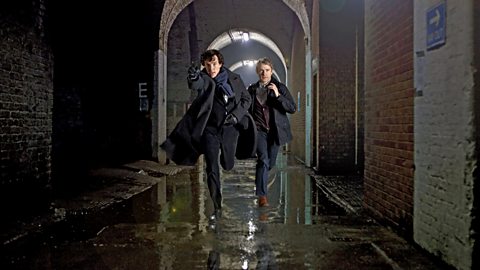
The guys striking a pose

All in all, first impressions were good. Then Season 2 started, and cliffhangers from Season 1 started getting some rather lame and unsatisfactory explanations. Characterisation got increasingly abrasive, the crimes were beginning to be solved purely by Sherlock "being clever" rather than actual logic, and slowly the long running teases the main show-runner (Steven Moffat, of Doctor Who fame) was piling onto the story started to feel decidedly hollow.

By the end of Season 2 the show started to feel like a mess - I haven't even seen Season 3 or 4 yet, but reviews have got worse and worse, with Season 4 apparently pulling some truly absurd jumping the shark moments - like "Sherlock has long lost relatives who are evil" and "Sherlock can literally attune his mind to infinite data points like a computer connecting to the internet."

In actuality, this disease eating at the show is simply poor writing and poor structure - and, on re-watching, is eminently obvious even in Season 1. To see why the show is so frustrating we first need to have a glance at some of Moffat's other work.
  
PART 1: Moffat and Dr. Who: An Obsession with Overpowered Protagonists, Endless "World-Building" and Loose Ends

Moffat's dubious writing style begins to show with Dr. Who...

I've never really got into the Moffat-era of Dr. Who. And since seeing Sherlock I finally understand why: the man has an absolutely infuriating writing style. I thought I was initially imagining it, but Sherlock really highlighted the flaws for me.

Season 1 of the new Dr. Who was primarily penned by Russell T. Davies (with a few one-off episodes by Moffat), and he performed an admirable job of keeping the stories accessible to all kinds of viewers while providing core pillars of good writing:

Davies-Era Writing

1. Interesting main focal points for a story for each episode that are focused on as a priority.

2. Actual character development and neat character arcs over the course of a single episode. New characters are only introduced if they have something to contribute to the episode.

3. Cliffhangers that are resolved in a logical and timely fashion one or two episodes after their introduction

4. No real long-hanging threads or loose ends that make no sense. In essence, no glaring plot holes.

These four qualities of his writing make the characters satisfying to watch (Christopher Ecclestone was by far my favourite of the new Doctors, in no small part due to Davies' fine writing style) as well as making the stories themselves interesting, entertaining and self-contained.

By contrast, Moffat-era episodes feature a number of very clear deviations from the original formula of the show that make the show a lot less enjoyable to watch:

Moffat-Era Writing

1. Interesting ideas for each episode that are often squandered by bizarre plot twists or are simply built into larger "world building" ideas hinted at for future episodes. These ideas are just continuously stacked up and never delivered on, resulting in growing frustration for long term viewers.

2. No real character development or even plot development across an episode. Any real changes or dangers to characters or the plot status quo are usually temporary or dismissed after the episode is concluded. Lots of minor characters are brought in and killed off over one or two episodes for seemingly no reason.

3. Slow power-creep of the Doctor as a protagonist and over-focusing episodes around him. Not only does the Doctor seem to become more and more God-like in his ability to get out of every situation, there's a clear shift away from the narrative idea of "the Doctor going on awesome adventures" to "The Doctor is being AWESOME because he's THE DOCTOR AND HE'S AWESOME!!!111ONE"

4. Mysteries and cliffhangers are wound up and up further and further across multiple episodes, with each episode promising increasingly spectacular mind-blowingly intriguing explanations for the thing that happened 8 episodes ago that still hasn't been explained.

5. Loose ends all over the place. Sometimes these are never even tied up, and often they leave serious glaring plot holes.

PART 2: Great, How does this apply to Sherlock?


So, how does all this figure in to the show about our favourite hatted detective?
Well, chances are you're already seeing the pattern - almost ALL of the flaws Moffat-era Dr. Who flaws are actually the critical flaws with Sherlock too!

Let's look at even just the first episode. When you first watch "A Study In Pink", it seems like pretty reasonable entertainment. We have an interesting villain - a serial-killing smart and evil cab driver who somehow always forces his victims to kill themselves when given a 50-50 chance of death with a poisonous pill. We have Sherlock being a dick but basically making seemingly logical and clever deductions about the murder.

We have Watson being somewhat helpful to Sherlock (using his medical skills and eventually shooting the main villain dead).

But there are questions - many questions, that the episode brings up even so early in the season. 

1. How did the murderer, a lowly serial killer, hear of, meet with and team up with Moriarty...who is basically the King of crime?

2. How did the killer convince his victims to pick the deadly option in his "chance" game every time? What did he say to them and how did he "play" them psychologically, exactly?

3. Did Sherlock pick the right pill? What was his reasoning? Would he have beaten the murderer with his intelligence and deduction in the end or not? Wasn't his whole plan to outsmart the guy?

4. If Sherlock is so damn intelligent, why does he always do the stupid thing when given a choice? (Not bothering to explain his deductions to his allies, leaving them blind...getting in the cab with a murderer rather than simply having him arrested and interrogating him, etc.)

All of these questions are raised throughout the episode (and 1-3 are actively encouraged for the audience to think about as key plot points). How many are answered? None. How many are ever answered by the show? Zero.

And that's just the first episode.

In literally every single episode of the show, Moffat builds these kind of questions up and then just doesn't bother answering them. He combines this with constantly ramping up every single plot to hint at the answers being included in the next episode, and then yet again doesn't bother.

And this is the main problem.

The result is that each episode feels (for want of a better word) like a massive cocktease. You're getting blue-balled over and over by Moffat's awful non-commitment to actually following through on his narrative promises. Yet you keep watching because you're hoping he'll explain.

The actual mysteries, or at least the interesting parts of them don't exist. They are never resolved or explained. In Dr. Who this is frustrating and bullshit, but it can be handwaved as it's a sci-fi show about different worlds.

In Sherlock, a show about a detective solving mysteries, we literally have mysteries that over the course of an hour and a half aren't actually solved or explained at all. And they never are. This is totally unforgivable for a show that's supposed to interest us in the details, and is utterly maddening when you realise that Moffat has literally no intention of doing anything with all the build-up he throws around in each episode.

--

And that concludes Part 1 of my disassembly of Sherlock's insane, manipulative writing style. I'll be continuing Part 2 shortly, covering inconsistent and weak characterisation, Holmes' dubious investigative approach, bizarre sub-plots and Moffat's addiction to building over the top ubermensch protagonists.

Sunday, 11 June 2017

Blood Bowl Races: Norse

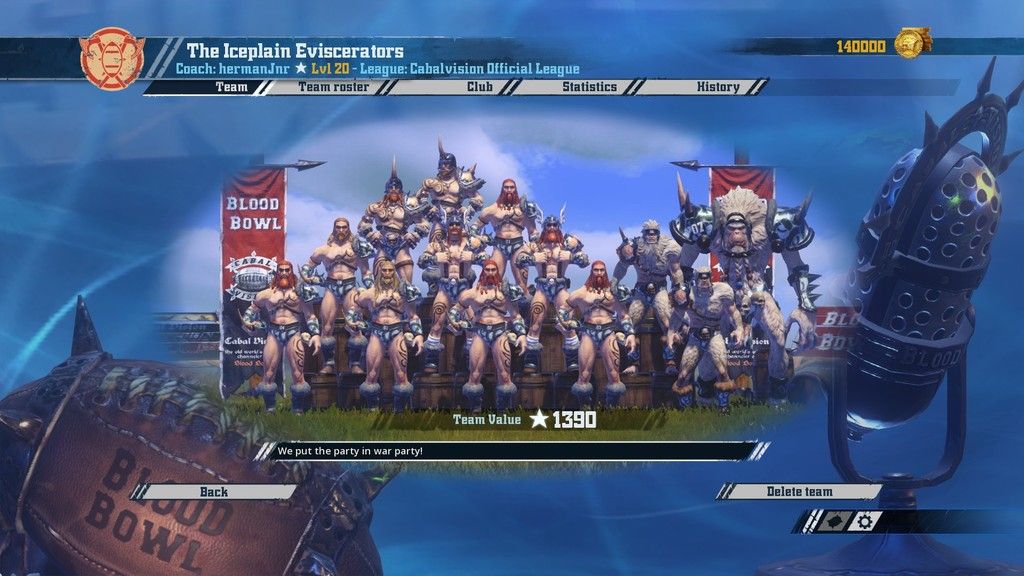
So it's been ages since I've written a Blood Bowl post, and since that's one reason I actually established this blog in the first place, I'm gonna get on it and talk today about the Norse, one of my favourite teams in Blood Bowl.

It's easy to look at Norse and dismiss them initially, or completely misunderstand what they're all about. "They almost all start with Block! What an easy team!" Wrong.

"They're like Dwarfs but faster." WRONG.

"They're a team for newbs trying to get to grips with Block before they play Dwarfs." WRONG. (I've actually seen this on the BB forums and found it kind of hilarious - they are just as hard to use as Dwarfs, if not more a heck of a lot more so in many ways).

The Norse Team


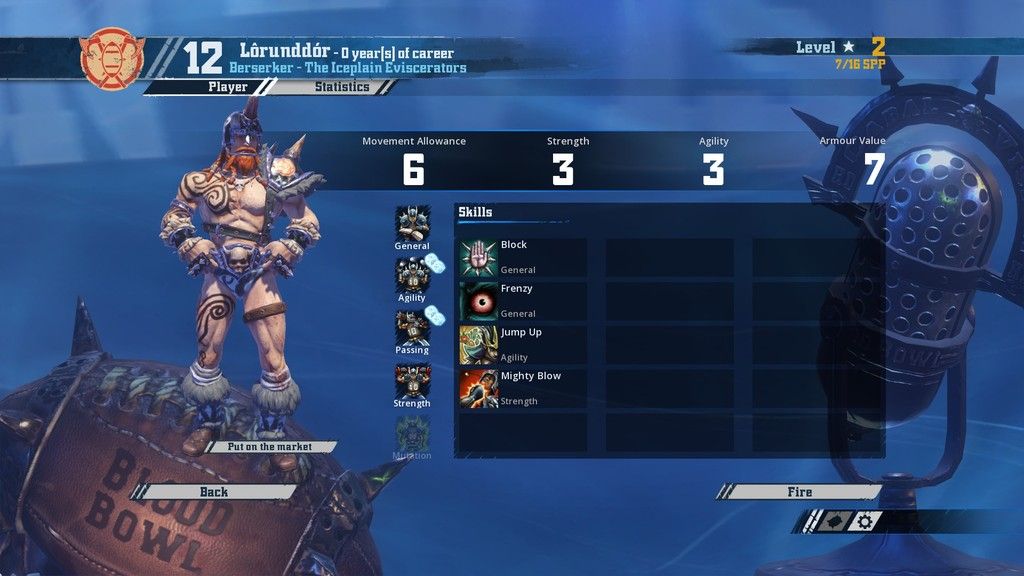
The Norse are a team of contradictions. First of all, the players all look like beefy savages, and they're all about maiming and killing the other team. Great...except the first thing that'll make you wince when looking at the team roster is that almost everyone has AV 7, almost the weakest Armour Value in the entire game!

Even your expensive positionals only have AV 8, which is by no means tough.

You've got guys who are all Movement Allowance 6. This is distinctly average. The Runners are MA 7, which is only slightly above average speed-wise, and won't allow them to outrun Elves.

Then you realise that for a "fighting" team, your guys can only have 5 players with Strength skill access on normal skill up rolls. Compared to Orcs, Chaos and Dwarfs, who can saturate the pitch with 9-11 Mighty Blow and Guard players, you suck by comparison, right?


Well, yes and no.

A Norse team that attempts to take on an Orc or Dwarf team in a line-against-line traditional bashing competition is going to get ruined.

The Norse operate around some very specific rules.

Norse Rule #1: DO NOT LET THE OTHER GUY PUNCH YOU IN THE FACE. This is the most important rule. Avoid ending your turn in contact with anyone unless your opponent is prone and you can hit him (again) reliably and safely next turn.

Norse Rule #2: At every possibility, punch the other guy in the face. Really hard. Lots. As many damage modifiers per Blitz/block as you can.

Norse Rule #3: Always look for opportunities to crowd-surf opposing players with Frenzy.

Norse Rule #4: Always look for opportunities to gang-foul opposing high value players. Spreading out your opponent with good positioning on your side helps this.

With a lot of Frenzy on their positionals (five Frenzy players is standard on a Norse team), Dauntless on their Runners and Claw on the Yhetee (their 5 STR big guy, for the un-initiated), the Norse EXCEL at moving their damage skills to exactly where they are needed, and really *really* making them hurt. No other team has so many guys with damage-skill access that can also move a pretty long way each turn.

Each match with Norse (at least how I play them) is basically a death race. Your opponent is going to be trying damn hard to smash up your AV 7, so you need to use that bloodlust to lure him to the players on your team who can hit like a freight train. Then you make him regret squaring up to you as much as you can.

So, now I've talked general tactics, let's elaborate when discussing each type of positional the team can hire.

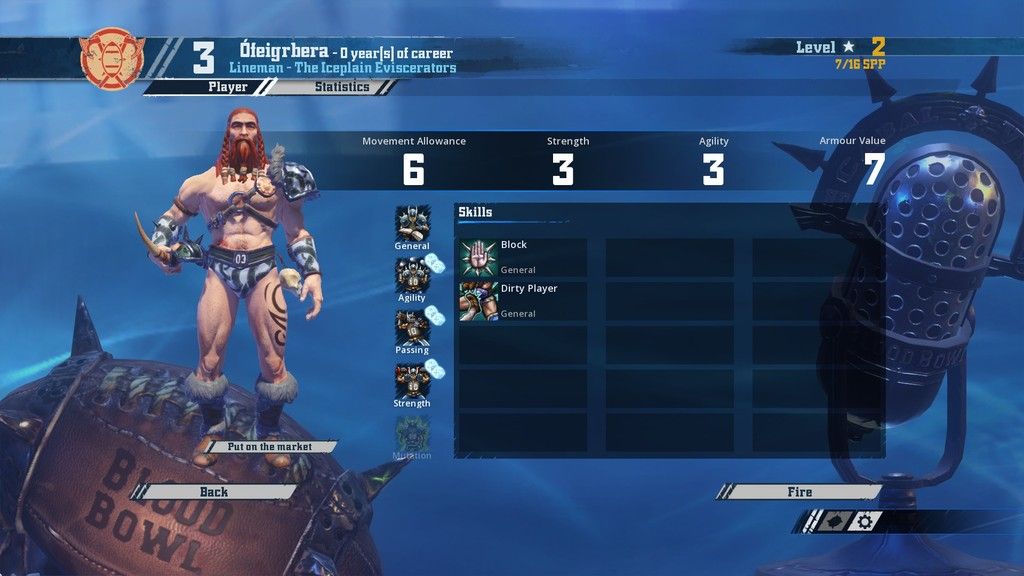
 The Norse Lineman

Norse Lineman
Cost: 50,000

Movement Allowance: 6
Strength: 3
Agility: 3
Armour Value: 7

Skill Access (no doubles):
General 

Starting Skills:
Block

Recommended Skills (normal roll):

Dirty Player
Fend
Dauntless
Tackle
Frenzy (if you're nuts)
Kick

Recommended Skills (double):

Guard (priority)
Dodge
Mighty Blow (only if you get 2 doubles on one guy, otherwise always Guard)

Recommended Stat-Ups:

+Strength  

Summary:

The humble Norse Lineman is a real workhorse for the team. He has Block right out of the box and thus is reliable when hitting people. He can 1-dice block out of trouble with only a 1/6 chance of failure (and a 50% chance of knocking a player without Block over!) and he has AG 3, so can dodge and handle the ball when needed. 

With MA 6 he can easily move around the field to provide blocking assists and screen players out of the action (something that makes him a lot more useful than a Dwarf Blocker or Line Orc in lots of situations).

His only big weakness (as with most of the team) is AV 7. This means he must be the one hitting people rather than the one taking hits. You only rarely want to man-mark players with him - it is far better to screen with him and force your opponent to blitz him.

Finally, at only 50 k, the Lineman is cheap enough to be easily replaced when killed or injured and makes an excellent cheap fouler too. 

Wherever possible, your Linemen should be used to shield your better players from your opponent's Blitzes. This is their most important task. This will keep injuries restricted to your crappier, less developed Linemen rather than your star killer Berserkers and the Yhetee.

In a pinch, Linemen make good blitzers and safeties, and can take down Elf catchers and the like as they sneak backfield.

Skills, Subs and Development:

When skilled up, Guard on doubles is lovely because your team will *always* lack Guard. Otherwise always take at least 1 Dirty Player (preferably 2) and a bench of at least 2 Linemen, even in matchmaking. I take only 2 rerolls as a trade off, to keep Team Value lower.

Dirty Player Linemen are essential for both pressuring your opponent and countering any damage skills your opponent has. Your opponent will lose the bash war nine times out of 10 if he's hitting you once every turn with Mighty Blow and you are fouling him with Dirty Player and 4 assists every turn. FOUL, FOUL and FOUL again! Especially against high armour teams.

The only time you should not foul is if you can't get enough assists, or you are already terribly outnumbered.

Getting three Linemen with Fend can be useful for limiting blocks your opponent gets on the Line of Scrimmage, but I find it can be of limited use: if your opponent knocks you into next week with one knockdown, Fend is useless!

Tackle is always useful against dodgy foes and Dauntless can help you out against stronger opponents that you might otherwise struggle against (such as Lizardmen and Orcs in particular).
The Norse Runner

Norse Runner
Cost: 90,000

Movement Allowance: 7
Strength: 3
Agility: 3
Armour Value: 7

Skill Access (no doubles):
General
Agility 

Starting Skills:
Block
Dauntless

Recommended Skills (normal roll):

Dodge
Fend
Tackle
Strip Ball
Diving Tackle

Recommended Skills (double):

Guard (priority)
Mighty Blow (good when combined with Tackle and Strip Ball for a safety Blitzer)

Recommended Stat-Ups:

+Strength
+MA
+AG  

Summary:

The Norse Runner adds a much-needed injection of speed into the Norse team, and makes for an excellent Blitzer against Big Guys and STR 4 players with his Dauntless skill. He is essentially a cross between a Troll Slayer and a more conventional Runner or Catcher.

In general you'll want to keep him hanging back to hit players who get through your lines, provide assists where necessary and he'll probably be your main scorer too. Definitely worth the money, they can transform your offensive game and be useful on defence too.

Otherwise notable is their default access to Dodge, which can make them hard to pin down and knock over.

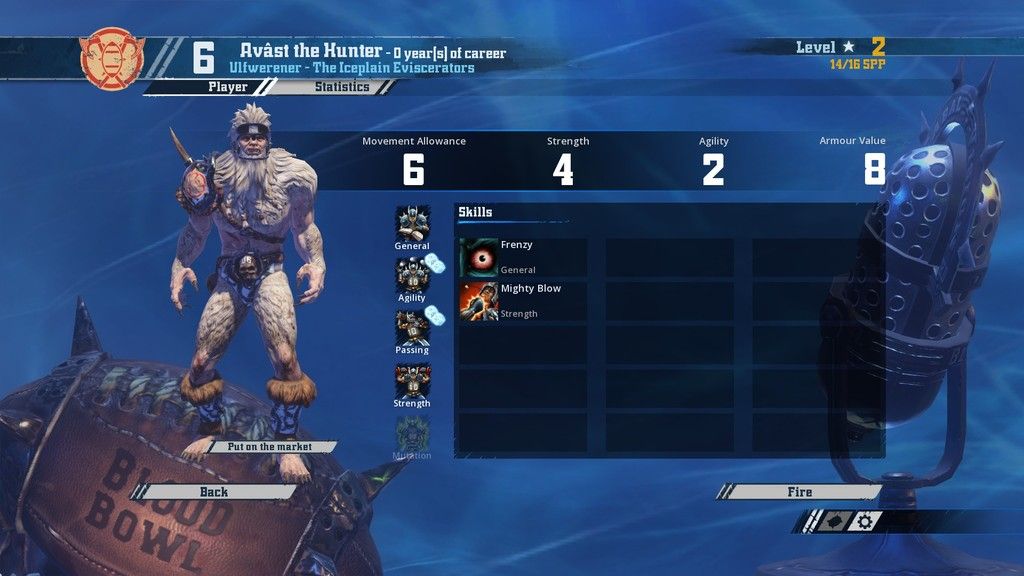
The Norse Ulfwerener

Norse Ulfwerener
Cost: 110,000

Movement Allowance: 6
Strength: 4
Agility: 2
Armour Value: 8

Skill Access (no doubles):
General
Strength 

Starting Skills:
Frenzy

Recommended Skills (normal roll):

Block (priority)
Mighty Blow (priority)
Guard
Juggernaut
Piling On
Stand Firm
Fend
Break Tackle
Strip Ball

Recommended Skills (double):

Dodge
Jump Up (maybe not as solid a choice due to AG 2)

Recommended Stat-Ups:

+Strength
+MA
+AV

Summary:

The Ulfwerener is one of the big punchers on your team. With AV 8 and STR 4, he is one of the best players on your team for man-marking weaker opponents, especially if you've got a numbers advantage. He's fast for a STR 4 player and starts with Frenzy, which makes him very dangerous to opponents on the sidelines.

Break Tackle can make him excellent at moving around to Blitz players, and Block is pretty much essential - with Frenzy he can be quite unreliable at hitting early on and will account for many of your turnovers. Be wary of this.

He must also be protected where possible because his STR 4 and poor armour will make him a hefty target.

I used to always go Block first, but actually I much prefer to get Mighty Blow first on my Ulfwereners now. This immediate makes them very scary and your opponent will be wary of getting too close to them. They will also level up faster and get Block sooner, plus the rest of your team has Block already so the reliablity is less of an issue. It also gives you at least one STR 4 player every turn with high damage potential.

They make *excellent* safeties because they can smack STR 3 ball carriers down on their own. To that end you can skill them up to be killers with MB and PO or have a more support role. Guard is always good on these guys (and much needed in many situations).

Personally I prefer NOT to take Piling On, and leave that to the Berserkers. Ulfwereners are better for chain pushing your players out of trouble and causing lots of damage every turn while they do it.

Juggernaut and Stand Firm can be used to turn them into very dangerous crowdsurfing players.

+STR is golden on an Ulf (and I'd definitely go Break Tackle next if I got it), and I'd also consider +AV considering the team really lacks armour across the board. Always get Block or Mighty Blow first, though, unless you get +STR.

The Norse Berserker

Norse Berserker
Cost: 90,000

Movement Allowance: 6
Strength: 3
Agility: 3
Armour Value: 7

Skill Access (no doubles):
General
Strength 

Starting Skills:
Block
Frenzy
Jump Up

Recommended Skills (normal roll):


Mighty Blow (priority)

Piling On (priority)

Tackle
Stand Firm
Dauntless
Guard
Fend
Juggernaut
Strip Ball

Recommended Skills (double):

Dodge
Diving Tackle

Recommended Stat-Ups:

+Strength
+MA 
+AG

Summary:

The Norse Berserker is not a subtle player, but nonetheless he's one of my favourites. He exists to do an insane amount of damage to the opposing team, whenever and wherever possible. You want to totally focus on damage skills with the Berserker as fast as possible: Mighty Blow or Piling On first, and then the skill you didn't take of the two second.
Piling On synergises very well with Jump Up and makes him a killing machine able to knock someone over, pile on to reroll the hurt and then immediately hit someone else (or the same guy) next to him the next turn. MB just amplifies the hurt. Your opponent will FEAR him!

After that, take skills that will either help him get people on the ground (Tackle) or keep him safer (Dodge, Fend). Guard is also handy, though it paints an even larger target sign on him, and ideally you don't even want him in contact with standing opponents.

Also, try not to let him get isolated because he WILL get fouled after piling on if you do. One of the team's biggest killers, and definitely the most reliable, it's worth giving them the ball in early games to help them level up quickly.

They can also be used to play the ball in a pinch, and make very good safeties and ball strippers thanks to Frenzy and Block.

The Norse Yhetee

Norse Yhetee
Cost: 140,000

Movement Allowance: 5
Strength: 5
Agility: 1
Armour Value: 8

Skill Access (no doubles):

Strength 

Starting Skills:
Loner
Disturbing Presence
Wild Animal
Frenzy
Claw

Recommended Skills (normal roll):

Mighty Blow (priority)
Guard (important)
Piling On (optional, but can really heap on the pain)
Stand Firm
Juggernaut

Recommended Skills (double):

Block (priority, an absolute Godsend)

Tackle

Recommended Stat-Ups:

+Strength
+AV

Summary:

The Yhetee is a controversial player. He can be amazing and clear the pitch of tough opposing players, or be or a total liability who loses you games. He can be a hammer who clubs enemies off of your players in chain push blitzes (one of the best ways to use him), or he might roll triple skulls on the Blitz and kill himself.

Out of all the Big Guys, I've always found Yhetees to be the least consistent. Lacking Mighty Blow to start with means they have a tendency to go a long time before they level up. I've had one go 10 games without his first 6 SPP!

Similarly, Frenzy plus no Block and Loner means it's *very* common for them to turnover, and AV 8 means that if an enemy big guy gets the Both Down or Attacker Down hit on you, you're normally watching your 140,000 gold Big Guy being carted off the pitch dead or unconscious.

The biggest weird thing about the Yhetee is that he's pretty much designed to be hitting opposing players as much as possible. Most Big Guys just as a road block, standing in the way and funnelling the opposition away from a key area of the pitch, maybe soaking up some knockdowns for the rest of your team.

With AV 8 and at a high cost, the Yhetee is terrible for this. If he takes hits he'll almost always bite the dust. By contrast, his Claws make him quite a danger against high AV targets when he's on the offensive, so you'll actually always want him getting stuck into tough targets wherever possible.

The Norse can REALLY struggle with high AV teams, especially if their fouls don't turn out well and they get a few send offs. Your damage skills can struggle to penetrate the armour and you start getting out bashed. For this reason, I almost always take the Yhetee.

Once you get MB on him, he can be a brutal blitzer who can kill the opposing team's hardest players before they get hits on you

Yhetee Rule #1: Always (where possible) use him LAST.

This goes for all big guys but especially the Yhetee. Whenever blocking with him, do it at the end of your turn. This limits the harmful turnovers from being game changers to usually less decisive affairs.

Yhetee Rule #2: Use him to maim weaker players who can't fight back (i.e. downed linemen behind your line).

Yhetee Rule #3: Use him to chainpush stronger players off of your line.

Yhetee Rule #4: Keep him out of scrums with stronger players.

Screen your Yhetee with Linemen and move him in for blitzes where necessary, or keep him focussed on an isolated downed player. He can push stronger guys off of your line, saving your Zerkers from taking blocks, but you don't want him bogged down or taking blitzes from killers.

After Mighty Blow, Juggernaut is a good skill pick for the Yhetee, making him more reliable. Break Tackle can help to get him out of trouble.

The Holy Grail is Block, and I might even take it over a +STR for him - in fact I almost always would, since it makes him far more dangerous to the opposition, harder to knock over and far less of a liability to my game.

--

Honourable Mention: Norse Thrower
Cost: 70,000

Movement Allowance: 6
Strength: 3
Agility: 3
Armour Value: 7

Skill Access (no doubles):
General
Passing 

Starting Skills:
Block
Pass

Recommended Skills (normal roll):

Sure Hands
Accurate
Leader
Fend
Tackle

Recommended Skills (double):

Guard
Dodge
Strong Arm

Recommended Stat-Ups:

+Strength
+AG
+MA

Summary:

I've not really bothered talking about the Norse Thrower here because, to be honest, I hardly use him. He's nice as a Leader (you're basically paying 20k extra for Passing Skill access on normal rolls) and that's handy because in a Matchmaking environment (like in the Cyanide games) you'll be wanting to keep your TV low.

He can add a bit of diversity and save you against very bashy teams, but frankly if you're losing the bash war you're probably losing the match big time anyway! He has much the same flexibility as a Lineman, with a few frills.

Definitely an optional position since the running game is dominant with Norse. I would take him in a league, not in perpetual matchmaking.

---

Well guys, I hope that was helpful. I will do another post on specific Norse tactics soon.